

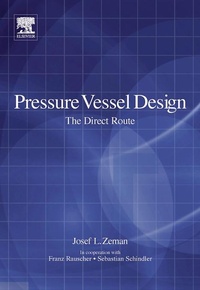
Pressure Vessel Design
The Direct Route: The Direct Route
Published on 14. May 2014
319 pages
978-0-08-046189-2 (ISBN)
Description

This book explores a new, economically viable approach to pressure vessel design, included in the (harmonized) standard EN 13445 (for unfired pressure vessels) and based on linear as well as non-linear Finite Element analyses. It is intended as a supporting reference of this standard's route, providing background information on the underlying principles, basic ideas, presuppositions, and new notions. Examples are included to familiarize readers with this approach, to highlight problems and solutions, advantages and disadvantages.* The only book with background information on the direct route in pressure vessel design. * Contains many worked examples, supporting figures and tables and a comprehensive glossary of terms.
More details
Series
Language
English
Place of publication
Oxford
United Kingdom
Product notice
Windows
Illustrations
Illustrated
ISBN-13
978-0-08-046189-2 (9780080461892)
Copyright in bibliographic data and cover images is held by Nielsen Book Services Limited or by the publishers or by their respective licensors: all rights reserved.
Schweitzer Classification
Other editions
Additional editions
Josef L. Zeman | Franz Rauscher | Sebastian Schindler
Pressure Vessel Design: The Direct Route
Book
06/2006
Elsevier
€229.03
Article exhausted; check different version
Content
- Cover
- Pressure Vessel Design the Direct Route
- Contents
- Foreword
- Acknowledgement
- On the Use of this Book
- Chapter 1. Introduction
- Chapter 2. General
- General on the Direct Route in Design by Analysis
- General Terms and Definitions
- Failure-Related Terms
- Action-Related Terms
- Model-Related Terms
- Thickness-Related Terms
- Response-Related Terms
- Design Check-Related Terms
- General on Characteristic Values and Characteristic Functions of Actions
- Requirements in the Pressure Equipment Directive
- Consequences from the PED Requirements
- General on Design Models and Constitutive Laws
- General on Design Models
- General on Constitutive Laws
- Chapter 3. Design Checks and Load Cases
- Design Checks
- Load Cases
- Procedure
- Step 1: Setting Up of Load Case Specifications List
- Step 2: Setting Up of Design Check Table
- Step 3: Setting Up of Design Models
- Step 4: Execution of Design Checks
- Step 5: Final Conclusion
- Example
- Chapter 4. Gross Plastic Deformation Design Check (GPD-DC)
- Introduction
- Procedure
- Design Models
- Design Values of Actions
- The Principle
- Application Rule
- Examples
- Chapter 5. Progressive Plastic Deformation Design Check (PD-DC)
- Introduction
- Procedure
- Design Models
- Design Functions of Actions
- The Principle
- Application Rules
- Examples
- Chapter 6. Stability Design Check (S-DC)
- Introduction
- Procedure
- Design Models
- Design Values and Functions of Actions
- The Principle
- Application Rules
- Examples
- Chapter 7. Cyclic Fatigue Design Check (F-DC)
- Introduction
- General Remarks to the F-DC
- General Remarks to the F-DC of Unwelded Region
- General Remarks to the F-DC of Welded Regions
- Procedure
- Design Models
- Requirements with Regard to Welded Regions
- Requirements with Regard to Unwelded Regions
- General Requirements with Regard to Welded and Unwelded Regions
- Design Values and Design Functions of Actions
- The Principle
- Correction Factors for Unwelded Regions
- Plasticity Correction Factor
- Effective Stress Concentration Factor
- Surface Finish Correction Factor
- Thickness Correction Factor
- Mean Stress Correction Factor
- Temperature Correction Factor
- Correction Factors for Welded Regions
- Plasticity Correction Factor
- Thickness Correction Factor
- Temperature Correction Factor
- Design Fatigue Curves
- Design Fatigue Curves for Welded Regions
- Design Fatigue Curves for Unwelded Regions
- Cycle Counting
- General
- The Reservoir Cycle Counting Method
- Fatigue Damage Accumulation
- General Remarks to the Methodology
- Methodology for Welded Regions and Surface Hot Spots
- Methodology for Welded Regions and Internal Hot Spots
- Methodology for Unwelded Regions
- Examples
- Chapter 8. Static Equilibrium Design Check (SE-DC)
- Introduction
- Procedure
- Design Models
- Design Values of Actions
- The Principle
- Examples
- Epilogue
- References
- Annex A: Useful Shakedown Theorems
- Annex E: Examples
- Annex E.3: Example of a design check table
- E.3.1: Design check table of a jacketed autoclave
- Annex E.4: Examples of Gross Plastic Deformation Design Checks
- E.4.1: GPD-DC of a hydrocracking reactor
- E.4.2: Detailed investigation of the transition of a cylindrical to a hemispherical shell
- E.4.3: GPD-DC of an air cooler header
- E.4.4: GPD-DC of a nozzle in hemispherical end
- Annex E.5: Examples of Progressive Plastic Deformation Design Checks
- E.5.1: PD-DC of a hydrocracking reactor
- E.5.2: PD-DC of an air cooler header
- E.5.3: PD-DC of a nozzle in hemispherical end
- Annex E.6: Examples of Stability Design Checks
- E.6.1: First S-DC of a jacketed stirring vessel
- E.6.2: Second S-DC of a jacketed stirring vessel
- Annex E.7: Examples of Cyclic Fatigue Design Checks
- E.7.1: F-DC of a cylindrical to hemispherical shell transition
- E.7.2: F-DC of an air cooler header
- Annex E.8: Examples of Static Equilibrium Design Checks
- E.8.1: SE-DC of a skirt supported heavy reactor column
- E.8.2: SE-DC of a skirt supported light pressure vessel
- E.8.3: SE-DC of a leg supported vertical storage tank
- Annex L: Input Listings
- L.4.1: GPD-DC of a hydrocracking reactor
- L.4.2: GPD-DC of details of cylindrical shell to hemispherical end
- L.4.3: GPD-DC of an air cooler header
- L.4.4: GPD-DC of a nozzle in hemispherical end
- L.5.1: PD-DC of a hydrocracking reactor
- L.5.2: PD-DC of an air cooler header
- L.5.3: PD-DC of a nozzle in hemispherical end
- L.6.1: First S-DC of a jacketed autoclave
- L.6.2: Second S-DC of a jacketed autoclave
- Subject Index
