

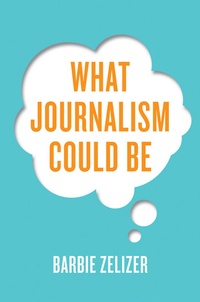
What Journalism Could Be
1st Edition
Published on 22. May 2017
256 pages
978-1-5095-0788-7 (ISBN)
Description

What Journalism Could Be asks readers to reimagine the news by embracing a conceptual prism long championed by one of journalism s leading contemporary scholars. A former reporter, media critic and academic, Barbie Zelizer charts a singular journey through journalism s complicated contours, prompting readers to rethink both how the news works and why it matters.
Zelizer tackles longstanding givens in journalism s practice and study, offering alternative cues for assessing its contemporary environment. Highlighting journalism s intersection with interpretation, culture, emotion, contingency, collective memory, crisis and visuality, Zelizer brings new meaning to its engagement with events like the global refugee crisis, rise of Islamic State, ascent of digital media and twenty-first-century combat.
Imagining what journalism could be involves stretching beyond the already-known. Zelizer enumerates journalism s considerable current challenges while suggesting bold and creative ways of engaging with them. This book powerfully demonstrates how and why journalism remains of paramount importance.
More details
Other editions
Additional editions
Content
- Cover
- Title Page
- Copyright
- Acknowledgments
- 1 Imagining Journalism
- Beginnings
- 2 Twelve Metaphors for Journalism
- Thinking about Journalism
- How Journalists Talk about Journalism
- How Scholars Talk about Journalism
- The Usefulness of Metaphors
- Section I Key Tensions in Journalism
- Cues for Considering Key Tensions in Journalism: With Jennifer Henrichsen and Natacha Yazbeck
- 3 "Eyewitnessing" as a Journalistic Key Word: Report, Role, Technology and Aura
- Key Words as Markers of Culture
- Eyewitnessing as a Journalistic Key Word
- First-Stage Eyewitnessing - Report
- Second-Stage Eyewitnessing - Report/Role
- Third-Stage Eyewitnessing - Report/Role/Technology
- Fourth-Stage Eyewitnessing - Report/Role/Technology/Aura
- From "Having Been There" to "Not Being There"
- 4 How the Shelf Life of Democracy in Journalism Scholarship Hampers Coverage of the Refugee Crisis
- The Shelf Life of Ideas
- Shelf Life and the Democracy/Journalism Nexus
- How Journalism Became Necessary for Democracy
- Why Democracy is Not Central for Journalism
- The Refugee Crisis and the Journalism/Democracy Link
- Refugees, Democracy and Journalism
- The Immunity of Democracy's Shelf Life
- Enabling Retirement
- 5 Practice, Ethics, Scandal, Terror
- The Problem of Ethics
- Temporality and Ethics
- Geography and Ethics
- Institutional Culture and Ethics
- Technology and Ethics
- On the Impossibility of Journalism Ethics
- Section II Disciplinary Matters
- Cues for Considering Disciplinary Matters: With Jennifer Henrichsen and Natacha Yazbeck
- 6 Journalism and the Academy, Revisited
- The Shape of Journalism and Its Study
- Interpretive Communities and Journalism's Study
- Blended Inquiry and Future Correctives
- 7 Journalism Still in the Service of Communication
- Reconsidering the Establishment of the Field of Communication
- How Journalism Helped to Establish the Field of Communication
- Where Did Journalism Go Over Time?
- How Journalism Challenges Assumptions about Communication
- Journalism @ the Center of Communication
- 8 On Journalism and Cultural Studies: When Facts, Truth and Reality Are God-Terms
- On Journalism from a Cultural Perspective
- Cultural Studies and Journalism
- On the Future of Journalism and Cultural Studies
- Section III New Ways of Thinking About Journalistic Practice
- Cues for Considering New Ways of Thinking About Journalistic Practice: With Jennifer Henrichsen and Natacha Yazbeck
- 9 A Return to Journalists as Interpretive Communities
- The Dominant Frame: Journalists as Professionals
- The Alternative Frame: Journalists as an Interpretive Community
- Local Mode of Interpretation
- Durational Mode of Interpretation
- Watergate and McCarthyism
- Discourse and the Interpretive Community
- 10 Reflecting on the Culture of Journalism
- Culture as a Construct
- What is the Culture of Journalism?
- Who Inhabits the Culture of Journalism?
- What is the Culture of Journalism For?
- The Culture of Journalism
- 11 When 21st-Century War and Conflict Are Reduced to a Photograph
- Why Do War and Conflict Turn to the Visual?
- Visualizing Twenty-first Century Combat
- When War and Conflict Are Reduced to a Photograph
- Endings
- 12 Thinking Temporally about Journalism's Future
- Predicting the Future
- On Knowledge Transfer and Time
- Tools of Temporal Engagement
- The Past and Reflexivity
- The Present and Transparency
- The Future and Proactivity
- Toward Journalism's Future
- References
- Index
- End User License Agreement
