

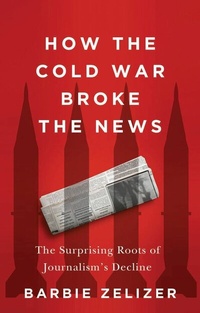
How the Cold War Broke the News
Description

While much blame has been levelled at big tech, Barbie Zelizer traces the decline of American journalism to the Cold War. She makes the bold claim that Cold War-era practices are to blame for the state of journalism today, undermining a once trusted media environment. This groundbreaking book shows how journalism's current problems can be traced back to customs developed over half a century ago and demonstrates how they've continued to upend journalism, journalists and the news ever since.
We all need a news environment that works. This book tells us why it doesn't and offers a plan to make it better. If our news is better, so is our democracy. And, if our democracy is better, we may be too.
Barbie Zelizer is Raymond Williams Professor of Communication and Director of the Center for Media at Risk at the Annenberg School for Communication, University of Pennsylvania.
More details
Other editions
Additional editions
Content
1
How It Took Hold
In early January 2025, longstanding warnings attached to extreme weather events became apocalyptic, as stories and pictures of Los Angeles on fire swept the United States and much of the world. Uncontrollable fires ravaged the California landscape in days and leveled multi-million-dollar celebrity mansions and trailer homes with equal ferocity. If ever there was a need for measured, accurate and reliable news coverage, it was now.
And yet, the media fell short. The disaster was framed as "an action blockbuster" overshadowing information critical to public health and safety. Though reporting conditions were daunting - CNN, Fox News, MSNBC and NewsNation all had to rely on backup generators - Media Left and Right provided endless and sometime tone-deaf on-the-street interviews with emergency responders, evacuating residents and local officials, while visuals shifted between burning homesteads and helicopters spraying pink water tinted by fire-retardant. Stories centered the plight of wealthy Pacific Palisades residents over that of the less affluent and racially diverse Altadena. As journalists waited for the fires to abate, they staked out hard positions shared across newsmaking in each corner: Media Left took on Trump's "uninformed" or "insensitive" response to the fires amidst predictions he would deny funds for Californians to rebuild, whereas Media Right criticized California's Democratic leaders for disaster mismanagement: a water reservoir left empty before the fires or forests improperly thinned out. While MSNBC complained Trump's "first instinct was to blame his political opponents, raise an irrelevant issue and misinform everyone about the basic facts," Breitbart blamed Democratic LA Mayor Karen Bass for being abroad and Alex Jones told Fox News "this is siege by design." Some outlets in Media Left connected the disaster to climate crisis, with the Washington Post calling it "a preview of what's to come," but it was estimated by Media Matters to have comprised only 6 percent of national TV coverage.1
The result? With scores of people dead or missing, thousands of buildings gone and millions of people under a critical fire threat, Media Left and Right provided a heavily partisan throughline rather than the public information needed by all residents. As local FOX 11 News anchor Elex Michaelson said, "on both sides the theme seems to be it's the other guy's fault. It wasn't me, that's the trend . This is not a time for political points. This is a time to come together." Or, in The Nation's words: "a mega-failure by much of the news media" is framing the fires "as a political spat between President-elect Donald Trump and California elected officials instead of a horrifying preview of what lies ahead."2
To be fair, the media's information shortage, recycling of unconfirmed stories and reduction of the topic to understandable motives are often the pitfall of any disaster coverage, where spinning stories so quickly and simplistically that they can't be checked or confirmed is more often the case than not. Even when it includes vital information, disaster coverage typically gets uneven marks. But the takeaway here should be obvious. Across the board, journalists have not developed conventions that give extreme weather the attention it deserves. Missing is the kind of widespread analysis that can put calamitous events like the fires in context for all. In their stead are patterned voyeuristic and disconnected scenes of disaster that invite part of the public to have a look and then move on. Two sets of coverage prevail, each providing partial information for a public in need of a fuller picture.
So why aren't journalists in Media Left or Right updating their approach to an issue that sorely needs it? It's because, regardless of ideological persuasion, they regularly turn to already proven routines, practices and interpretations in the face of topics that are hard to cover, like disaster. We know occupational fixity encourages them to adopt proven cues for the newsmaking they're responsible for, and that it embeds itself across the multiple arrangements where journalists work. What's surprising is not how hard it is to let go, but that letting go happens at all.
Cold War thinking capitalizes on the inability of journalists to let go. It took hold of American journalism by piggybacking on their reluctance to move on from proven ways of making news. By targeting individual journalists, the occupational ethos that guided their work, the organizations that housed them and the institutional priorities shaping what they could and could not do, Cold War strategists drew journalists into a certain way of thinking that rode on a resistance to change. Our story now turns to how this happened. For when resisting change occurs across a community of like-minded individuals and is buttressed by occupational, organizational and institutional pressures, there's less chance of unpredictable turns down the road.
Being in synch has always been part of journalism. It coheres with ideas of pack journalism and groupthink, slogans like the "boys on the bus" and the "eyes in the gallery" or phrases like "playing the game" and "following the pack." Thinking and acting in tandem tends to go unnoticed because it hides under the test of time. But journalists' widespread reliance on the same shared values, routines and practices is an invitation for more consequential conformity to take hold. Think about how infrequently a particular news story stands out. When coupled with the tendency toward occupational fixity that makes journalists unwilling to let go of what they know, this eagerness to stand with the pack sustains journalists as an interpretive community, one drawn together through shared interpretations of what matters.3 Because politics appears to create groups separated from each other, it often obscures the commonality they share. And this is part of how collective thinking escapes notice.
Importantly, the inclination to be like other journalists helps keep change out of the picture. It produces a closed circle of views that's protected by interpersonal ties, occupational standards, organizational priorities and institutional power networks, and it results in repetitive coverage that looks and sounds the same across adjacent news outlets. Thinking and acting in tandem occurs whenever journalists come together, and it has lots of names: frames of mind, points of view, ideologies, paradigms, perspectives or ways of thinking. Our story will call them mindsets, shared ways of thinking that encourage a collective reliance on familiar cues to make the world congruent with existing beliefs and aspirations. Mindsets instill confidence and help people make sense of things that otherwise might remain confusing or irrelevant. They pop up like online reminders of a recurring commitment - ever-present, ready to invoke at a moment's notice, reliably infallible because they've been there for so long.
Mindsets take hold in journalism by working their way into its every possible crevice. They're picked up by individuals, anticipated by occupational norms, woven into organizational settings and ultimately legitimated by institutional ties. This is how Cold War logic took hold. When it went underground at the supposed end of the Cold War, all it had to do to take hold of journalism was lay in wait, ready to surface whenever journalists needed help explaining and interpreting challenging current affairs.
*****
We know the Cold War mindset was born in a perfect storm that developed during the war's formative years. From 1947 through the early 1950s, the combination of political, social, economic, occupational and technological circumstances created optimum conditions for Cold War logic to form. As it took hold, the majority of American journalists turned into Cold Warriors. While today most of us might agree the war could not have happened without journalists' participation, we need to understand how and why so many eagerly stepped on board.
Survival of the fittest tells us a lot. Though nearly all Americans exited World War II with anxiety and uncertainty about what would come next, those running America's institutions were emboldened by the United States emerging relatively unscathed. American leaders of the time - in politics, business, culture and education - projected a mix of elitist and myopic views about America's growing stature in the world. Image management, secrecy, militarism and fear as a mode of control were all used to support a postwar version of American democracy and its twinning with capitalism. Accustomed to cooperating with government during World War II, America's institutions developed their own ways of falling in line behind these priorities.
For journalists, the prospect of becoming drivers of Cold War logic flew in the face of their professional commitment to autonomy, truth and freedom of expression. And yet, Cold War thinking was particularly useful in framing news from afar, so much so that Lippmann and Merz's earlier observation about journalism reflecting whatever people wanted to see came into full focus. More of an idea, ideology or time period than a conventional conflict, the Cold War needed journalists to...
