

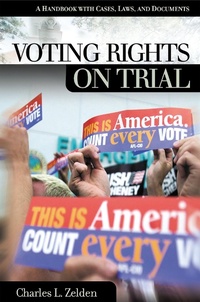
Voting Rights on Trial
A Handbook with Cases, Laws, and Documents
1st Edition
Published on 11. January 2002
368 pages
978-1-57607-795-5 (ISBN)
Description

Explores and documents the causes and effects of the long history of vote denial on American politics, culture, law, and society.
The debate over who can and cannot vote has been "on trial" since the American Revolution. Throughout U.S. history, the franchise has been awarded and denied on the basis of wealth, status, gender, ethnicity, and race. Featuring a unique mix of analysis and documentation, Voting Rights on Trial illuminates the long, slow, and convoluted path by which vote denial and dilution were first addressed, and then defeated, in the courts.
Four narrative chapters survey voting rights from colonial times to the 2000 presidential election, focus on key court cases, and examine the current voting climate. The volume includes analysis of voting rights in the new century and their implications for future electoral contests. The coverage concludes with selections of documents from cases discussed, relevant statutes and amendments, and other primary sources.
The debate over who can and cannot vote has been "on trial" since the American Revolution. Throughout U.S. history, the franchise has been awarded and denied on the basis of wealth, status, gender, ethnicity, and race. Featuring a unique mix of analysis and documentation, Voting Rights on Trial illuminates the long, slow, and convoluted path by which vote denial and dilution were first addressed, and then defeated, in the courts.
Four narrative chapters survey voting rights from colonial times to the 2000 presidential election, focus on key court cases, and examine the current voting climate. The volume includes analysis of voting rights in the new century and their implications for future electoral contests. The coverage concludes with selections of documents from cases discussed, relevant statutes and amendments, and other primary sources.
More details
Series
Edition
1. Auflage
Language
English
Place of publication
New York
United States
Publishing group
Bloomsbury Publishing Plc
Target group
Interest Age: From 7 to 17 years
File size
2,40 MB
ISBN-13
978-1-57607-795-5 (9781576077955)
Copyright in bibliographic data and cover images is held by Nielsen Book Services Limited or by the publishers or by their respective licensors: all rights reserved.
Schweitzer Classification
Other editions
Additional editions
Book
01/2002
ABC-CLIO
€87.50
Shipment within 3-4 weeks
Content
- Cover
- Voting Rights ON TRIAL
- Series Foreword
- Preface
- Acknowledgments
- Part One
- 1 Introduction
- The Strange Career of Voting in the United States
- The Right to Vote: A Short History of a Contested Right
- The Eighteenth Century
- From the Constitution to the Civil War
- From the Civil War to World War I
- The Twentieth Century
- Conclusion
- References and Further Reading
- 2 Historical Background
- Vote Denial: Democracy's Dark Secret
- Class
- Status
- Gender
- Ethnicity and Race
- Conclusion
- References and Further Reading
- 3 Cases
- The Courts Say No to Expanded Voting Rights
- The Fall of the All-White Primary
- Victory and Defeat in the Lower Federal Courts
- The One Person/One Vote Standard
- The Voting Rights Act of 1965 and the Attack on Race-Based Vote Denial
- Vote Dilution, Redistricting, and the Shift from At-Large Elections to Single-Member Districts
- The Conservative Reaction to Expanded Voting Rights
- Conclusion
- References and Further Reading
- 4 Impact and Legacy
- Equal Protection or Equal Effect? Voting Rights in the Twenty-first Century
- The Election the Judges Resolved: Bush v. Gore and the Debate over the Nationalization of Voting in America
- Conclusion
- References and Further Reading
- Part Two
- Documents
- Foundations: The Constitution of the United States
- Article I
- Article II
- Amendment XII
- Amendment XIII
- Amendment XIV
- Amendment XV
- Amendment XVII
- Amendment XIX
- Amendment XXIV
- Amendment XXVI
- The Courts Say No to Expanded Voting Rights: Elk v. Wilkins and Minor v. Happersett
- Elk v. Wilkins
- Minor v. Happersett
- The Fall of the All-White Primary: Smith v. Allwright
- Smith v. Allwright
- Victory and Defeat in the Lower Federal Courts: Terry v. Adams
- Terry v. Adams
- Adams v. Terry
- Terry v. Adams
- The One Person/One Vote Standard: Reynolds v. Sims
- Reynolds v. Sims
- II
- III
- IV
- VI
- X
- Voting Rights Act of 1965
- 42 U.S. C. § 1973
- Section 2
- Section 3
- Section 4
- Section 5
- Section 6
- Section 7
- Section 8
- Section 9
- Section 10
- Section 11
- Section 13
- Section 14
- Section 17
- Vote Dilution and the Shift from At-Large to Single-Member Districts: Allen v. State Board of Elections
- Allen v. State Board of Elections
- I
- IV
- VI
- The Conservative Reaction to Expanded Voting Rights: Dissents in Reynolds and Allen
- Majority in Shaw
- Dissent in Reynolds v. Sims
- Preliminary Statement
- II
- Conclusion
- Dissent in Allen v. State Board of Elections
- I
- II
- Majority in Shaw v. Reno
- I
- II
- III
- V
- The Debate over Nationalization of Voting Rights: Bush v. Gore
- Gore v. Harris
- Bush v. Gore (Stay of Florida Recount)
- Bush v. Gore
- Key People, Laws, and Concepts
- Allen v. State Board of Elections
- All-White Primary
- At-Large Elections
- Baker v. Carr
- Black Codes
- Breyer, Stephen G.
- Bush, George W.
- Bush v. Gore
- Butterfly Ballots
- Chads
- Circuit Court of Appeals
- Colegrove v. Green
- Constitutional Conventions
- Democracy
- Dependency
- Disenfranchisement (also Disfranchisement)
- District Courts
- Eight-Box Rule
- Electoral College
- Elk v. Wilkins
- Equal Protection
- Federalism
- Felony Restrictions
- Fifteenth Amendment
- Fourteenth Amendment
- Franchise
- Frankfurter, Felix
- Freeholders/Non-Freeholders
- Gerrymander/Gerrymandering
- Ginsburg, Ruth Bader
- Gray v. Sanders
- Harlan, John Marshall
- Harris, Katherine
- Legislative Districting/Redistricting
- Literacy Requirements
- Majority Vote Requirements
- Majority-Minority Districts/Districting
- Marshall, Thurgood
- McKay v. Campbell
- Minor v. Happersett
- Nineteenth Amendment
- Nixon v. Herndon and Nixon v. Condon
- O'Connor, Sandra Day
- "One Man/One Vote"
- Overvotes
- Ozawa v. United States
- Paupers
- Poll Tax
- Preclearance
- Property Qualifications
- Purging Laws
- Rehnquist, William H.
- Republic/Republicanism
- Reynolds v. Sims
- Scalia, Antonin
- Shaw v. Reno
- Single-Shot Voting
- Smith v. Allwright
- Souter, David H.
- Stevens, John Paul
- Suffrage
- Terry v. Adams
- Thomas, Clarence
- Three-Judge Courts
- "Understanding" Rules
- Undervotes
- United States v. Classic
- Universal Suffrage
- Vote Denial
- Vote Dilution
- Voter Intimidation
- Voter Registration
- Voting Rights Act of 1965 (VRA)
- White v. Regester
- Chronology
- Table of Cases
- Annotated Bibliography
- Index
- About the Author
