

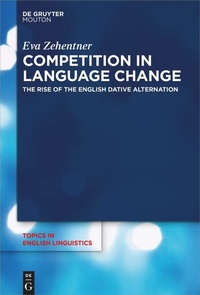
Competition in Language Change
Description

This book addresses one of the most pervasive questions in historical linguistics - why variation becomes stable rather than being eliminated - by revisiting the so far neglected history of the English dative alternation.
The alternation between a nominal and a prepositional ditransitive pattern (John gave Mary a book vs. John gave a book to Mary) emerged in Middle English and is closely connected to broader changes at that time. Accordingly, the main quantitative investigation focuses on ditransitive patterns in the Penn-Helsinki Parsed Corpus of Middle English; in addition, the book employs an Evolutionary Game Theory model. The results are approached from an 'evolutionary construction grammar' perspective, combining evolutionary thinking with diachronic constructionist notions, and the alternation's emergence is interpreted as a story of constructional innovation, competition, cooperation and co-evolution.
The book not only provides a thorough and detailed analysis of the history of one of the most-discussed syntactic phenomena in English, but by fusing two frameworks and employing two different methodologies also presents a highly innovative approach to a problem of relevance to historical linguistics in general.
More details
Other editions
Additional editions
Person
Content
- Intro
- Acknowledgements
- Contents
- Tables
- Figures
- List of abbreviations
- 1. Introduction
- 2. PDE ditransitives in usage-based construction grammar
- 3. Ditransitives in the history of English
- 4. Ditransitives in a corpus of Middle English
- 5. Evolutionary linguistics and Evolutionary Game Theory
- 6. Evolutionary construction grammar
- 7. Competition and cooperation in the English dative alternation: An evolutionary construction grammar account
- 8. Conclusion
- References
- Index
