

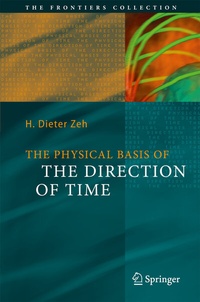
The Physical Basis of The Direction of Time
Description

Reviews / Votes
From the reviews of the fifth edition:
"Why does one never see a broken cup on the floor, jump back on the table? A question that many will have heard during lectures on statistical physics . . Dieter Zeh addresses this and similar phenomena expressing the asymmetric evolution of time. . I would like to recommend this book to those who have a deep interest in the problems associated with the arrow of time, as it contains a enormous amount of information on the subject and explains the problems very well." (J. Dubbeldam, Kwantitatieve Methoden, 2008)
More details
Other editions
Additional editions
Previous edition
Person
H. Dieter Zeh studied physics in Brunswick and Heidelberg, where he began work on theoretical nuclear physics. After a year of research at the California Institute of Technology, he moved to the University of California in San Diego to work on the synthesis of the heavy elements, before returning to the University of Heidelberg, where he later became professor of theoretical physics. His studies of collective motion in nuclei led him to address the quantum-to-classical transition in general, and in particular the quantum measurement problem, which is in turn related to many aspects of irreversibility (arrows of time). During this work, Zeh recognized and formulated the universal and unavoidable role of uncontrollable quantum entanglement, thus becoming a founder of the area now known as decoherence.
