

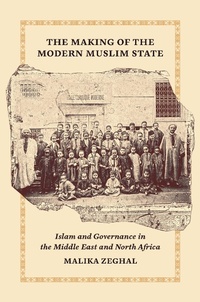
The Making of the Modern Muslim State
Islam and Governance in the Middle East and North Africa
1st Edition
Published on 27. March 2024
424 pages
978-0-691-18903-1 (ISBN)
Description

An innovative analysis that traces the continuity of the state's custodianship of Islam as the preferred religion in the Middle East and North Africa
In The Making of the Modern Muslim State, Malika Zeghal reframes the role of Islam in modern Middle East governance. Challenging other accounts that claim that Middle Eastern states turned secular in modern times, Zeghal shows instead the continuity of the state's custodianship of Islam as the preferred religion. Drawing on intellectual, political, and economic history, she traces this custodianship from early forms of constitutional governance in the nineteenth century through post-Arab Spring experiments in democracy. Zeghal argues that the intense debates around the implementation and meaning of state support for Islam led to a political cleavage between conservatives and their opponents that long predated the polarization of the twentieth century that accompanied the emergence of mass politics and Islamist movements.
Examining constitutional projects, public spending, school enrollments, and curricula, Zeghal shows that although modern Muslim-majority polities have imported Western techniques of governance, the state has continued to protect and support the religion, community, and institutions of Islam. She finds that even as Middle Eastern states have expanded their nonreligious undertakings, they have dramatically increased their per capita supply of public religious provisions, especially Islamic education-further feeding the political schism between Islamists and their adversaries. Zeghal illuminates the tensions inherent in the partnerships between states and the body of Muslim scholars known as the ulama, whose normative power has endured through a variety of political regimes. Her detailed and groundbreaking analysis, which spans Tunisia, Morocco, Egypt, Turkey, Syria, and Lebanon, makes clear the deep historical roots of current political divisions over Islam in governance.
In The Making of the Modern Muslim State, Malika Zeghal reframes the role of Islam in modern Middle East governance. Challenging other accounts that claim that Middle Eastern states turned secular in modern times, Zeghal shows instead the continuity of the state's custodianship of Islam as the preferred religion. Drawing on intellectual, political, and economic history, she traces this custodianship from early forms of constitutional governance in the nineteenth century through post-Arab Spring experiments in democracy. Zeghal argues that the intense debates around the implementation and meaning of state support for Islam led to a political cleavage between conservatives and their opponents that long predated the polarization of the twentieth century that accompanied the emergence of mass politics and Islamist movements.
Examining constitutional projects, public spending, school enrollments, and curricula, Zeghal shows that although modern Muslim-majority polities have imported Western techniques of governance, the state has continued to protect and support the religion, community, and institutions of Islam. She finds that even as Middle Eastern states have expanded their nonreligious undertakings, they have dramatically increased their per capita supply of public religious provisions, especially Islamic education-further feeding the political schism between Islamists and their adversaries. Zeghal illuminates the tensions inherent in the partnerships between states and the body of Muslim scholars known as the ulama, whose normative power has endured through a variety of political regimes. Her detailed and groundbreaking analysis, which spans Tunisia, Morocco, Egypt, Turkey, Syria, and Lebanon, makes clear the deep historical roots of current political divisions over Islam in governance.
More details
Other editions
Additional editions
Malika Zeghal
The Making of the Modern Muslim State
Islam and Governance in the Middle East and North Africa
Book
03/2024
Princeton University Press
€104.16
Article not available at the moment
Malika Zeghal
The Making of the Modern Muslim State
Islam and Governance in the Middle East and North Africa
Book
03/2024
Princeton University Press
€33.00
Shipment within 10-20 days
Person
Malika Zeghal is the Prince Alwaleed Bin Talal Professor in Contemporary Islamic Thought and Life in the Department of Near Eastern Languages and Civilizations and the Committee on the Study of Religion at Harvard University. She is the author of Gardiens de l'Islam, Les Oulémas d'al-Azhar dans l'Egypte Contemporaine and Islamism in Morocco: Religion, Authoritarianism, and Electoral Politics.
Content
- Cover
- Contents
- List of Tables
- Note on Transliterations
- Acknowledgments
- Abbreviations
- Introduction
- 1. The State's Enduring Custodianship of Islam: Old Ideals and New Techniques of Governance in the Regency of Tunis's 1861 Constitution
- 2. Competing Custodians of Islam in the 1907-1959 Tunisian Constitutional Episode: Islamic France, the Bey, and Independent Tunisia
- 3. State Custodianship of Islam in the Tunisian 2014 Constitution: Debating a Muslim and Democratic State
- 4. The Political Cleavage about Islam in Governance in the Modern Middle East: A Reappraisal
- 5. The Concrete Implementation of the State's Custodianship of Islam in the Longue Durée and Its Discontents
- Conclusion
- Tables
- Data Appendix
- Bibliography
- Index
