

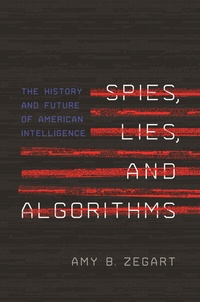
Spies, Lies, and Algorithms
The History and Future of American Intelligence
1st Edition
Published on 7. February 2022
424 pages
978-0-691-22308-7 (ISBN)
Description

A riveting account of espionage for the digital age, from one of America's leading intelligence experts
Spying has never been more ubiquitous-or less understood. The world is drowning in spy movies, TV shows, and novels, but universities offer more courses on rock and roll than on the CIA and there are more congressional experts on powdered milk than espionage. This crisis in intelligence education is distorting public opinion, fueling conspiracy theories, and hurting intelligence policy. In Spies, Lies, and Algorithms, Amy Zegart separates fact from fiction as she offers an engaging and enlightening account of the past, present, and future of American espionage as it faces a revolution driven by digital technology.
Drawing on decades of research and hundreds of interviews with intelligence officials, Zegart provides a history of U.S. espionage, from George Washington's Revolutionary War spies to today's spy satellites; examines how fictional spies are influencing real officials; gives an overview of intelligence basics and life inside America's intelligence agencies; explains the deadly cognitive biases that can mislead analysts; and explores the vexed issues of traitors, covert action, and congressional oversight. Most of all, Zegart describes how technology is empowering new enemies and opportunities, and creating powerful new players, such as private citizens who are successfully tracking nuclear threats using little more than Google Earth. And she shows why cyberspace is, in many ways, the ultimate cloak-and-dagger battleground, where nefarious actors employ deception, subterfuge, and advanced technology for theft, espionage, and information warfare.
A fascinating and revealing account of espionage for the digital age, Spies, Lies, and Algorithms is essential reading for anyone who wants to understand the reality of spying today.
Spying has never been more ubiquitous-or less understood. The world is drowning in spy movies, TV shows, and novels, but universities offer more courses on rock and roll than on the CIA and there are more congressional experts on powdered milk than espionage. This crisis in intelligence education is distorting public opinion, fueling conspiracy theories, and hurting intelligence policy. In Spies, Lies, and Algorithms, Amy Zegart separates fact from fiction as she offers an engaging and enlightening account of the past, present, and future of American espionage as it faces a revolution driven by digital technology.
Drawing on decades of research and hundreds of interviews with intelligence officials, Zegart provides a history of U.S. espionage, from George Washington's Revolutionary War spies to today's spy satellites; examines how fictional spies are influencing real officials; gives an overview of intelligence basics and life inside America's intelligence agencies; explains the deadly cognitive biases that can mislead analysts; and explores the vexed issues of traitors, covert action, and congressional oversight. Most of all, Zegart describes how technology is empowering new enemies and opportunities, and creating powerful new players, such as private citizens who are successfully tracking nuclear threats using little more than Google Earth. And she shows why cyberspace is, in many ways, the ultimate cloak-and-dagger battleground, where nefarious actors employ deception, subterfuge, and advanced technology for theft, espionage, and information warfare.
A fascinating and revealing account of espionage for the digital age, Spies, Lies, and Algorithms is essential reading for anyone who wants to understand the reality of spying today.
More details
Other editions
Additional editions
Book
02/2023
Princeton University Press
€21.00
Shipment within 10-20 days
Book
02/2022
Princeton University Press
€60.00
Available immediately
Person
Amy Zegart is senior fellow at the Hoover Institution and the Freeman Spogli Institute for International Studies at Stanford University and a contributing writer at The Atlantic. Her books include Spying Blind: The CIA, the FBI, and the Origins of 9/11 (Princeton) and (with Condoleezza Rice) Political Risk: How Businesses and Organizations Can Anticipate Global Insecurity. She lives in Stanford, California. Twitter @AmyZegart
Content
- Cover
- Contents
- Tables
- Figures
- Abbreviations and Acronyms
- 1. Intelligence Challenges in the Digital Age: Cloaks, Daggers, and Tweets
- 2. The Education Crisis: How Fictional Spies are Shaping Public Opinion and Intelligence Policy
- 3. American Intelligence History at a Glance: From Fake Bakeries to Armed Drones
- 4. Intelligence Basics: Knowns and Unknowns
- 5. Why Analysis Is So Hard: The Seven Deadly Biases
- 6. Counterintelligence: To Catch a Spy
- 7. Covert Action: "A Hard Business of Agonizing Choices"
- 8. Congressional Oversight: Eyes on Spies
- 9. Intelligence Isn't Just for Governments Anymore: Nuclear Sleuthing in a Google Earth World
- 10. Decoding Cyber Threats
- Acknowledgments
- Notes
- Selected Reading
- Index
