

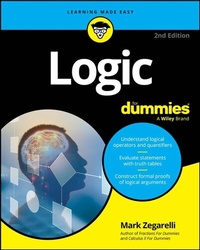
Logic For Dummies
Description

An accessible resource to help you puzzle out logic concepts
Logic For Dummies, 2nd Edition explains all the varied ways we use logic in philosophy, science, and everyday life. College students taking a logic course and lifelong learners alike can benefit from this accessible guide to logic concepts-such as syllogisms, constructing proofs and refutations, propositional and predicate logic, symbolic logic, modal and fuzzy logic, deductive and inductive reasoning, and beyond. With real-world examples, fun logic problems, and fully worked out proofs, you have plenty of opportunities to follow along and apply what you've learned. Logic For Dummies, 2nd Edition helps you connect the logical dots!
Inside:
- Grasp formal and informal logic with clear explanations and practice problems
- See how logic shows up in everyday life and discover how to spot logical fallacies
- Work through logical proofs and refutations, with answer explanations to strengthen your understanding
- Sharpen your ability to reason through complex issues with truth tables
Logic For Dummies, 2nd Edition is the logical choice for anyone who wants or needs to learn the concepts, theories, and formulas of logical reasoning.
More details
Other editions
Additional editions
Person
Mark Zegarelli is a math teacher and professional writer who holds degrees in Mathematics and English from Rutgers University. He's the author of Fractions For Dummies, Basic Math & Pre-Algebra For Dummies, and Basic Math & Pre-Algebra Workbook For Dummies.
Content
Introduction 1
Part 1: Getting Started with Logic 5
Chapter 1: Taking a Logical Perspective 7
Chapter 2: Following Logical Developments from Aristotle to AI 17
Chapter 3: Just for the Sake of Argument 35
Part 2: Flourishing with Formal Sentential Logic 61
Chapter 4: Engaging with Formal Affairs 63
Chapter 5: Embracing the Value of Evaluation 87
Chapter 6: Turning the Tables: Evaluating Statements with Truth Tables 101
Chapter 7: Taking the Easy Way Out: Creating Quick Tables 121
Chapter 8: Knowing How Truth Grows on Trees 137
Part 3: Exploring Proofs, Syntax, and Semantics in SL 159
Chapter 9: Providing Proof for What You Propose 161
Chapter 10: Applying Equivalence Rules 177
Chapter 11: Making Big Assumptions with Conditional and Indirect Proof 195
Chapter 12: Polishing Off Your Proofs 207
Chapter 13: Putting Operators in Their Place 229
Chapter 14: Syntactical Maneuvers and Semantic Considerations 237
Part 4: Questing After Quantification Logic 247
Chapter 15: Expressing Quantity with Quality: Quantification Logic 249
Chapter 16: Embracing QL Translations 263
Chapter 17: Proving Arguments with QL 275
Chapter 18: Expanding Logical Relations 301
Chapter 19: Planting a Quantity of Truth Trees 315
Part 5: Meditating on Modern Developments in Logic 327
Chapter 20: Computer Logic 329
Chapter 21: Sporting Propositions: Non-classical Logic 341
Chapter 22: Paradox and Axiomatic Systems 357
Part 6: The Part of Tens 369
Chapter 23: Ten (or So) Quotes about Logic 371
Chapter 24: Ten Big Names in Logic 373
Chapter 25: Ten Tips for Passing a Logic Exam 377
Index 383
Chapter 1
Taking a Logical Perspective
IN THIS CHAPTER
Seeing the world from a logical point of view
Using logic to build valid arguments
Applying the laws of thought
Understanding the connections between math and logic
You and I live in an illogical world. If you doubt this fact, just watch a few YouTube videos. Or really listen to the person sitting at the next barstool. Or, better yet, spend the weekend with your in-laws.
With so many people thinking and acting illogically, why should you be any different? Wouldn't it be more sensible just to be as illogical as the rest of the human race?
Well, okay, being illogical on purpose is probably not the best idea. For one thing, how can trying to be illogical possibly be sensible? For another, if you've picked up this book in the first place, you probably aren't built to be illogical. Let's face it - some folks thrive on chaos (or claim to), and others don't.
In this chapter, I introduce you to the basics of logic and how it applies to life. I tell you about a few words and ideas that are key to logic. And I touch briefly on the connections between logic and math.
Getting an Overview of Practical Logic
Whether you know it or not, you already understand a lot about logic. In fact, you already have a built-in logic detector. Don't believe me? Take this quick test to see whether you're logical:
- Q: How many pancakes does it take to shingle a doghouse?
- A: 23, because bananas don't have bones.
If the answer seems illogical to you, that's a good sign that you're at least on your way to being logical. Why? Simply put, if you can spot something that's illogical, you must have a decent sense of what's actually logical.
In this section, I start with what you already understand about logic (though you may not be aware of that knowledge) and build toward a foundation that can help you in your study of logic.
Bridging the gap from here to there
Most children are naturally curious. They constantly want to know why everything is the way it is. And for every because answer they receive, they have one more why question. For example, consider these common kid questions:
- Why does the sun rise in the morning?
- Why do I have to go to school?
- Why does the car start when you turn the key?
- Why do people break the law when they know they could go to jail?
When you think about it, every great mystery seeks a solution via these types of questions: Even when the world doesn't make sense on its own, why does it feel like it should?
Kids sense from an early age that even though they don't understand something - like why the sun rises in the morning - the answer must be somewhere. And they think, "If I'm here and the answer is somewhere else, what do I have to do to get there?" (Often, their determination to get there leads them to bug their parents with more questions.)
Human desire to get from here to there - from ignorance to understanding - is one of the main reasons logic came into existence as philosophy and science. Logic grew out of an essential human need to make sense of the world and, as much as possible, gain some control over it.
Understanding cause and effect
One way to understand the world is to notice the connection between cause and effect.
As you grow from a child to an adult, you begin to piece together how one event causes another. Typically, you can express the connections between cause and effect by using an if-statement (which is a basic conditional structure in logic). For example, consider these if-statements:
- If I let my favorite ball roll under the couch, then I can't reach it.
- If I do all my homework before Dad comes home, then he'll play catch with me before dinner.
- If I practice on my own this summer, then the coach will pick me for the team in the fall.
- If I keep showing up at job interviews prepared and with confidence, then I'll eventually get a job.
Understanding how if-statements work is an important aspect of logic.
Breaking down if-statements
Every if-statement is made up of two smaller statements called sub-statements: The antecedent, which follows the word if, and the consequent, which follows the word then. For example, consider this if-statement:
If it is 5 p.m., then it's time to go home.
In this if-statement, the antecedent is the sub-statement it is 5 p.m. The consequent is the sub-statement it's time to go home.
Every sub-statement can stand as a complete statement in its own right.
Stringing if-statements together
In many cases, the consequent of one if-statement becomes the antecedent of another. When this happens, you get a string of consequences, which the Greeks called a sorites (suh-rye-tease). For example:
In this case, you can link these if-statements together to form a new if-statement:
If it's 5 p.m., then I need to call my husband to make reservations at the restaurant.
Thickening the plot
As you gain more life experience, you may find that the connections between cause and effect become more and more sophisticated:
- If I let my favorite ball roll under the couch, then I can't reach it, unless I scream so loud that Grandma gets it for me, though if I do that more than once, then she gets annoyed and puts me back in my highchair.
- If I practice on my own this summer but not so hard that I blow my knees out, then the coach will pick me for the team in the fall only if there's a position open, but if I do not practice, then the coach will not pick me.
Knowing everything and more
As you begin to understand the world and what you find in it, you begin to make more general statements about it. For example:
- All horses are friendly.
- All 5-year-olds are silly.
- Every teacher at that school is out to get me.
- Every time I hear a phone ring in our house, it's my sister's phone.
Words like all and every allow you to categorize things into sets (groups of objects) and subsets (groups within groups). For example, when you say, "All horses are friendly," you mean that the set of all horses is contained within the set of all friendly things - that is, horses are a subset of friendly things.
Explaining existence itself
You also discover connections within the world by figuring out what exists and doesn't exist. For example:
- Some of my teachers are nice.
- There is at least one student in school who likes me.
- No one in the chess club can beat me.
- There is no such thing as a Martian.
Existence statements like these generally use wording that points to connections (or not):
- An intersection of sets: Words like some, there is, and there exists show an overlapping of sets called an intersection. For example, when you say, "Some of my teachers are nice," you mean that there's an intersection between the set of your teachers and the set of nice things.
- No intersection between sets: Words like no, there is no, and none show that there's no intersection between sets. For example, when you say, "No one in the chess club can beat me," you mean that there's no intersection between the set of all the chess club members and the set of all the chess players who can beat you.
Identifying a few logical words
As you can see, certain words show up a lot as you begin to make logical connections. Some of these common words are:
if . then
and
but
or
not
unless
though
every
all
only if
each
there is
there exists
some
there is no
none
Taking a closer look at words like these is an important step in the development of logic. When you do, you begin to see how these words enable you to divide and categorize the world in different ways (and therefore understand it better).
Building and Evaluating Logical Arguments
When people say "Let's be logical" about a given situation or problem, they often mean "Let's follow steps like these":
- Figure out what we know to be true.
- Spend some time thinking about it.
- Find the best...
