

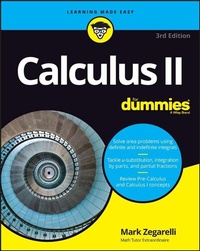
Calculus II For Dummies
Description

Calculus II For Dummies will help you get through your (notoriously difficult) calc class--or pass a standardized test like the MCAT with flying colors. Calculus is required for many majors, but not everyone's a natural at it. This friendly book breaks down tricky concepts in plain English, in a way that you can understand. Practical examples and detailed walkthroughs help you manage differentiation, integration, and everything in between. You'll refresh your knowledge of algebra, pre-calc and Calculus I topics, then move on to the more advanced stuff, with plenty of problem-solving tips along the way.
* Review Algebra, Pre-Calculus, and Calculus I concepts
* Make sense of complicated processes and equations
* Get clear explanations of how to use trigonometry functions
* Walk through practice examples to master Calc II
Use this essential resource as a supplement to your textbook or as refresher before taking a test--it's packed with all the helpful knowledge you need to succeed in Calculus II.
More details
Other editions
Additional editions
Person
Content
Part 1: Introduction to Integration 7
Chapter 1: An Aerial View of the Area Problem 9
Chapter 2: Forgotten but Not Gone: Review of Algebra and Pre-Calculus 27
Chapter 3: Recent Memories: Review of Calculus I 53
Part 2: From Definite to Indefinite Integrals 73
Chapter 4: Approximating Area with Riemann Sums 75
Chapter 5: There Must Be a Better Way -- Introducing the Indefinite Integral 87
Part 3: Evaluating Indefinite Integrals 103
Chapter 6: Instant Integration: Just Add Water (And C) 105
Chapter 7: Sharpening Your Integration Moves 117
Chapter 8: Here's Looking at U-Substitution 141
Part 4: Advanced Integration Techniques 153
Chapter 9: Parting Ways: Integration by Parts 155
Chapter 10: Trig Substitution: Knowing All the (Tri)Angles 173
Chapter 11: Rational Solutions: Integration with Partial Fractions 197
Part 5: Applications of Integrals 219
Chapter 12: Forging into New Areas: Solving Area Problems 221
Chapter 13: Pump Up the Volume: Using Calculus to Solve 3-D Problems 243
Chapter 14: What's So Different about Differential Equations? 265
Part 6: Infinite Series 275
Chapter 15: Following a Sequence, Winning the Series 277
Chapter 16: Where Is This Going? Testing for Convergence and Divergence 295
Chapter 17: Dressing Up Functions with the Taylor Series 319
Part 7: The Part of Tens 341
Chapter 18: Ten "Aha!" Insights in Calculus II 343
Chapter 19: Ten Tips to Take to the Test 351
Index 357
Chapter 1
An Aerial View of the Area Problem
IN THIS CHAPTER
Measuring the area of shapes by using classical and analytic geometry
Using integration to frame the area problem
Approximating area using Riemann sums
Applying integration to more complex problems
Seeing how differential equations are related to integrals
Looking at sequences and series
Humans have been measuring the area of shapes for thousands of years. One practical use for this skill is measuring the area of a parcel of land. Measuring the area of a square or a rectangle is simple, so land tends to get divided into these shapes.
Discovering the area of a triangle, circle, or polygon is also relatively easy, but as shapes get more unusual, measuring them gets harder. Although the Greeks were familiar with the conic sections - parabolas, ellipses, and hyperbolas - they couldn't reliably measure shapes with edges based on these figures.
René Descartes's invention of analytic geometry - studying lines and curves as equations plotted on the xy-graph - brought great insight into the relationships among the conic sections. But even analytic geometry didn't answer the question of how to measure the area inside a shape that includes a curve.
This bit of mathematical history is interesting in its own right, but I tell the story in order to give you, the reader, a sense of what drove those who came up with the concepts that eventually got bundled together as part of a standard Calculus II course. I start out by showing you how integral calculus (integration for short) was developed from attempts to answer this basic question of measuring the area of weird shapes, called the area problem. To do this, you will discover how to approximate the area under a parabola on the xy-graph in ways that lead to an ordered system of measuring the exact area under any function.
First, I frame the problem using a tool from calculus called the definite integral. I show you how to use the definite integral to define the areas of shapes you already know how to measure, such as circles, squares, and triangles.
With this introduction to the definite integral, you're ready to look at the practicalities of measuring area. The key to approximating an area that you don't know how to measure is to slice it into shapes that you do know how to measure - for example, rectangles. This process of slicing unruly shapes into nice, crisp rectangles - called finding a Riemann sum - provides the basis for calculating the exact value of a definite integral.
At the end of this chapter, I give you a glimpse into the more advanced topics in a basic Calculus II course, such as finding volume of unusual solids, looking at some basic differential equations, and understanding infinite series.
Checking Out the Area
Finding the area of certain basic shapes - squares, rectangles, triangles, and circles - is easy using geometric formulas you typically learn in a geometry class. But a reliable method for finding the exact area of shapes containing more esoteric curves eluded mathematicians for centuries. In this section, I give you the basics of how this problem, called the area problem, is formulated in terms of a new concept, the definite integral.
The definite integral represents the area of a region bounded by the graph of a function, the x-axis, and two vertical lines located at the bounds of integration. Without getting too deep into the computational methods of integration, I give you the basics of how to state the area problem formally in terms of the definite integral.
Comparing classical and analytic geometry
In classical geometry, you discover a variety of simple formulas for finding the area of different shapes. For example, Figure 1-1 shows the formulas for the area of a rectangle, a triangle, and a circle.
FIGURE 1-1: Formulas for the area of a rectangle, a triangle, and a circle.
On the xy-graph, you can generalize the problem of finding area to measure the area under any continuous function of x. To illustrate how this works, the shaded region in Figure 1-2 shows the area under the function f(x) between the vertical lines x = a and x = b.
The area problem is all about finding the area under a continuous function between two constant values of x that are called the bounds of integration, usually denoted by a and b. This problem is generalized as follows:
WISDOM OF THE ANCIENTS
Long before calculus was invented, the ancient Greek mathematician Archimedes used his method of exhaustion to calculate the exact area of a segment of a parabola. He was also the first mathematician to come up with an approximation for (pi) within about a 0.2% margin of error.
Indian mathematicians also developed quadrature methods for some difficult shapes before Europeans began their investigations in the 17th century.
These methods anticipated some of the methods of calculus. But before calculus, no single theory could measure the area under arbitrary curves.
FIGURE 1-2: A typical area problem.
In a sense, this formula for the shaded area isn't much different from the geometric formulas you already know. It's just a formula, which means that if you plug in the right numbers and calculate, you get the right answer.
For example, suppose you want to measure the area under the function between x = 1 and x = 5. (You can see what this area looks like by flipping a few pages forward to Figure 1-5.) Here's how you plug these values into the area formula shown previously:
The catch, however, is how exactly to calculate using this new symbol. As you may have figured out, the answer is on the cover of this book: calculus. To be more specific, integral calculus, or integration.
Most typical Calculus II courses taught at your friendly neighborhood college or university focus on integration - the study of how to solve the area problem. So, if what you're studying starts to get confusing (and to be honest, you probably will get confused somewhere along the way), try to relate what you're doing to this central question: "How does what I'm working on help me find the area under a function?"
Finding definite answers with the definite integral
You may be surprised to find out that you've known how to integrate some functions for years without even knowing it. (Yes, you can know something without knowing that you know it.)
For example, find the rectangular area under the function y = 2 between x = 1 and x = 4, as shown in Figure 1-3.
FIGURE 1-3: The rectangular area under the function f(x) = 2, between a = 1 and b = 4 equals 6.
This is just a rectangle with a base of 3 and a height of 2, so its area is 6. But this is also an area problem that can be stated in terms of integration as follows:
As you can see, the function I'm integrating here is f(x) = 2. The bounds of integration are 1 and 4 (notice that the greater value goes on top). You already know that the area is 6, so you can solve this calculus problem without resorting to any scary or hairy methods. But you're still integrating, so please pat yourself on the back, because I can't quite reach it from here.
The following expression is called a definite integral:
For now, don't spend too much time worrying about the deeper meaning behind the symbol or the dx (which you may fondly remember from your days spent differentiating in Calculus I). Just think of and dx as notation placed around a function - notation that means area.
What's so definite about a definite integral? Two things, really:
- You definitely know the bounds of integration (in this case, 1 and 4). Their presence distinguishes a definite integral from an indefinite integral, which you find out about in Chapter 5. Definite integrals always include the bounds of integration; indefinite integrals never include them.
- A definite integral definitely equals a number (assuming that its limits of integration are also numbers). This number may be simple to find or difficult enough to require a room full of math professors scribbling away with #2 pencils. But, at the end of the day, a number is just a number. And, because a definite integral is a measurement of area, you should expect the answer to be a number.
When the limits of integration aren't numbers, a definite integral doesn't necessarily equal a number. For example, expressions such as k and 2k might be used as limits of integration to stand in for constants. In such cases, the answer to a definite integral may include the letter k. Similarly, a definite integral whose limits of integration are sin and 2 sin would most likely equal a trig expression that includes...
