

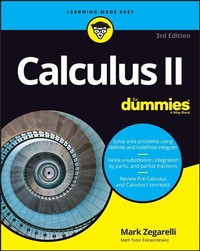
Calculus II For Dummies
Description

The easy (okay, easier) way to master advanced calculus topics and theories
Calculus II For Dummies will help you get through your (notoriously difficult) calc class-or pass a standardized test like the MCAT with flying colors. Calculus is required for many majors, but not everyone's a natural at it. This friendly book breaks down tricky concepts in plain English, in a way that you can understand. Practical examples and detailed walkthroughs help you manage differentiation, integration, and everything in between. You'll refresh your knowledge of algebra, pre-calc and Calculus I topics, then move on to the more advanced stuff, with plenty of problem-solving tips along the way.
- Review Algebra, Pre-Calculus, and Calculus I concepts
- Make sense of complicated processes and equations
- Get clear explanations of how to use trigonometry functions
- Walk through practice examples to master Calc II
Use this essential resource as a supplement to your textbook or as refresher before taking a test-it's packed with all the helpful knowledge you need to succeed in Calculus II.
More details
Other editions
Additional editions
Content
- Cover
- Title Page
- Copyright Page
- Table of Contents
- Introduction
- About This Book
- Conventions Used in This Book
- What You're Not to Read
- Foolish Assumptions
- Icons Used in This Book
- Beyond the Book
- Where to Go from Here
- Part 1 Introduction to Integration
- Chapter 1 An Aerial View of the Area Problem
- Checking Out the Area
- Comparing classical and analytic geometry
- Finding definite answers with the definite integral
- Slicing Things Up
- Untangling a hairy problem using rectangles
- Moving left, right, or center
- Defining the Indefinite
- Solving Problems with Integration
- We can work it out: Finding the area between curves
- Walking the long and winding road
- You say you want a revolution
- Differential Equations
- Understanding Infinite Series
- Distinguishing sequences and series
- Evaluating series
- Identifying convergent and divergent series
- Chapter 2 Forgotten but Not Gone: Review of Algebra and Pre-Calculus
- Quick Review of Pre-Algebra and Algebra
- Working with fractions
- Adding fractions
- Subtracting fractions
- Multiplying fractions
- Dividing fractions
- Knowing the facts on factorials
- Polishing off polynomials
- Powering through powers (exponents)
- Understanding zero and negative exponents
- Understanding fractional exponents
- Expressing functions using exponents
- Rewriting rational functions using exponents
- Simplifying rational expressions by factoring
- Review of Pre-Calculus
- Trigonometry
- Noting trig notation
- Figuring the angles with radians
- Identifying some important trig identities
- Asymptotes
- Graphing common parent functions
- Linear and polynomial functions
- Exponential and logarithmic functions
- Trigonometric functions
- Transforming continuous functions
- Polar coordinates
- Summing up sigma notation
- Chapter 3 Recent Memories: Review of Calculus I
- Knowing Your Limits
- Telling functions and limits apart
- Evaluating limits
- Hitting the Slopes with Derivatives
- Referring to the limit formula for derivatives
- Knowing two notations for derivatives
- Understanding Differentiation
- Memorizing key derivatives
- Derivatives of the trig functions
- Derivatives of the inverse trig functions
- The Power rule
- The Sum rule
- The Constant Multiple rule
- The Product rule
- The Quotient rule
- Evaluating functions from the inside out
- Differentiating functions from the outside in
- Finding Limits Using L'Hôpital's Rule
- Introducing L'Hôpital's rule
- Alternative indeterminate forms
- Case #1: 0 · 8
- Case #2: 8 - 8
- Case #3: Indeterminate powers
- Part 2 From Definite to Indefinite Integrals
- Chapter 4 Approximating Area with Riemann Sums
- Three Ways to Approximate Area with Rectangles
- Using left rectangles
- Using right rectangles
- Finding a middle ground: The Midpoint rule
- Two More Ways to Approximate Area
- Feeling trapped? The Trapezoid rule
- Don't have a cow! Simpson's rule
- Building the Riemann Sum Formula
- Approximating the definite integral with the area formula for a rectangle
- Widening your understanding of width
- Limiting the margin of error
- Summing things up with sigma notation
- Heightening the functionality of height
- Finishing with the slack factor
- Chapter 5 There Must Be a Better Way - Introducing the Indefinite Integral
- FTC2: The Saga Begins
- Introducing FTC2
- Evaluating definite integrals using FTC2
- Your New Best Friend: The Indefinite Integral
- Introducing anti-differentiation
- Solving area problems without the Riemann sum formula
- Understanding signed area
- Distinguishing definite and indefinite integrals
- FTC1: The Journey Continues
- Understanding area functions
- Making sense of FTC1
- Part 3 Evaluating Indefinite Integrals
- Chapter 6 Instant Integration: Just Add Water (And C?)
- Evaluating Basic Integrals
- Using the 17 basic antiderivatives for integrating
- Three important integration rules
- The Sum rule for integration
- The Constant Multiple rule for integration
- The Power rule for integration
- What happened to the other rules?
- Evaluating More Difficult Integrals
- Integrating polynomials
- Integrating more complicated-looking functions
- Understanding Integrability
- Taking a look at two red herrings of integrability
- Computing integrals
- Representing integrals as elementary functions
- Getting an idea of what integrable really means
- Chapter 7 Sharpening Your Integration Moves
- Integrating Rational and Radical Functions
- Integrating simple rational functions
- Integrating radical functions
- Using Algebra to Integrate Using the Power Rule
- Integrating by using inverse trig functions
- Integrating Trig Functions
- Recalling how to anti-differentiate the six basic trig functions
- Using the Basic Five trig identities
- Applying the Pythagorean trig identities
- Using to integrate trig functions
- Using to integrate trig functions
- Using to integrate trig functions
- Integrating Compositions of Functions with Linear Inputs
- Understanding how to integrate familiar functions that have linear inputs
- Integrating the function composed with a linear input
- Integrating the six basic trig functions with linear inputs
- Integrating power functions composed with a linear input
- Knowing the handy arctan formula
- Using algebra to solve more complex problems
- Using trig identities to integrate more complex functions
- Understanding why integrating compositions of functions with linear inputs actually works
- Chapter 8 Here's Looking at U-Substitution
- Knowing How to Use U-Substitution
- Recognizing When to Use U-Substitution
- The simpler case: f?(x) · f '(x)
- The more complex case: g(??f?(x)) · f '(x) when you know how to integrate g?(x)
- Using Substitution to Evaluate Definite Integrals
- Part 4 Advanced Integration Techniques
- Chapter 9 Parting Ways: Integration by Parts
- Introducing Integration by Parts
- Reversing the Product rule
- Knowing how to integrate by parts
- Knowing when to integrate by parts
- Integrating by Parts with the DI-agonal Method
- Looking at the DI-agonal chart
- Using the DI-agonal method
- L is for logarithm
- I is for inverse trig
- A is for algebraic
- T is for trig
- Chapter 10 Trig Substitution: Knowing All the (Tri)Angles
- Integrating the Six Trig Functions
- Integrating Powers of Sines and Cosines
- Odd powers of sines and cosines
- Even powers of sines and cosines
- Integrating Powers of Tangents and Secants
- Even powers of secants
- Odd powers of tangents
- Other tangent and secant cases
- Integrating Powers of Cotangents and Cosecants
- Integrating Weird Combinations of Trig Functions
- Using Trig Substitution
- Distinguishing three cases for trig substitution
- Integrating the three cases
- The sine case
- The tangent case
- The secant case
- Knowing when to avoid trig substitution
- Chapter 11 Rational Solutions: Integration with Partial Fractions
- Strange but True: Understanding Partial Fractions
- Looking at partial fractions
- Using partial fractions with rational expressions
- Solving Integrals by Using Partial Fractions
- Case 1: Distinct linear factors
- Setting up partial fractions
- Solving for unknowns A, B, and C
- Evaluating the integral
- Case 2: Repeated linear factors
- Setting up partial fractions
- Solving for unknowns A and B
- Evaluating the integral
- Case 3: Distinct quadratic factors
- Setting up partial fractions
- Solving for unknowns A, B, and C
- Evaluating the integral
- Case 4: Repeated quadratic factors
- Setting up partial fractions
- Solving for unknowns A, B, C, and D
- Evaluating the integral
- Beyond the Four Cases: Knowing How to Set Up Any Partial Fraction
- Integrating Improper Rationals
- Distinguishing proper and improper rational expressions
- Trying out an example
- Part 5 Applications of Integrals
- Chapter 12 Forging into New Areas: Solving Area Problems
- Breaking Us in Two
- Improper Integrals
- Getting horizontal
- Going vertical
- Handling asymptotic limits of integration
- Piecing together discontinuous integrands
- Finding the Unsigned Area of Shaded Regions on the xy-Graph
- Finding unsigned area when a region is separated horizontally
- Crossing the line to find unsigned area
- Calculating the area under more than one function
- Measuring a single shaded region between two functions
- Finding the area of two or more shaded regions between two functions
- The Mean Value Theorem for Integrals
- Calculating Arc Length
- Chapter 13 Pump Up the Volume: Using Calculus to Solve 3-D Problems
- Slicing Your Way to Success
- Finding the volume of a solid with congruent cross sections
- Finding the volume of a solid with similar cross sections
- Measuring the volume of a pyramid
- Measuring the volume of a weird solid
- Turning a Problem on Its Side
- Two Revolutionary Problems
- Solidifying your understanding of solids of revolution
- Skimming the surface of revolution
- Finding the Space Between
- Playing the Shell Game
- Peeling and measuring a can of soup
- Using the shell method without inverses
- Knowing When and How to Solve 3-D Problems
- Chapter 14 What's So Different about Differential Equations?
- Basics of Differential Equations
- Classifying DEs
- Ordinary and partial differential equations
- Order of DEs
- Linear DEs
- Looking more closely at DEs
- How every integral is a DE
- Why building DEs is easier than solving them
- Checking DE solutions
- Solving Differential Equations
- Solving separable equations
- Solving initial-value problems
- Part 6 Infinite Series
- Chapter 15 Following a Sequence, Winning the Series
- Introducing Infinite Sequences
- Understanding notations for sequences
- Looking at converging and diverging sequences
- Introducing Infinite Series
- Getting Comfy with Sigma Notation
- Writing sigma notation in expanded form
- Seeing more than one way to use sigma notation
- Discovering the Constant Multiple rule for series
- Examining the Sum rule for series
- Connecting a Series with Its Two Related Sequences
- A series and its defining sequence
- A series and its sequences of partial sums
- Recognizing Geometric Series and p-Series
- Getting geometric series
- Pinpointing p-series
- Harmonizing with the harmonic series
- Testing p-series when p = 2, p = 3, and p = 4
- Testing p-series when
- Chapter 16 Where Is This Going? Testing for Convergence and Divergence
- Starting at the Beginning
- Using the nth-Term Test for Divergence
- Let Me Count the Ways
- One-way tests
- Two-way tests
- Choosing Comparison Tests
- Getting direct answers with the direct comparison test
- Testing your limits with the limit comparison test
- Two-Way Tests for Convergence and Divergence
- Integrating a solution with the integral test
- Rationally solving problems with the ratio test
- Rooting out answers with the root test
- Looking at Alternating Series
- Eyeballing two forms of the basic alternating series
- Making new series from old ones
- Alternating series based on convergent positive series
- Checking out the alternating series test
- Understanding absolute and conditional convergence
- Testing alternating series
- Chapter 17 Dressing Up Functions with the Taylor Series
- Elementary Functions
- Identifying two drawbacks of elementary functions
- Appreciating why polynomials are so friendly
- Representing elementary functions as series
- Power Series: Polynomials on Steroids
- Integrating power series
- Understanding the interval of convergence
- The interval of convergence is never empty
- Three varieties for the interval of convergence
- Expressing Functions as Series
- Expressing sin x as a series
- Expressing cos x as a series
- Introducing the Maclaurin Series
- Introducing the Taylor Series
- Computing with the Taylor series
- Examining convergent and divergent Taylor series
- Expressing functions versus approximating functions
- Understanding Why the Taylor Series Works
- Part 7 The Part of Tens
- Chapter 18 Ten "Aha!" Insights in Calculus II
- Integrating Means Finding the Area
- When You Integrate, Area Means Signed Area
- Integrating Is Just Fancy Addition
- Integration Uses Infinitely Many Infinitely Thin Slices
- Integration Contains a Slack Factor
- A Definite Integral Evaluates to a Number
- An Indefinite Integral Evaluates to a Function
- Integration Is Inverse Differentiation
- Every Infinite Series Has Two Related Sequences
- Every Infinite Series Either Converges or Diverges
- Chapter 19 Ten Tips to Take to the Test
- Breathe
- Start by Doing a Memory Dump as You Read through the Exam
- Solve the Easiest Problem First
- Don't Forget to Write dx and + C
- Take the Easy Way Out Whenever Possible
- If You Get Stuck, Scribble
- If You Really Get Stuck, Move On
- Check Your Answers
- If an Answer Doesn't Make Sense, Acknowledge It
- Repeat the Mantra, "I'm Doing My Best," and Then Do Your Best
- Index
- EULA
