

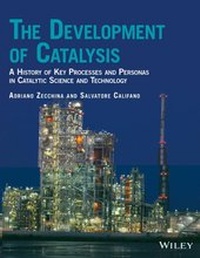
The Development of Catalysis
Description

More details
Other editions
Additional editions
Persons
Content
Preface ix
1 From the Onset to the First Large-Scale Industrial Processes 1
1.1 Origin of the Catalytic Era 1
1.2 Berzelius and the Affinity Theory of Catalysis 4
1.3 Discovery of the Occurrence of Catalytic Processes in Living Systems in the Nineteenth Century 6
1.4 Kinetic Interpretation of Catalytic Processes in Solutions: The Birth of Homogeneous Catalysis 8
1.5 Onset of Heterogeneous Catalysis 18
1.6 First Large-Scale Industrial Processes Based on Heterogeneous Catalysts 26
1.6.1 Sulfuric Acid Synthesis 26
1.6.2 Ammonia Problem 29
1.6.3 Ammonia Oxidation Process 32
1.6.4 Ammonia Synthesis 33
1.7 Fischer-Tropsch Catalytic Process 40
1.8 Methanol Synthesis 44
1.9 Acetylene Production and Utilization 46
1.10 Anthraquinone Process for Hydrogen Peroxide Production 47
References 49
2 Historical Development of Theories of Catalysis 59
2.1 Heterogeneous Catalysis 59
2.2 Chemical Kinetics and the Mechanisms of Catalysis 62
2.3 Electronic Theory of Catalysis: Active Sites 72
References 76
3 Catalytic Processes Associated with Hydrocarbons and the Petroleum Industry 83
3.1 Petroleum and Polymer Eras 83
3.2 Catalytic Cracking, Isomerization, and Alkylation of Petroleum Fractions 84
3.3 Reforming Catalysts 91
3.4 Hydrodesulfurization (HDS) Processes 93
3.5 Hydrocarbon Hydrogenation Reactions with Heterogeneous Catalysts 94
3.6 Olefin Polymerization: Ziegler-Natta, Metallocenes, and Phillips Catalysts 98
3.7 Selective Oxidation Reactions 109
3.7.1 Alkane Oxidation 109
3.7.2 Olefin Oxidation 110
3.7.3 Aromatic Compounds Oxidation 111
3.8 Ammoximation and Oxychlorination of Olefins 113
3.9 Ethylbenzene and Styrene Catalytic Synthesis 117
3.10 Heterogeneous Metathesis 118
3.11 Catalytic Synthesis of Carbon Nanotubes and Graphene from Hydrocarbon Feedstocks 119
References 121
4 Surface Science Methods in the Second Half of the Twentieth Century 131
4.1 Real Dispersed Catalysts versus Single Crystals: A Decreasing Gap 131
4.2 Physical Methods for the Study of Dispersed Systems and Real Catalysts 132
4.3 Surface Science of Single-Crystal Faces and of Well-defined Systems 139
References 147
5 Development of Homogeneous Catalysis and Organocatalysis 155
5.1 Introductory Remarks 155
5.2 Homogeneous Acid and Bases as Catalysts: G. Olah Contribution 156
5.3 Organometallic Catalysts 161
5.4 Asymmetric Epoxidation Catalysts 175
5.5 Olefin Oligomerization Catalysts 179
5.6 Organometallic Metathesis 180
5.7 Cross-Coupling Reactions 186
5.8 Pd(II)-Based Complexes and Oxidation of Methane to Methanol 190
5.9 Non-transition Metal Catalysis, Organocatalysis, and Organo-Organometallic Catalysis Combination 191
5.9.1 Metal-Free Hydrogen Activation and Hydrogenation 192
5.9.2 Amino Catalysis 193
5.10 Bio-inspired Homogeneous Catalysts 194
References 195
6 Material Science and Catalysis Design 205
6.1 Metallic Catalysts 205
6.2 Oxides and Mixed Oxides 208
6.2.1 SiO2 and SiO2-Based Catalysts and Processes 209
6.2.2 Al2O3 and Al2O3-Based Catalysts and Processes 211
6.2.3 SiO2-Al2O3- and SiO2-Al2O3-Based Catalysts and Processes 211
6.2.4 MgO- and MgO-Based Catalysts and Processes 212
6.2.5 ZrO2 and ZrO2-Based Catalysts and Processes 212
6.3 Design of Catalysts with Shape and Transition-State Selectivity 213
6.4 Zeolites and Zeolitic Materials: Historical Details 214
6.5 Zeolites and Zeolitic Materials Structure 218
6.6 Shape-Selective Reactions Catalyzed by Zeolites and Zeolitic Materials 221
6.6.1 Alkanes- and Alkene-Cracking and Isomerization 222
6.6.2 Aromatic Ring Positional Isomerizations 223
6.6.3 Synthesis of Ethyl Benzene, Cumene, and Alkylation of Aromatic Molecules 224
6.6.4 Friedel-Crafts Acylation of Aromatic Molecules 225
6.6.5 Toluene Alkylation with Methanol 225
6.6.6 Asaki Process for Cyclohexanol Synthesis 226
6.6.7 Methanol-to-Olefins (MTO) Process 226
6.6.8 Nitto Process 227
6.6.9 Butylamine Synthesis 227
6.6.10 Beckman Rearrangements on Silicalite Catalyst 227
6.6.11 Partial Oxidation Reactions Using Titanium Silicalite 227
6.6.12 Nylon-6 Synthesis: The Role of Zeolitic Catalysts 229
6.6.13 Pharmaceutical Product Synthesis 229
6.7 Organic-Inorganic Hybrid Zeolitic Materials and Inorganic Microporous Solids 230
6.7.1 Organic-Inorganic Hybrid Zeolitic Materials 230
6.7.2 ETS-10: A Microporous Material Containing Monodimensional TiO2 Chains 231
6.7.3 Hydrotalcites: Microporous Solids with Exchangeable Anions 232
6.8 Microporous Polymers and Metal-Organic Frameworks (MOFs) 232
6.8.1 Microporous Polymers 232
6.8.2 Metal-organic Frameworks 234
References 235
7 Photocatalysis 243
7.1 Photochemistry and Photocatalysis: Interwoven Branches of Science 243
7.2 Photochemistry Onset 245
7.3 Physical Methods in Photochemistry 249
7.4 Heterogeneous and Homogeneous Photocatalysis 251
7.5 Natural Photosynthesis as Model of Photocatalysis 253
7.6 Water Splitting, CO2 Reduction, and Pollutant Degradation: The Most Investigated Artificial Photocatalytic Processes 256
7.6.1 Water Splitting 257
7.6.2 CO2 Photoreduction 261
7.6.3 Photocatalysis in Environmental Protection 263
References 264
8 Enzymatic Catalysis 269
8.1 Early History of Enzymes 269
8.2 Proteins and Their Role in Enzymatic Catalysis 273
8.3 Enzymes/Coenzymes Structure and Catalytic Activity 284
8.4 Mechanism of Enzyme Catalysis 288
8.5 Biocatalysis 294
References 295
9 Miscellanea 299
9.1 Heterogeneous and Homogeneous Catalysis in Prebiotic Chemistry 299
9.2 Opportunities for Catalysis in the Twenty-First Century and the
Green Chemistry 312
References 317
Index 321
Chapter 1
From the Onset to the First Large-Scale Industrial Processes
1.1 Origin of the Catalytic Era
Chemists have always known, even before becoming scientists in the modern term (i.e., during the long alchemist era), how to increase reaction rates by raising the temperature. Only much later on, they realized that the addition to the reaction of a third chemical substance, the catalyst, could give rise to the same effect.
Formerly the word "affinity" was used in chemical language to indicate the driving force for a reaction, but this concept had no direct connection with the understanding of reaction rates at a molecular level.
The first known processes involving reactions in solution accelerated by the addition of small amounts of acids are normally defined today as homogeneous catalysis. Experimental evidence for such processes dates back to the sixteenth century, when the German physician and botanist Valerius Cordus published posthumously in 1549 his lecture notes with the title Annotations on Dioscorides.
Valerius Cordus (1515-1544), born in Erfurt, Germany, organized the first official pharmacopoeia (?a?µa?opo??a) in Germany. He wrote a booklet that described names and properties of medicaments, completing and improving the famous pharmacopoeia written by the Roman natural philosopher Pliny the Elder and listing all known drugs and medicaments. In 1527, he enrolled at the University of Leipzig where he obtained his bachelor's degree in 1531. During these years, he was strongly influenced by his father Euricius, author in 1534 of a systematic treatise on botany (Botanologicon). Valerius Cordus, after completing his training in the pharmacy of his uncle at Leipzig, moved in 1539 to Wittenberg University. As a young man, he also made several trips to Europe, the last one to Italy where he visited several Italian towns, including Venice, Padua, Bologna, and Rome. There he died in 1544 at the age of only 29 and was buried in the church of Santa Maria dell'Anima.
His role in pharmacy was based on the Dispensatorium, a text he prepared in 1546 that, using a limited selection of prescriptions, tried to create order in the unsystematic corpus of medicaments existing at that time. Soon his dispensatory became obligatory for the complete German territory. In 1540 Cordus discovered ether and described the first method of preparing this special solvent in the De artificiosis extractionibus liber. Following a recipe imported to Europe from the Middle East by Portuguese travelers, he discovered how to synthesize ethyl ether by reacting oil of vitriol, "oleum dulci vitrioli" (sweet oil of vitriol), with ethyl alcohol (Califano, 2012, Chapter 2, p. 40). The synthesis was published in 1548 (Cordus, 1548) after his death and again later in the De artificiosis extractionibus liber (Cordus, 1561) (Figure 1.1).
Figure 1.1 (a) Valerius Cordus, discoverer of ethyl ether formation from ethyl alcohol in the presence of an acid (oil of vitriol). (b) Cover page of Dispensatorium Pharmacorum. Images in the public domain.
He, of course, did not grasp the fact that the presence of an acid in the solution had a catalytic effect on the reaction. Only at the end of the eighteenth century did chemists realize that a few drops of acid or even of a base added to a solution could speed up reactions in solutions, giving rise to the era of homogeneous catalysis.
The chemical importance of these processes became evident only several years later, when the French agronomist and nutritionist Antoine-Augustin Parmentier (1737-1813) realized in 1781 that the addition of acetic acid accelerated the transformation of potato flour into a sweet substance. Parmentier was known for his campaign in which he promoted potatoes as an important source of food for humans not only in France but also throughout Europe (Block, 2008) (Figure 1.2).
Figure 1.2 (a) Augustin Parmentier (1737-1813) and (b) Anselme Payen (1795-1871) (images in the public domain). Parmentier discovered the accelerating action of acetic acid in the transformation of potato flour into a sweet substance. Payen attributed the starch transformation induced by few drops of sulfuric acid previously discovered by Constantin Kirchhoff to the concomitant action of a particular biological substance named diastase. Thus, we can consider him a true precursor of the modern enzyme science (vide infra: Chapter 8).
During the Seven Years' War, while performing an inspection at the first front lines, Parmentier, captured by a Prussian patrol, was sent on probation to the shop of a German pharmacist Johann Meyer, a person who became his friend and had a great influence on his scientific formation. After his return to Paris in the year 1763, he pursued his research in nutrition chemistry. His prison experience came back to his mind in 1772 when he proposed, in a contest sponsored by the Academy of Besançon, to use the potato as a convenient food for dysenteric patients, a suggestion that he soon extended to the whole French population. This suggestion, complemented in 1794 by the book La Cuisinière Républicaine written by Madame Mérigot, definitely promoted the use of potatoes as food for the common people first in France and subsequently over the entire continent. In 1772, he won a prize from the Academy of Besançon with memoirs in which he further emphasized the praise of the potato as a source of nutrients (Parmentier, 1773, 1774).
An additional early example of catalytic processes was found by the Russian chemist Gottlieb Sigismund Constantin Kirchhoff (1764-1833) born in Teterow in the district of Rostock, in Mecklenburg-Western Pomerania (Germany), who was working in St. Petersburg as an assistant in a chemist's shop. In 1811, he became the first person who succeeded in converting starch into sugar (corn syrup), discovering that the hydrolysis of starch in glucose was made faster by heating a solution to which he had added only a few drops of sulfuric acid (Kirchhoff, 1811a, b). This gluey juice was a kind of sugar, eventually named glucose. Kirchhoff showed at a meeting of the Imperial Academy of Sciences in St. Petersburg three versions of his experiments. He apparently discussed the problem with Berzelius who then told the Royal Institute in London about Kirchhoff's experiments, remarking upon the treatment with sulfuric acid.
At the suggestion of Sir Humphry Davy, members of the Royal Institution in London repeated his experiment and produced similar results. It was, however, only in 1814 that the Swiss chemist Nicolas-Théodore de Saussure showed that the syrup contained dextrose.
1.2 Berzelius and the Affinity Theory of Catalysis
The first who coined the name catalysis was Berzelius, one of the founders of modern chemistry, in 1836. Born in 1779 at Väversunda in Östergötland, Sweden, although in continual financial difficulties and suffering many privations, he was able to study at the Linköping secondary school and then enroll at Uppsala University to study medicine during the period between 1796 and 1801, thanks to the moral support of Jacob Lindblom, Bishop of Linköping. At Uppsala, he studied medicine and chemistry under the supervision of Anders Gustaf Ekeberg, the discoverer of tantalum and supporter of the interest in the chemical nomenclature of Lavoisier.
He worked then, as a medical doctor near Stockholm, until Wilhelm Hisinger, proprietor of a foundry, discovered his analytical abilities and decided to provide him with a laboratory where he could work on his research on looking for new elements.
In 1807, the Karolinska Institute appointed Berzelius as professor in chemistry and pharmacy. In 1808, he was elected as a member of the Royal Swedish Academy of Sciences and, in 1818, became secretary of the Academy, a position that he held until 1848. During his tenure, he revitalized the Academy, bringing it into a significant golden era (Figure 1.3).
Figure 1.3 Jöns Jacob Berzelius (1779-1848) (image in the public domain), one of the founders of modern chemistry. He coined the word catalysis.
In 1822, the American Academy of Arts and Sciences nominated him as Foreign Honorary Member, and in 1837, he became a member of the Swedish Academy. Between 1808 and 1836, Berzelius worked with Anna Sundström, who acted as his assistant (Leicester, 1970-1980).
Berzelius developed a modern system of chemical formula notation in which the Latin name of an element was abbreviated to one or two letters and superscripts (in place of the subscripts currently used today) to designate the number of atoms of each element present in the atom or molecule.
Berzelius discovered several new elements, including cerium and thorium. He developed isomerism and catalysis that owe their names to him. He concluded that a new force operates in chemical reactions, the catalytic force (Califano, 2012, Chapter 2, p. 42).
A first attempt to interpret the mechanism of catalysis was made by Berzelius who, in a report to the Swedish Academy of Sciences of 1835 published in 1836 (Berzelius, 1836a), had collected a large number of results on both homogeneous and heterogeneous catalytic reactions that he reviewed, proposing the existence of a "new catalytic force," acting on the matter. In 1836, he wrote in...
