

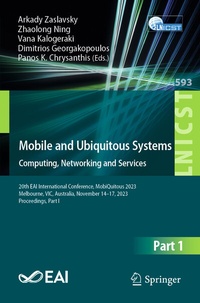
Mobile and Ubiquitous Systems: Computing, Networking and Services
Description

These two-volume proceedings constitute the refereed post-conference proceedings of the 20th EAI International Conference on Mobile and Ubiquitous Systems: Computing, Networking and Services, MobiQuitous 2023, held in Melbourne, Australia, during November 14-17, 2023.
The 65 papers presented in these proceedings were carefully reviewed and selected from 161 submissions. The conference papers are organized in topical sections on:
Part I - Tracking and Detection; IoT; Federated learning; Networks; Activity recognition; Security Management; Urban/Mobile Crowdsensing.
Part II - Urban/Mobile Crowdsensing; Edge computing; Crowdsourcing, Platforms and localization; Activity recognition and prediction; AI and machine learning; Mobile edge and fog computing; Mobile augmented reality and applications for mobile computing; interaction technologies; AutoQuitous workshop.
More details
Other editions
Additional editions
Content
.- Tracking and Detection.
.- NoD: Lightweight Continuous Neighbor Discovery on Everyday Devices.
.- Decentralized Collaborative Inertial Tracking.
.- High-Performance Features in Generalizable Fingerprint- based Indoor Positioning.
.- SCORE: Scalable Contact Tracing Over Uncertain Trajectories.
.- IoT.
.- FaultBit : Generic and E?icient Wireless Fault Detection Using the Internet of Things.
.- DeepHeteroIoT: Deep Local and Global Learning over Heterogeneous IoT Sensor Data.
.- Federated Reinforcement Learning for Automated LoRaWAN Management in Industrial IoT.
.- A Hybrid Approach to Monitor Context Parameters for Optimising Caching for Context-Aware IoT Applications.
.- LOADHoC: Towards the Automatic local Distribution of Computation using Existing IoT Devices.
.- E-Go Bicycle Intelligent Speed Adaptation System for Catching the Green Light.
.- Federated Learning.
.- FedGCS: Addressing Class Imbalance in Long-Tail Federated Learning.
.- FedRC: Representational Consistency Guided Model Uploading Mechanism for Asynchronous Federated Learning.
.- RADEAN: A Resource Allocation Model Based on Deep Reinforcement Learning and Generative Adversarial Networks in Edge Computing.
.- Networks.
.- A Stream Data Service Framework for Real-time Vehicle Companion Discovery.
.- KS-Autoformer: An Autoformer-based SOC Prediction Framework for Electric Vehicles.
.- Deep Reinforcement Learning-based Multi-Node Collaborative Task Offloading Optimization in 6G
Space-Air-Ground Integrated Networks.
.- Securing Wireless Communication in Critical Infrastructure: Challenges and Opportunities.
.- Activity Recognition.
.- Cross-user activity recognition via temporal relation optimal transport.
.- SelfAct: Personalized Activity Recognition based on Self-Supervised and Active Learning.
.- A Novel Method for Wearable Activity Recognition with Feature Evolvable Streams.
.- Let's Vibrate with Vibration: Augmenting Structural Engineering with Low-Cost Vibration Sensing.
.- Security Management.
.- Research on Data Drift and Class Imbalance in Android Malware detection.
.- Reputation-based Dissemination of Trustworthy Information in VANETs.
.- Reputation Systems for Supply Chains: The Challenge of Achieving Privacy Preservation.
.- Data Management in Appendable-block Blockchains: A Case Study for IT Life-cycle Management.
.- Exploiting the Potential Anomaly Detection in Automobile Safety Data with Multi-type Neural Network.
.- Urban/Mobile Crowdsensing.
.- HAUM3: A Height Aware Urban Map Matching Mechanism.
.- A resource-e?icient approach of GNSS activation for pedestrian monitoring.
