

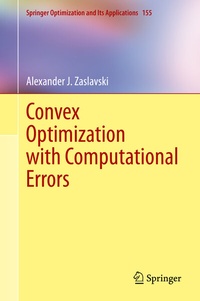
Convex Optimization with Computational Errors
1st Edition
Published on 31. January 2020
XI, 360 pages
978-3-030-37822-6 (ISBN)
Description

The book is devoted to the study of approximate solutions of optimization problems in the presence of computational errors. It contains a number of results on the convergence behavior of algorithms in a Hilbert space, which are known as important tools for solving optimization problems. The research presented in the book is the continuation and the further development of the author's (c) 2016 book
Numerical Optimization with Computational Errors
, Springer 2016. Both books study the algorithms taking into account computational errors which are always present in practice. The main goal is, for a known computational error, to find out what an approximate solution can be obtained and how many iterates one needs for this.
The main difference between this new book and the 2016 book is that in this present book the discussion takes into consideration the fact that for every algorithm, its iteration consists of several steps and that computational errors for different steps are generally, different. This fact, which was not taken into account in the previous book, is indeed important in practice. For example, the subgradient projection algorithm consists of two steps. The first step is a calculation of a subgradient of the objective function while in the second one we calculate a projection on the feasible set. In each of these two steps there is a computational error and these two computational errors are different in general.
It may happen that the feasible set is simple and the objective function is complicated. As a result, the computational error, made when one calculates the projection, is essentially smaller than the computational error of the calculation of the subgradient. Clearly, an opposite case is possible too. Another feature of this book is a study of a number of important algorithms which appeared recently in the literature and which are not discussed in the previous book.
This monograph contains 12 chapters. Chapter 1 is an introduction. In Chapter 2 we study the subgradient projection algorithm for minimization of convex and nonsmooth functions. We generalize the results of [NOCE] and establish results which has no prototype in [NOCE]. In Chapter 3 we analyze the mirror descent algorithm for minimization of convex and nonsmooth functions, under the presence of computational errors. For this algorithm each iteration consists of two steps. The first step is a calculation of a subgradient of the objective function while in the second one we solve an auxiliary minimization problem on the set of feasible points. In each of these two steps there is a computational error. We generalize the results of [NOCE] and establish results which has no prototype in [NOCE]. In Chapter 4 we analyze the projected gradient algorithm with a smooth objective function under the presence of computational errors. In Chapter 5 we consider an algorithm, which is an extension of the projection gradient algorithm used for solving linear inverse problems arising in signal/image processing. In Chapter 6 we study continuous subgradient method and continuous subgradient projection algorithm for minimization of convex nonsmooth functions and for computing the saddle points of convex-concave functions, under the presence of computational errors. All the results of this chapter has no prototype in [NOCE]. In Chapters 7-12 we analyze several algorithms under the presence of computational errors which were not considered in [NOCE]. Again, each step of an iteration has a computational errors and we take into account that these errors are, in general, different. An optimization problems with a composite objective function is studied in Chapter 7. A zero-sum game with two-players is considered in Chapter 8. A predicted decrease approximation-based method is used in Chapter 9 for constrained convex optimization. Chapter 10 is devoted tominimization of quasiconvex functions. Minimization of sharp weakly convex functions is discussed in Chapter 11. Chapter 12 is devoted to a generalized projected subgradient method for minimization of a convex function over a set which is not necessarily convex.
The book is of interest for researchers and engineers working in optimization. It also can be useful in preparation courses for graduate students. The main feature of the book which appeals specifically to this audience is the study of the influence of computational errors for several important optimization algorithms. The book is of interest for experts in applications of optimization to engineering and economics.
The main difference between this new book and the 2016 book is that in this present book the discussion takes into consideration the fact that for every algorithm, its iteration consists of several steps and that computational errors for different steps are generally, different. This fact, which was not taken into account in the previous book, is indeed important in practice. For example, the subgradient projection algorithm consists of two steps. The first step is a calculation of a subgradient of the objective function while in the second one we calculate a projection on the feasible set. In each of these two steps there is a computational error and these two computational errors are different in general.
It may happen that the feasible set is simple and the objective function is complicated. As a result, the computational error, made when one calculates the projection, is essentially smaller than the computational error of the calculation of the subgradient. Clearly, an opposite case is possible too. Another feature of this book is a study of a number of important algorithms which appeared recently in the literature and which are not discussed in the previous book.
This monograph contains 12 chapters. Chapter 1 is an introduction. In Chapter 2 we study the subgradient projection algorithm for minimization of convex and nonsmooth functions. We generalize the results of [NOCE] and establish results which has no prototype in [NOCE]. In Chapter 3 we analyze the mirror descent algorithm for minimization of convex and nonsmooth functions, under the presence of computational errors. For this algorithm each iteration consists of two steps. The first step is a calculation of a subgradient of the objective function while in the second one we solve an auxiliary minimization problem on the set of feasible points. In each of these two steps there is a computational error. We generalize the results of [NOCE] and establish results which has no prototype in [NOCE]. In Chapter 4 we analyze the projected gradient algorithm with a smooth objective function under the presence of computational errors. In Chapter 5 we consider an algorithm, which is an extension of the projection gradient algorithm used for solving linear inverse problems arising in signal/image processing. In Chapter 6 we study continuous subgradient method and continuous subgradient projection algorithm for minimization of convex nonsmooth functions and for computing the saddle points of convex-concave functions, under the presence of computational errors. All the results of this chapter has no prototype in [NOCE]. In Chapters 7-12 we analyze several algorithms under the presence of computational errors which were not considered in [NOCE]. Again, each step of an iteration has a computational errors and we take into account that these errors are, in general, different. An optimization problems with a composite objective function is studied in Chapter 7. A zero-sum game with two-players is considered in Chapter 8. A predicted decrease approximation-based method is used in Chapter 9 for constrained convex optimization. Chapter 10 is devoted tominimization of quasiconvex functions. Minimization of sharp weakly convex functions is discussed in Chapter 11. Chapter 12 is devoted to a generalized projected subgradient method for minimization of a convex function over a set which is not necessarily convex.
The book is of interest for researchers and engineers working in optimization. It also can be useful in preparation courses for graduate students. The main feature of the book which appeals specifically to this audience is the study of the influence of computational errors for several important optimization algorithms. The book is of interest for experts in applications of optimization to engineering and economics.
More details
Series
Language
English
Place of publication
Cham
Switzerland
Publishing group
Springer International Publishing
Target group
Professional and scholarly
Product notice
Reflowable
Illustrations
XI, 360 p. 150 illus.
File size
3,23 MB
ISBN-13
978-3-030-37822-6 (9783030378226)
DOI
10.1007/978-3-030-37822-6
Schweitzer Classification
Other editions
Additional editions
Alexander J. Zaslavski
Convex Optimization with Computational Errors
Book
02/2020
1st Edition
Springer
€96.29
Shipment within 7-9 days
Person
Alexander J. Zaslavski
is professor in the Department of Mathematics, Technion-Israel Institute of Technology, Haifa, Israel.
Content
Preface.- 1. Introduction.- 2. Subgradient Projection Algorithm.- 3. The Mirror Descent Algorithm.- 4. Gradient Algorithm with a Smooth Objective Function.- 5. An Extension of the Gradient Algorithm.- 6. Continuous Subgradient Method.- 7. An optimization problems with a composite objective function.- 8. A zero-sum game with two-players.- 9. PDA-based method for convex optimization.- 10 Minimization of quasiconvex functions.-11. Minimization of sharp weakly convex functions.-12. A Projected Subgradient Method for Nonsmooth Problems.- References. -Index.
