

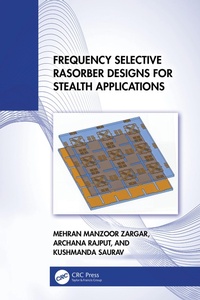
Frequency Selective Rasorber Designs for Stealth Applications
Published on 25. February 2026
264 pages
978-1-040-62265-0 (ISBN)
Description

This book offers a comprehensive guide to the principles, design methodologies, and practical implementations of Frequency Selective Rasorbers (FSRs) with a focus on radar cross-section (RCS) reduction for modern stealth technologies. It clears the fundamentals of FSRs and absorptive structures while bridging the gap between theory and real-world application. Through a structured and accessible approach, readers will gain a deep understanding of how to design, simulate, fabricate, and evaluate narrowband and broadband FSRs. The book also explores cutting-edge low-RCS antenna designs co-integrated with FSRs, serving as both a foundational text and a motivation for new research directions.
This book:
Contains in-depth discussion of the theoretical foundations and classifications of frequency selective rasorbers.
Offers a systematic organization of various FSR types across dedicated chapters for clarity and ease of understanding.
Presents step-by-step design procedures for both narrowband and broadband rasorber structures.
Explains practical insights into RCS reduction techniques, including co-designed low-RCS antenna systems.
Provides detailed coverage of fabrication and measurement processes for validating rasorber and stealth system performance.
It is primarily written for senior undergraduates, graduate students, and academic researchers in radio frequency (RF), microwave and antenna engineering.
This book:
Contains in-depth discussion of the theoretical foundations and classifications of frequency selective rasorbers.
Offers a systematic organization of various FSR types across dedicated chapters for clarity and ease of understanding.
Presents step-by-step design procedures for both narrowband and broadband rasorber structures.
Explains practical insights into RCS reduction techniques, including co-designed low-RCS antenna systems.
Provides detailed coverage of fabrication and measurement processes for validating rasorber and stealth system performance.
It is primarily written for senior undergraduates, graduate students, and academic researchers in radio frequency (RF), microwave and antenna engineering.
More details
Language
English
Place of publication
London
United Kingdom
Publishing group
Taylor & Francis Ltd
Target group
College/higher education
Professional and scholarly
Product notice
Reflowable
Illustrations
21 Tables, black and white; 115 Line drawings, black and white; 18 Halftones, black and white; 133 Illustrations, black and white
File size
14,70 MB
ISBN-13
978-1-040-62265-0 (9781040622650)
Copyright in bibliographic data and cover images is held by Nielsen Book Services Limited or by the publishers or by their respective licensors: all rights reserved.
Schweitzer Classification
Other editions
Additional editions
Mehran Manzoor Zargar | Archana Rajput | Kushmanda Saurav
Frequency Selective Rasorber Designs for Stealth Applications
Book
approx. 02/2026
1st Edition
CRC Press
€169.50
Not yet published
Persons
Mehran Manzoor Zargar received the B.Tech. degree in Electronics and Communication Engineering from the University of Kashmir, India, in 2014, the M.Tech. degree in Microelectronics from the National Institute of Technology Srinagar, India, in 2018, and the Ph.D. degree from the Department of Electrical Engineering, Indian Institute of Technology Jammu in 2023, where he is currently working as a Postdoctoral Research Associate, under the Core Research Grant Project funded by the Anusandhan National Research Foundation (ANRF), Government of India. He was an Early Postdoctoral Fellow with the Department of Electrical Engineering, IIT Jammu from February 2023 to March 2023. He has published several research papers in esteemed journals and conferences. He has served as reviewers for many reputed journals like IEEE TAP, IEEE AWPL, IEEE Access Wiley MOTL. His research interest includes FSS-based rasorbers and low RCS antenna systems. Dr. Zargar is IEEE member and has served as the Chair for IEEE AP-S Student Branch Chapter of IIT Jammu for 2022 and 2023.
Archana Rajput received the B.Tech. Degree in Electronics Engineering from Kamla Nehru Institute of Technology, Sultanpur, affiliated under Uttar Pradesh Technical University Lucknow, in 2009, the M. Tech degree in microwave electronics from Delhi University, South Campus in 2012 and the Ph.D. degree from the Department of Electrical Engineering from Indian Institute of Technology, Kanpur, India in 2018. She is currently an Assistant Professor with the Department of Electrical Engineering, Indian Institute of Technology Jammu, India. She has published several research papers in esteemed journals and conferences. One of her journal paper entitled Design of a two-dimensional metamaterial cloak with minimum scattering using a quadratic transformation function has been featured on the Cover Page of AIP Journal of Applied Physics. Her current research interests include transformation electromagnetics, cloaking/invisibility, Metamaterials, Antennas, and frequency selective surfaces.
Kushmanda Saurav received the B.E. degree in electronics and telecommunication from Bengal Engineering and Science University, Shibpur, India, in 2009, the M.Tech. degree in electronics and communication engineering from IIT Roorkee, India, in 2011, and the Ph.D. degree in electrical engineering from IIT Kanpur, India, in 2017. He worked as a Postdoctoral Fellow with the Royal Military College Canada. He is currently an Associate Professor with the Department of Electrical Engineering, IIT Jammu, India. His research interests include microwave and millimetre wave antennas and frequency selective surfaces. He has published more than 70 research papers in esteemed journals and conferences. He has served as reviewers in IEEE, IET and Wiley Journals. He is actively involved in the professional activities of the IEEE. He is currently the faculty advisor of IEEE MTTS and APS Student Branch Chapters of IIT Jammu. He has the experience of supervising M.Tech. and PhD students and undertaking sponsored projects.
Archana Rajput received the B.Tech. Degree in Electronics Engineering from Kamla Nehru Institute of Technology, Sultanpur, affiliated under Uttar Pradesh Technical University Lucknow, in 2009, the M. Tech degree in microwave electronics from Delhi University, South Campus in 2012 and the Ph.D. degree from the Department of Electrical Engineering from Indian Institute of Technology, Kanpur, India in 2018. She is currently an Assistant Professor with the Department of Electrical Engineering, Indian Institute of Technology Jammu, India. She has published several research papers in esteemed journals and conferences. One of her journal paper entitled Design of a two-dimensional metamaterial cloak with minimum scattering using a quadratic transformation function has been featured on the Cover Page of AIP Journal of Applied Physics. Her current research interests include transformation electromagnetics, cloaking/invisibility, Metamaterials, Antennas, and frequency selective surfaces.
Kushmanda Saurav received the B.E. degree in electronics and telecommunication from Bengal Engineering and Science University, Shibpur, India, in 2009, the M.Tech. degree in electronics and communication engineering from IIT Roorkee, India, in 2011, and the Ph.D. degree in electrical engineering from IIT Kanpur, India, in 2017. He worked as a Postdoctoral Fellow with the Royal Military College Canada. He is currently an Associate Professor with the Department of Electrical Engineering, IIT Jammu, India. His research interests include microwave and millimetre wave antennas and frequency selective surfaces. He has published more than 70 research papers in esteemed journals and conferences. He has served as reviewers in IEEE, IET and Wiley Journals. He is actively involved in the professional activities of the IEEE. He is currently the faculty advisor of IEEE MTTS and APS Student Branch Chapters of IIT Jammu. He has the experience of supervising M.Tech. and PhD students and undertaking sponsored projects.
Content
1. Introduction. 2. Single Layer Dual-Band Transmissive Rasorber. 3. Single-Layered Flexible Multi-Band Rasorbers. 4. A-T FSR Using Modified Double Cross Slot Bandpass Layer. 5. T-A-T FSR. 6. A-T-A FSR for Low RCS Radiating System. 7. Dual Transmission Miniaturized A-T-A-T FSR. 8. Low RCS Crossed Dipole Antenna Co-Designed with AFSR Structure.
