

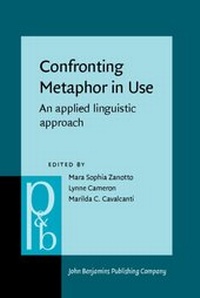
Confronting Metaphor in Use
An applied linguistic approach
1st Edition
Published on 27. March 2008
VII, 315 pages
978-90-272-9142-4 (ISBN)
Description

It is timely for researchers to approach metaphor as social and situated, as a matter of language and discourse, and not just as a matter of thought. Over the last twenty five years, scholars have come to appreciate in depth the cognitive, motivated and embodied nature of metaphor, but have tended to background the linguistic form of metaphor and have largely ignored how this connects to its role in the discourses in which our lives are constructed and lived. This book brings language and social dimensions into the picture, offering snapshots of metaphor use in real language and in real lives across the very different cultures of Europe and Brazil and contributing to the theorizing of metaphor in discourse.
More details
Other editions
Additional editions
Mara Sophia Zanotto | Lynne Cameron | Marilda C. Cavalcanti
Confronting Metaphor in Use
An applied linguistic approach
Book
03/2008
John Benjamins Publishing Co
€111.30
Shipment within 10-15 days
Persons
Content
- Confronting Metaphor in Use
- Editorial page
- Title page
- LCC data
- Table of contents
- Acknowledgements
- Confronting metaphor in use
- An applied linguistic approach
- Introduction
- What is an applied linguistic approach to metaphor
- Researching metaphor in an applied linguistic approach
- Investigating the nature of metaphor in use stability and variation
- Examining metaphor in corpora
- Understanding metaphor in language education
- Using metaphor as a tool in professional development
- Opening dialogue
- References
- Part I. Investigating the nature of metaphor in use
- Chapter 1. Opening Pandora's box
- Multiple readings of 'a metaphor'
- Metaphor indeterminacy
- Methodology
- Qualitative methodology and Group Think-Aloud technique
- Instrumental and collective case study
- The text
- The focal metaphor
- Data analysis
- First phase GA and GB groups
- Group GA
- Extract
- Extract
- Group GB
- Extract
- Transition to the second reading
- Extract
- Second reading a riddle to be solved
- Extract
- Extract
- Extract
- Third reading - death
- Extract
- Discussion of the readings of the first phase
- Second phase
- Group
- Extract
- Group G
- Extract
- Extract
- Discussion of the readings of the second phase
- General discussion
- Acknowledgments
- References
- Chapter 2. Metaphor shifting in the dynamics of talk
- Background
- Discourse contexts
- Vehicle re-deployment shifting in topics
- Extract 1
- Extract 2
- Extract 3
- Extract 4
- Extract 5
- Extract 6
- Extract 7
- Extract 8
- Vehicle development
- Extract 9: Volcanoes
- Extract 10
- Extract 11
- Extract 12
- Shifting into the real world: Vehicle literalization
- Extract 13
- Discussion and conclusions
- References
- Chapter 3. Adding sound to the picture
- Motivating the lexical composition of metaphorical idioms in English, Dutch and Spanish
- Part of the picture
- Adding the sound
- Anchor 3
- Conclusions
- Perspectives for further research
- Acknowledgements
- References
- Appendix some more examples of the investigated kinds of phonological motivation
- Prototypical alliteration repetition of word-initial consonants
- Non-prototypical alliteration
- Prototypical assonance rhyme
- Non-prototypical assonance
- Chapter 4. Metaphor and positioning in academicbook reviews
- Why study book reviews
- The present study
- Method
- Results
- Baseline data
- Recurrent metaphors
- Self-positioning in other contexts
- A member of the relevant research community
- Having expertise
- Positioning the reader and third parties
- Conclusion
- References
- Appendix The corpus of academic book reviews
- Social Science SSCI
- Science SCI
- SCI journal but social science book and social science reviewer
- Part II. Examining metaphor in corpora
- Chapter 5. Brothers in arms
- Contradictory metaphors in contemporary marketing discourse
- Theory
- Data and method
- Empirical findings
- Metaphors in secondary marketing discourse
- Metaphors in primary marketing discourse
- Conclusion
- References
- Chapter 6. Metaphor probabilities in corpora*
- Probabilities in linguistic theory
- Probabilities in metaphor studies
- Data and method
- Probabilities of metaphor Vehicles
- Word form probabilities
- Word class probabilities
- Summary and discussion
- Conclusion
- References
- Chapter 7. Corpus linguistic data and conceptualmetaphor theory
- Cognitive approaches and language
- Problems with the cognitive approach to linguistic evidence
- Using corpora to research metaphor
- Corpus methodology
- Linguistic evidence for argument is war
- The scope of the linguistic metaphors
- Extract of the concordance for strategy
- Fixed expressions in realizations of argument is war
- Extract of the concordance for fired
- Conclusion
- References
- Chapter 8. Exploring metaphors in corpora
- A study of 'war' in corpus generated data
- Analysing metaphors the linguists intuition vs real language use
- Towards an empirical analysis of the metaphoricity of war using a collocational database
- Concluding remarks
- References
- Part III. Understanding metaphor in language education
- Chapter 9. Young learners' understanding of figurative language*
- Lexico-grammatical features of give me a hand the hands of a watch and hand it to me
- Method
- Stimuli and design
- Procedure
- Results
- Case Give me a hand
- Case The hands of a watch
- Case Hand it to me
- Discussion
- Conclusions
- References
- Appendix
- Case The hands of a watch
- Case Hand it to me
- Chapter 10. The relationship between associative thinking, analogical reasoning, image formation and metaphoric extension strategies
- Figurative extensions of word meaning
- How might metaphoric extension processes be exploited for language learning purposes
- Processes involved in metaphor interpretation
- Associative fluency
- Analogical reasoning
- Image formation
- Factors likely to affect a students ability to use metaphoric extension strategies
- The presence of contextual clues
- Cognitive style
- The study
- The participants
- Method
- Scoring the items
- Example
- Example
- Example
- Example
- Example
- Results
- Are concrete imageable items more likely to provoke and be successfully interpreted through metaphoric extension strategies
- Does the presence of contextual clues affect a students inclination and ability to use context-based strategies as opposed to metaphoric extension strategies
- Does a persons cognitive style affect their inclination and ability to use metaphoric extension strategies
- Discussion
- References
- Appendix
- Appendix
- Appendix
- Appendix
- Part IV. Using metaphor as a tool in professional development
- Chapter 11. The awakening of Sleeping Beauty
- A teacher's metaphor of professional development and of language teaching1
- Identifying metaphors
- Hiking along the path Towards Language and Professional development
- Final remarks
- References
- Chapter 12. En route through metaphors
- Chatrooms as safe places to deal with difficulties1in an online course
- Theoretical framework
- Context and methodology
- The course participants
- The students profiles
- The teacher educators
- The technical assistants
- The study
- The online module a view of the students difficulties
- En route through the Chatroom Conversations
- Identifying voices which announce the construction of metaphors
- Chatroom Conversation CC-
- Blind person in the middle of a battle
- From a journey in an unknown road to the boat journey
- Mapping the boat journey metaphor
- The diploma course is a journey
- Entailments of the journey metaphor
- Chatroom Conversation CC-
- The boat and the cocoon
- Chatroom Conversation CC-
- Final Remarks
- Transcription Conventions
- References
- Chapter 13. School teachers in favela contexts
- Metaphors and metonymies they live by1
- Theoretical background
- Method and the context of the study
- Teachers metaphors and metonymies
- Community metaphors and metonymies
- School metaphors and metonymies
- Concluding remarks
- References
- Appendix Questionnaire
- The multipliers role
- Describing your context
- The community
- School
- School teachers in favela contexts
- Chapter 14. Professional knowledge landscape
- A metaphor to conceive of e-mail practices inbusiness settings
- Seeking to approach the landscapes
- Undertaking a reflective sightseeing through the landscapes
- Stepping outside the landscapes the tacit and the unknown
- A final glance at the landscapes
- Index of subject
- Index of name
- The Pragmatics & Beyond New Series
