

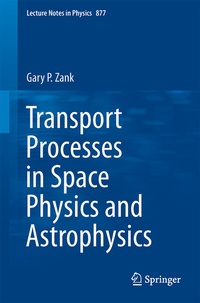
Transport Processes in Space Physics and Astrophysics
Published on 19. October 2013
XI, 286 pages
978-1-4614-8480-6 (ISBN)
Description

"Transport Processes in Space Physics and Astrophysics" is aimed at graduate level students to provide the necessary mathematical and physics background to understand the transport of gases, charged particle gases, energetic charged particles, turbulence, and radiation in an astrophysical and space physics context. Subjects emphasized in the work include collisional and collisionless processes in gases (neutral or plasma), analogous processes in turbulence fields and radiation fields, and allows for a simplified treatment of the statistical description of the system. A systematic study that addresses the common tools at a graduate level allows students to progress to a point where they can begin their research in a variety of fields within space physics and astrophysics. This book is for graduate students who expect to complete their research in an area of plasma space physics or plasma astrophysics. By providing a broad synthesis in several areas of transport theory and modeling, the work also benefits researchers in related fields by providing an overview that currently does not exist.
For numerous interesting and challenging space physics and astrophysics problems, there is a need to describe the "long-term" behavior of systems governed by macroscopic laws and microscopic randomness. A random event has an outcome that is uncertain and unpredictable, yet the collective behavior of a system can be governed by well defined mathematical and physical principles. Examples of physical problems include the behavior of gases in the presence of microscopic inter-particle collisions, the evolution of a gas of charged protons and electrons (a plasma), the collective propagation of solar energetic particles or cosmic rays in a magnetically turbulent medium, the collective behavior of dust in an accretion disk subject to coagulation and destruction, the evolution of low-frequency magnetic field turbulence in the inhomogeneous solar wind, or the transport of photosin a partially ionized interstellar medium. This book provides graduate students with a unified introduction to the physics of collective phenomena or transport processes for gases (charged and uncharged), fields, and photons in a space physics or astrophysics context.
For numerous interesting and challenging space physics and astrophysics problems, there is a need to describe the "long-term" behavior of systems governed by macroscopic laws and microscopic randomness. A random event has an outcome that is uncertain and unpredictable, yet the collective behavior of a system can be governed by well defined mathematical and physical principles. Examples of physical problems include the behavior of gases in the presence of microscopic inter-particle collisions, the evolution of a gas of charged protons and electrons (a plasma), the collective propagation of solar energetic particles or cosmic rays in a magnetically turbulent medium, the collective behavior of dust in an accretion disk subject to coagulation and destruction, the evolution of low-frequency magnetic field turbulence in the inhomogeneous solar wind, or the transport of photosin a partially ionized interstellar medium. This book provides graduate students with a unified introduction to the physics of collective phenomena or transport processes for gases (charged and uncharged), fields, and photons in a space physics or astrophysics context.
Reviews / Votes
"Undoubtedly provide a valuable theoretical resource for researchers in space physics and astrophysics, written by authors who are clearly deeply immersed in their subject material." (S. W. H. Cowley, The Observatory, Vol. 136 (1254), October, 2016)
More details
Series
Language
English
Place of publication
New York
United States
Publishing group
Springer US
Target group
Primary & secondary/elementary & high school
Product notice
Reflowable
Illustrations
XI, 286 p. 21 illus., 1 illus. in color.
File size
2,76 MB
ISBN-13
978-1-4614-8480-6 (9781461484806)
DOI
10.1007/978-1-4614-8480-6
Schweitzer Classification
Other editions
Additional editions
Book
10/2013
Springer
€53.49
Shipment within 15-20 days
Person
Dr. Gary P. Zank began his current position as Pei-Ling Chan Chair Scholar in Physics and Director of the Center for Space Plasma and Aerononmic Research (CSPAR) at University of Alabama at Huntsville in 2008. In 2010 he also became the Chair of the Physics Department in the College of Science.
Dr. Zank is one of the leading theorists working on the IBEX satellites, which earlier in 2010 started to return data on the shape and size of the Sun's "bubble" in the interstellar medium. Other notable funded research since his move to UAHuntsville include NASA's "Particle Acceleration for Solar Energetic Particle and Energetic Particle Storm Events" (2008), GSFC/EPSCoR's "The Dynamical Inner Heliosheath and the Space Radiation Environment" (2009), and most recently SAO's "Solar Wind Electrons Alphas and Protons (SWEAP) Investigations for Solar Probe" (2010).
Dr. Zank is well-known in the world of space physics for his extensive list of peer-reviewed publications and numerous books. He has published in excess of 350 papers. He is also distinguished in his field because of his wide-ranging honors and awards achieved throughout his career. Notable mentions are the Max-Planck-Post-Doctoral-Fellowship (1987-1989); Quest for Excellence Award, SciQuest (2009); NASA Group Achievement Award, NASA (2011). Dr. Zank is a Fellow of the American Association for the Advancement of Science; The American Physical Society; and of the American Geophysical Union (AGU). He is the Pei-Ling Chan Chair of Physics and Eminent Scholar at the University of Alabama, Huntsville, Solar Terrestrial Distinguished Lecturer at the Asia Oceania Geosciences Society, and Chancellor's Professor of Physics and Astronomy at University of California, Riverside.
Dr. Zank obtained his BSc (Hons), and Ph.D. both from the University Natal, South Africa.
Dr. Zank is one of the leading theorists working on the IBEX satellites, which earlier in 2010 started to return data on the shape and size of the Sun's "bubble" in the interstellar medium. Other notable funded research since his move to UAHuntsville include NASA's "Particle Acceleration for Solar Energetic Particle and Energetic Particle Storm Events" (2008), GSFC/EPSCoR's "The Dynamical Inner Heliosheath and the Space Radiation Environment" (2009), and most recently SAO's "Solar Wind Electrons Alphas and Protons (SWEAP) Investigations for Solar Probe" (2010).
Dr. Zank is well-known in the world of space physics for his extensive list of peer-reviewed publications and numerous books. He has published in excess of 350 papers. He is also distinguished in his field because of his wide-ranging honors and awards achieved throughout his career. Notable mentions are the Max-Planck-Post-Doctoral-Fellowship (1987-1989); Quest for Excellence Award, SciQuest (2009); NASA Group Achievement Award, NASA (2011). Dr. Zank is a Fellow of the American Association for the Advancement of Science; The American Physical Society; and of the American Geophysical Union (AGU). He is the Pei-Ling Chan Chair of Physics and Eminent Scholar at the University of Alabama, Huntsville, Solar Terrestrial Distinguished Lecturer at the Asia Oceania Geosciences Society, and Chancellor's Professor of Physics and Astronomy at University of California, Riverside.
Dr. Zank obtained his BSc (Hons), and Ph.D. both from the University Natal, South Africa.
Content
Statistical Background.- The Boltzmann transport equation.- Charged particle transport in a collisional magnetized plasma.- Charged particle transport in a collisionless magnetized plasma.- The transport of low frequency turbulence.- Radiative transport.
