

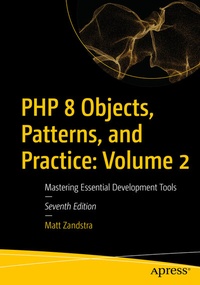
PHP 8 Objects, Patterns, and Practice: Volume 2
Description

Continue to develop elegant and rock-solid systems using PHP. With a focus on mastering essential development tools and applying best practices, Volume 2 of this 7th edition has been fully updated for PHP 8.3 and the most recent stable iterations of all tools and processes. It includes entirely new chapters covering Docker, Ansible, refactoring tools, and PHP on the command line. The volume also reintroduces a chapter on inline documentation and extends its coverage of continuous integration to include GitHub Actions.
This book builds on the solid grounding provided by Volume 1 to cover the tools and practices needed to develop, test, and deploy robust code. You'll see how to manage multiple developers and releases with git, create development environments, and deploy Composer to leverage thousands of tools and libraries and manage dependencies. You'll also explore strategies for automated testing and continuous integration and learn essential techniques for deploying your code using Git and Ansible.
After reading and using this book, you will have mastered a toolset that can support the entire lifecycle of a PHP project, from the creation of a flexible development environment, through collaboration, the use of standards-based best practice and documentation, to testing and deployment across multiple production servers.
You Will Learn To:
- Master the tools and strategies for testing new code, and techniques for testing legacy projects
- Create inline documentation for use by team members, users, and tools such as IDEs
- Work with Selenium to test web interfaces
- Manage your code and collaborate with your team using Git
- Leverage continuous integration to build rock solid systems
- Deploy your system and securely manage your project's configuration with Ansible
Who This Book Is For
Anyone with at least a basic knowledge of PHP who wants to learn about the practices and tools) that can make projects safe, elegant and stable.
More details
Other editions
Additional editions
Person
Matt Zandstra has worked as a web programmer, consultant, and writer for over two decades. He is the author of SAMS Teach Yourself PHP in 24 Hours (three editions) and is a contributor to DHTML Unleashed . He has written articles for Linux Magazine, Zend , IBM DeveloperWorks , and php|architect Magazine , among others.
Matt was a senior developer/tech lead at Yahoo and API tech lead at LoveCrafts. He now runs an agency which advises companies on their architectures and system management, and also develops systems primarily with PHP, Python and Java. Matt also writes fiction.
Content
Chapter 1. Good (and Bad) Practice.- Chapter 2. Inline Documentation.- Chapter 3. PHP Standards.- Chapter 4. Refactoring and Standards Tools.- Chapter 5. Using and Creating Components with Composer.- Chapter 6. Version Control with Git.- Chapter 7. Testing.- Chapter 8. Vagrant.- Chapter 9. Docker.- Chapter 10. Ansible.- Chapter 11. PHP on the Command Line.- Chapter 12. Continuous Integration.- Chapter 13. PHP Practice.- Appendix A: A Simple Parser.
