

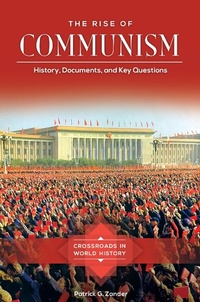
The Rise of Communism
History, Documents, and Key Questions
1st Edition
Published on 16. February 2018
256 pages
978-1-4408-4706-6 (ISBN)
Description

This book investigates the Communist political phenomenon, including the origins and development of Communism as well as the revolutions that led to the rise of the major Communist states around the world.
Written for high school students, undergraduates, and general readers, this book surveys the global rise of Communism. It begins with a timeline and narrative overview, which are followed by reference entries, primary source documents, and original argumentative essays on enduring issues related to Communism.
The book first covers the earliest phases of the "Utopian Socialist" movement and the beginnings of Marxist theory. It then discusses the Russian Revolution of 1917; the creation of the Soviet Union; the regime of terror instituted by Stalin; the expansion of Communism during the years of the Cold War, particularly in Asia; and the Cuban Revolution and the regime of Fidel Castro. It also discusses the progression toward revolution among the European Satellite countries as it included the Hungarian Revolution of 1956, the Czech revolution of 1968, and the multiple revolutions from 1989-1991 that saw the collapse of the Soviet system and the Cold War.
Written for high school students, undergraduates, and general readers, this book surveys the global rise of Communism. It begins with a timeline and narrative overview, which are followed by reference entries, primary source documents, and original argumentative essays on enduring issues related to Communism.
The book first covers the earliest phases of the "Utopian Socialist" movement and the beginnings of Marxist theory. It then discusses the Russian Revolution of 1917; the creation of the Soviet Union; the regime of terror instituted by Stalin; the expansion of Communism during the years of the Cold War, particularly in Asia; and the Cuban Revolution and the regime of Fidel Castro. It also discusses the progression toward revolution among the European Satellite countries as it included the Hungarian Revolution of 1956, the Czech revolution of 1968, and the multiple revolutions from 1989-1991 that saw the collapse of the Soviet system and the Cold War.
More details
Series
Language
English
Place of publication
United States
Publishing group
Bloomsbury Publishing Plc
Target group
Interest Age: From 7 to 17 years
File size
1,58 MB
ISBN-13
978-1-4408-4706-6 (9781440847066)
Copyright in bibliographic data and cover images is held by Nielsen Book Services Limited or by the publishers or by their respective licensors: all rights reserved.
Schweitzer Classification
Other editions
Additional editions
Book
02/2018
ABC-CLIO
€72.80
Shipment within 10-20 days
Content
Alphabetical List of Entries
Topical List of Entries
How to Use This Book
Preface
Timeline
Historical Overview
The Rise of Communism: A to Z
Primary Documents
Karl Marx and Friedrich Engels, The Communist Manifesto (February 1848)
Vladimir Lenin, Imperialism, the Highest Stage of Capitalism (1917)
Vladimir Lenin, The "April Theses" (April 1917)
The Call for a Popular Front against Fascism: "Resolution of the Seventh World Congress of the Communist International" (August 1935)
Joseph Stalin's Response to Churchill's Iron Curtain Speech (March 14, 1946)
Mao Zedong Calls for a People's Democratic Dictatorship (June 1949)
Kim Il-Sung, Address to the Korean People on the Occasion of the Liberation of Pyong Yang (December 1950)
Manifesto of the South Vietnam National Liberation Front (1961)
Communication from Nikita Khrushchev to President John F. Kennedy during the Cuban Missile Crisis (October 28, 1962)
The Central Committee of the Chinese Communist Party, "The Sixteen Points of the Cultural Revolution" (August 8, 1966)
Key Questions
Question 1: Was Communism an Inherently Flawed Theoretical Conception That Would Inevitably Lead to Repressive, Totalitarian States, or Was It a Promising Theory Twisted by Particular Individuals and Institutions Making Communist Regimes Particularly Repressive and Violent?
Question 2: Did Communism Provide a Particularly Strong System for the Rapid Advancement of Science and Technology, or Was Such Development Impeded by the Communist System and Inevitably Doomed to Lag Behind the Democratic/Capitalist States?
Question 3: Were Cold War Fears about the Communists' Intentions and Means for the Continual Spread of Communism and Eventual World Domination Justified on the Part of the Western Democracies?
Selected Annotated Bibliography
Index
About the Author and Contributors
Topical List of Entries
How to Use This Book
Preface
Timeline
Historical Overview
The Rise of Communism: A to Z
Primary Documents
Karl Marx and Friedrich Engels, The Communist Manifesto (February 1848)
Vladimir Lenin, Imperialism, the Highest Stage of Capitalism (1917)
Vladimir Lenin, The "April Theses" (April 1917)
The Call for a Popular Front against Fascism: "Resolution of the Seventh World Congress of the Communist International" (August 1935)
Joseph Stalin's Response to Churchill's Iron Curtain Speech (March 14, 1946)
Mao Zedong Calls for a People's Democratic Dictatorship (June 1949)
Kim Il-Sung, Address to the Korean People on the Occasion of the Liberation of Pyong Yang (December 1950)
Manifesto of the South Vietnam National Liberation Front (1961)
Communication from Nikita Khrushchev to President John F. Kennedy during the Cuban Missile Crisis (October 28, 1962)
The Central Committee of the Chinese Communist Party, "The Sixteen Points of the Cultural Revolution" (August 8, 1966)
Key Questions
Question 1: Was Communism an Inherently Flawed Theoretical Conception That Would Inevitably Lead to Repressive, Totalitarian States, or Was It a Promising Theory Twisted by Particular Individuals and Institutions Making Communist Regimes Particularly Repressive and Violent?
Question 2: Did Communism Provide a Particularly Strong System for the Rapid Advancement of Science and Technology, or Was Such Development Impeded by the Communist System and Inevitably Doomed to Lag Behind the Democratic/Capitalist States?
Question 3: Were Cold War Fears about the Communists' Intentions and Means for the Continual Spread of Communism and Eventual World Domination Justified on the Part of the Western Democracies?
Selected Annotated Bibliography
Index
About the Author and Contributors
