

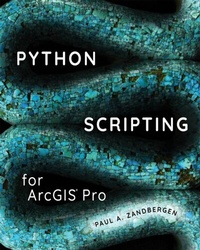
Python Scripting for ArcGIS Pro
Description

The definitive, easy-to-follow guide to writing Python code with spatial data in ArcGIS Pro, whether you're new to programming or not.
Python Scripting for ArcGIS Pro starts with the fundamentals of Python programming and then dives into how to write useful Python scripts that work with spatial data in ArcGIS Pro. Learn how to execute geoprocessing tools, describe, create and update data, as well as execute a number of specialized tasks. See how to write simple, custom scripts that will automate your ArcGIS Pro workflows.
Some of the key topics you will learn include:
- Python fundamentals
- Setting up a Python editor
- Automating geoprocessing tasks using ArcPy
- Exploring and manipulating spatial and tabular data
- Working with geometries using cursors
- Working with rasters and map algebra
- Map scripting
- Debugging and error handling
Helpful "points to remember," key terms, and review questions are included at the end of each chapter to reinforce your understanding of Python. Corresponding data and exercises are available online.
Whether you want to learn Python or already have some experience, Python Scripting for ArcGIS Pro is the comprehensive, hands-on book for learning the versatility of Python coding as an approach to solving problems and increasing your productivity in ArcGIS Pro. Follow the step-by-step instruction and common workflow guidance for automating tasks and scripting with Python.
Don't forget to also check out Esri Press's other Python title:
Advanced Python Scripting for ArcGIS Pro (9781589486188)
All prices
More details
Other editions
Additional editions
Person
Dr. Paul A. Zandbergen is a professor in the GIS program at Vancouver Island University. His teaching includes courses in introductory GIS, spatial analysis and modeling, spatial statistics, and GIS programming. His research focuses on the robustness of spatial analytical techniques in the areas of crime analysis, environmental science, public health, spatial ecology, and water resources. His research has been funded by the National Science Foundation, the National Institute of Justice, and the National Institutes of Health. He has published over 50 journal articles and book chapters. He is the author of Python Scripting for ArcGIS, published in 2013 with Esri Press. He lives with his family in Vancouver, British Columbia, Canada.
Content
Preface
Acknowledgments
Chapter 1. Introducing Python
Chapter 2. Working with Python editors
Chapter 3. Geoprocessing in ArcGIS Pro
Chapter 4. Learning Python language fundamentals
Chapter 5. Geoprocessing using Python
Chapter 6. Exploring spatial data
Chapter 7. Debugging and error handling
Chapter 8. Manipulating spatial and tabular data
Chapter 9. Working with geometries
Chapter 10. Working with rasters
Chapter 11. Map scripting
Index
