

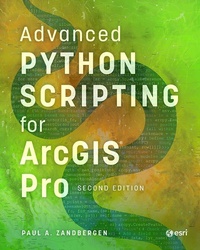
Advanced Python Scripting for ArcGIS Pro
Description

Tackle complex spatial data tasks effortlessly with this easy-to-follow guide to writing specialized Python scripts and developing tools for spatial datäin ArcGIS® Pro.
Intended for users who have a good foundation in Python, this book explores how to develop scripts into tools and notebooks to share with others, use third-party packages, and learn other more specialized tasks. By the end of this book, you'll be confident in writing more advanced scripts, developing them into tools and notebooks, and sharing them with others.
Helpful points to remember, key terms, and review questions are included at the end of each chapter to reinforce your understanding of Python. Companion data and tutorials are available online.¿ Advanced Python Scripting for ArcGIS Pro¿follows on the topics explained in¿Python Scripting for ArcGIS Pro¿(Esri Press, 2024) and is now updated for ArcGIS Pro 3.2.
Packed with advanced techniques and practical examples, Advanced Python Scripting for ArcGIS Pro¿is perfect for more experienced ArcGIS Pro users who are looking to upgrade their Python skills and enhance their workflows.
Dr. Paul A. Zandbergen is a professor in the GIS program at Vancouver Island University. His research focuses on the robustness of spatial analytical techniques in crime analysis, environmental science, public health, spatial ecology, and water resources. His research has been funded by the National Science Foundation, the National Institute of Justice, and the National Institutes of Health. In addition to this book and Python Scripting for ArcGIS, he has published over 50 journal articles and book chapters. He lives with his family in Vancouver, British Columbia, Canada.
More details
Other editions
Additional editions
Person
Dr. Paul A. Zandbergen is a professor in the GIS program at Vancouver Island University. His teaching includes courses in introductory GIS, spatial analysis and modeling, spatial statistics, and GIS programming. His work focuses on the robustness of spatial analytical techniques in the areas of crime analysis, environmental science, public health, spatial ecology, and water resources. Dr. Zandbergen's research has been funded by the National Science Foundation, the National Institute of Justice, and the National Institutes of Health. He has published over 50 journal articles and book chapters, and is the author of Python Scripting for ArcGIS Pro and Advanced Python Scripting for ArcGIS Pro. Dr. Zandbergen lives with his family in Vancouver, British Columbia, Canada.
Content
Preface
Acknowledgments
Chapter 1. Introducing advanced Python scripting
Chapter 2. Creating Python functions and classes
Chapter 3. Creating Python script tools
Chapter 4. Python toolboxes
Chapter 5. Sharing tools
Chapter 6. Managing Python packages and environments
Chapter 7. Essential Python modules and packages for geoprocessing
Chapter 8. Migrating scripts from Python 2 to 3
Chapter 9. ArcGIS API for Python
Index
