

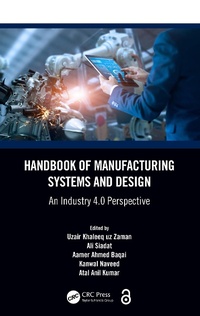
Handbook of Manufacturing Systems and Design
An Industry 4.0 Perspective
1st Edition
Published on 24. August 2023
344 pages
978-1-000-95986-4 (ISBN)
Description

This book provides a comprehensive overview of manufacturing systems, their role in product/process design, and their interconnection with an Industry 4.0 perspective, especially related to design, manufacturing, and operations.
Handbook of Manufacturing Systems and Design: An Industry 4.0 Perspective provides the knowledge related to the theories and concepts of Industry 4.0. It focuses on the different types of manufacturing systems in Industry 4.0 along with associated design, and control strategies. It concentrates on the operations in Industry 4.0 with a particular focus on supply chain, logistics, risk management, and reverse engineering perspectives. Offering basic concepts and applications through to advanced topics, the handbook feeds into the goal of being a source of knowledge as well as a vehicle to explore the future possibilities of design, techniques, methods, and operations associated with Industry 4.0. Concepts with practical applications in the form of case studies are added to each chapter to round out the many attributes this handbook offers.
This handbook targets students, engineers, managers, designers, and manufacturers, and will assist in their understanding of the core concepts of manufacturing systems in connection with Industry 4.0 and optimize alignment between supply and demand in real time for effective implementation of the design concepts.
Handbook of Manufacturing Systems and Design: An Industry 4.0 Perspective provides the knowledge related to the theories and concepts of Industry 4.0. It focuses on the different types of manufacturing systems in Industry 4.0 along with associated design, and control strategies. It concentrates on the operations in Industry 4.0 with a particular focus on supply chain, logistics, risk management, and reverse engineering perspectives. Offering basic concepts and applications through to advanced topics, the handbook feeds into the goal of being a source of knowledge as well as a vehicle to explore the future possibilities of design, techniques, methods, and operations associated with Industry 4.0. Concepts with practical applications in the form of case studies are added to each chapter to round out the many attributes this handbook offers.
This handbook targets students, engineers, managers, designers, and manufacturers, and will assist in their understanding of the core concepts of manufacturing systems in connection with Industry 4.0 and optimize alignment between supply and demand in real time for effective implementation of the design concepts.
More details
Edition
1. Auflage
Language
English
Place of publication
London
United Kingdom
Publishing group
Taylor & Francis Ltd
Target group
College/higher education
Professional and scholarly
Illustrations
28 Tables, black and white; 102 Line drawings, black and white; 55 Halftones, black and white; 157 Illustrations, black and white
ISBN-13
978-1-000-95986-4 (9781000959864)
Copyright in bibliographic data and cover images is held by Nielsen Book Services Limited or by the publishers or by their respective licensors: all rights reserved.
Schweitzer Classification
Other editions
Additional editions
Uzair Khaleeq uz Zaman | Ali Siadat | Aamer Ahmed Baqai
Handbook of Manufacturing Systems and Design
An Industry 4.0 Perspective
Book
12/2024
1st Edition
CRC Press
€94.40
Shipment within 10-20 days
Uzair Khaleeq uz Zaman | Ali Siadat | Aamer Ahmed Baqai
Handbook of Manufacturing Systems and Design
An Industry 4.0 Perspective
Book
08/2023
1st Edition
CRC Press
€247.60
Shipment within 10-20 days
Persons
Uzair Khaleeq uz Zaman is an Assistant Professor at the College of Electrical and Mechanical Engineering, National University of Sciences and Technology, Pakistan. Dr. Zaman obtained his Ph.D. in Industrial Engineering from Arts et Metiers ParisTech, France, and carries a blend of experience in academia and industry. In industry, he has 8 years worth of experience in SAP Data Planning and Coordination, product development, and project management. As part of his academic career, Dr. Zaman has taught multiple courses and is involved in postgraduate research at Beihang University (China), Georgia Tech (France), ParisTech (France), and the University of Lorraine (France). His research interests lie in integrated product process design, additive manufacturing, design of experiments, decision making, product life cycle assessment, robotic systems, and navigation systems.
Ali Siadat is a Professor and Director of Design, Manufacturing and Control Laboratory at Arts et Metiers ParisTech, France. With over 30 years of experience, Prof. Siadat has supervised 25 Ph.D. students and more than 60 Master thesis. He is a research scholar of international repute, and his research interests lie in integrated design, process and manufacturing, intelligent computation for smart industrial systems, human factors, risk analysis, knowledge and information system for quality, and process control.
Aamer Ahmed Baqai is a Professor and Dean at the College of Electrical and Mechanical Engineering, National University of Sciences and Technology, Pakistan. He obtained his Ph.D. & Master's degree in Mechanical Engineering from Arts et Metiers ParisTech, France. With over 26 years of professional experience, he has a vast knowledge of academia and industry. Dr. Baqai is a researcher of international repute and is a research visiting Professor at ParisTech, France. He has also acted as a foreign evaluator for Ph.D. thesis students at ParisTech. His research interests include advanced manufacturing, manufacturing system design and optimization, reconfigurable manufacturing systems, process modeling and optimization, additive manufacturing, and decision-making.
Kanwal Naveed is an Electrical Engineer who did her master's degree in Control Systems from the National University of Sciences and Technology in 2014. She is also undergoing her Ph.D. from NUST in Robotics and Artificial Intelligence. Currently, Ms. Naveed is serving as an Assistant Professor at the Department of Mechatronics Engineering where she is also designated as Head of the undergraduate program. Her research interests include control of service and field robotics, machine learning, artificial intelligence, and non-linear control systems.
Atal Anil Kumar is currently working as a Postdoctoral researcher at the University of Luxembourg. His research interests include Nonlinear Control, Collaborative robots, Robot Kinematics and Dynamics, and Human-robot interaction. He has a bachelor's degree in Mechatronics and an Erasmus master's in advanced Robotics (with scholarship) from France and Italy. He has been awarded a research internship grant by the Indian Institute of Technology, Bombay for performing research during his bachelor's degree. Dr. Atal has also worked as a R&D Engineer in the automotive and steel manufacturing industries to gain significant hands-on experience to apply his theoretical knowledge.
Ali Siadat is a Professor and Director of Design, Manufacturing and Control Laboratory at Arts et Metiers ParisTech, France. With over 30 years of experience, Prof. Siadat has supervised 25 Ph.D. students and more than 60 Master thesis. He is a research scholar of international repute, and his research interests lie in integrated design, process and manufacturing, intelligent computation for smart industrial systems, human factors, risk analysis, knowledge and information system for quality, and process control.
Aamer Ahmed Baqai is a Professor and Dean at the College of Electrical and Mechanical Engineering, National University of Sciences and Technology, Pakistan. He obtained his Ph.D. & Master's degree in Mechanical Engineering from Arts et Metiers ParisTech, France. With over 26 years of professional experience, he has a vast knowledge of academia and industry. Dr. Baqai is a researcher of international repute and is a research visiting Professor at ParisTech, France. He has also acted as a foreign evaluator for Ph.D. thesis students at ParisTech. His research interests include advanced manufacturing, manufacturing system design and optimization, reconfigurable manufacturing systems, process modeling and optimization, additive manufacturing, and decision-making.
Kanwal Naveed is an Electrical Engineer who did her master's degree in Control Systems from the National University of Sciences and Technology in 2014. She is also undergoing her Ph.D. from NUST in Robotics and Artificial Intelligence. Currently, Ms. Naveed is serving as an Assistant Professor at the Department of Mechatronics Engineering where she is also designated as Head of the undergraduate program. Her research interests include control of service and field robotics, machine learning, artificial intelligence, and non-linear control systems.
Atal Anil Kumar is currently working as a Postdoctoral researcher at the University of Luxembourg. His research interests include Nonlinear Control, Collaborative robots, Robot Kinematics and Dynamics, and Human-robot interaction. He has a bachelor's degree in Mechatronics and an Erasmus master's in advanced Robotics (with scholarship) from France and Italy. He has been awarded a research internship grant by the Indian Institute of Technology, Bombay for performing research during his bachelor's degree. Dr. Atal has also worked as a R&D Engineer in the automotive and steel manufacturing industries to gain significant hands-on experience to apply his theoretical knowledge.
Content
Part I Theory and Concepts in Manufacturing Systems
Chapter 1 Introduction to Industry 4.0 and Smart Manufacturing
Uzair Khaleeq uz Zaman, Ali Siadat, Aamer Ahmed Baqai, Kanwal Naveed, and Atal Anil Kumar
Chapter 2 Computer-Aided Design, Computer-Aided Process Planning, and Computer-Aided Manufacturing
Anas Bin Aqeel, Uzair Khaleeq uz Zaman, Shahid Aziz, and Aamer Ahmed Baqai
Chapter 3 Quality 4.0
Uzair Khaleeq uz Zaman
Part II Manufacturing Systems in Industry 4.0
Chapter 4 Digital Twins in Smart Manufacturing
Shahid Aziz, Dong Won Jung, Uzair Khaleeq uz Zaman, and Anas Bin Aqeel
Chapter 5 Robotic Systems
Kanwal Naveed and Uzair Khaleeq uz Zaman
Chapter 6 Collaborative Robots
Atal Anil Kumar, Uzair Khaleeq uz Zaman, and Peter Plapper
Chapter 7 Control Strategies: A Pathway to Adaptive and Learning Techniques
Kanwal Naveed and Atal Anil Kumar
Chapter 8 Mixed Reality for Industry 4.0 in Manufacturing Systems
Sri Kolla, Atal Anil Kumar, and Peter Plapper
Chapter 9 Inferential Modeling and Soft Sensors
Muhammad Asad Ullah Khalid, Shahid Aziz, and Uzair Khaleeq uz Zaman
Chapter 10 Energy Harvesting and Industry 4.0
Rashid Naseer
Chapter 11 Internet of Things for Manufacturing Industry
Atal Anil Kumar, Usman Qamar, Kanwal Naveed, and Uzair Khaleeq uz Zaman
Chapter 12 Product Life Cycle Management and Cloud Manufacturing
Afshan Naseem, Yasir Ahmad, and Uzair Khaleeq uz Zaman
Part III Operations in Industry 4.0
Chapter 13 Material Supply and Logistics 4.0
Taiba Zahid, Mathias Kuehn, and Thorsten Schmidt
Chapter 14 Workforce Engagement Within Decentrally Controlled Production Systems
Julia Schwemmer and Thorsten Schmidt
Chapter 15 Managing Risks in Product Development and Manufacturing Processes
Jelena Petronijevic, Stephane Hubac, Marc Lassagne, and Alain Etienne
Chapter 16 Reverse Engineering: Past, Present, and Future Prospects
Anas Bin Aqeel, Muhammad Irfan Aziz, Uzair Khaleeq uz Zaman, and Nayyer Aafaq
Chapter 17 Conclusion
Index
Chapter 1 Introduction to Industry 4.0 and Smart Manufacturing
Uzair Khaleeq uz Zaman, Ali Siadat, Aamer Ahmed Baqai, Kanwal Naveed, and Atal Anil Kumar
Chapter 2 Computer-Aided Design, Computer-Aided Process Planning, and Computer-Aided Manufacturing
Anas Bin Aqeel, Uzair Khaleeq uz Zaman, Shahid Aziz, and Aamer Ahmed Baqai
Chapter 3 Quality 4.0
Uzair Khaleeq uz Zaman
Part II Manufacturing Systems in Industry 4.0
Chapter 4 Digital Twins in Smart Manufacturing
Shahid Aziz, Dong Won Jung, Uzair Khaleeq uz Zaman, and Anas Bin Aqeel
Chapter 5 Robotic Systems
Kanwal Naveed and Uzair Khaleeq uz Zaman
Chapter 6 Collaborative Robots
Atal Anil Kumar, Uzair Khaleeq uz Zaman, and Peter Plapper
Chapter 7 Control Strategies: A Pathway to Adaptive and Learning Techniques
Kanwal Naveed and Atal Anil Kumar
Chapter 8 Mixed Reality for Industry 4.0 in Manufacturing Systems
Sri Kolla, Atal Anil Kumar, and Peter Plapper
Chapter 9 Inferential Modeling and Soft Sensors
Muhammad Asad Ullah Khalid, Shahid Aziz, and Uzair Khaleeq uz Zaman
Chapter 10 Energy Harvesting and Industry 4.0
Rashid Naseer
Chapter 11 Internet of Things for Manufacturing Industry
Atal Anil Kumar, Usman Qamar, Kanwal Naveed, and Uzair Khaleeq uz Zaman
Chapter 12 Product Life Cycle Management and Cloud Manufacturing
Afshan Naseem, Yasir Ahmad, and Uzair Khaleeq uz Zaman
Part III Operations in Industry 4.0
Chapter 13 Material Supply and Logistics 4.0
Taiba Zahid, Mathias Kuehn, and Thorsten Schmidt
Chapter 14 Workforce Engagement Within Decentrally Controlled Production Systems
Julia Schwemmer and Thorsten Schmidt
Chapter 15 Managing Risks in Product Development and Manufacturing Processes
Jelena Petronijevic, Stephane Hubac, Marc Lassagne, and Alain Etienne
Chapter 16 Reverse Engineering: Past, Present, and Future Prospects
Anas Bin Aqeel, Muhammad Irfan Aziz, Uzair Khaleeq uz Zaman, and Nayyer Aafaq
Chapter 17 Conclusion
Index
