

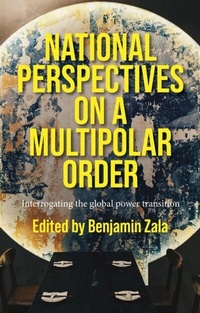
National Perspectives on a Multipolar Order
Interrogating the Global Power Transition
1st Edition
Published on 26. October 2021
232 pages
978-1-5261-5936-6 (ISBN)
Description

The global distribution of power is changing. But how should we make sense of this moment of transition?
With the rise of new powers and the decline of seemingly unchallenged US dominance in world politics, a conventional wisdom is gaining ground that a new multipolar order is taking shape. Yet multipolarity - an order with multiple centres of power - is variously used as a description of the current distribution of power, of the likely shape of a future global order, or even as a prescription for how power 'should' be distributed in the international system.
To understand the power of the different - and sometimes competing - narratives on offer today about the changing global order, a global perspective is necessary. This book explores how the concept of a multipolar order is being used for different purposes in different national contexts. From rising powers to established powers, contemporary debates are analysed by a set of leading scholars to provide in-depth insight into the use and abuse of a widely employed but rarely explored concept. -- .
With the rise of new powers and the decline of seemingly unchallenged US dominance in world politics, a conventional wisdom is gaining ground that a new multipolar order is taking shape. Yet multipolarity - an order with multiple centres of power - is variously used as a description of the current distribution of power, of the likely shape of a future global order, or even as a prescription for how power 'should' be distributed in the international system.
To understand the power of the different - and sometimes competing - narratives on offer today about the changing global order, a global perspective is necessary. This book explores how the concept of a multipolar order is being used for different purposes in different national contexts. From rising powers to established powers, contemporary debates are analysed by a set of leading scholars to provide in-depth insight into the use and abuse of a widely employed but rarely explored concept. -- .
All prices
More details
Language
English
Place of publication
United Kingdom
Target group
College/higher education
Professional and scholarly
Illustrations
5 black & white figures
ISBN-13
978-1-5261-5936-6 (9781526159366)
Copyright in bibliographic data and cover images is held by Nielsen Book Services Limited or by the publishers or by their respective licensors: all rights reserved.
Schweitzer Classification
Other editions
Additional editions
Book
10/2021
Manchester University Press
€125.20
Shipment within 15-20 days
Person
Benjamin Zala is Research Fellow in the Department of International Relations, Coral Bell School of Asia Pacific Affairs, Australian National University -- .
Content
Introduction
1 The utility and limits of polarity analysis - Benjamin Zala
Part I: Rising and re-emerging powers
2 'Mirror, mirror on the wall': China and the concept of multipolarity in the post-Cold War era - Nicholas Khoo and Zhang Qingmin
3 India: Seeking multipolarity, favouring multilateralism, pursuing multialignment - Ian Hall
4 Brazil: Pursuing a multipolar mirage? - Luis L. Schenoni
5 Multipolarity in Russia: A philosophical and practical understanding - Elena Chebankova
Part II: The unipole and its allies
6 Does the United States face a multipolar future? Washington's response through the lens of technology - James S. Johnson
7 Japan and the dangers of multipolarisation - H.D.P. Envall
8 The uses and abuses of the polarity discourse in UK foreign and defence politics - David Blagden
Conclusion
9 Debating the distribution of power and status in the early twenty-first century - Benjamin Zala
Index -- .
1 The utility and limits of polarity analysis - Benjamin Zala
Part I: Rising and re-emerging powers
2 'Mirror, mirror on the wall': China and the concept of multipolarity in the post-Cold War era - Nicholas Khoo and Zhang Qingmin
3 India: Seeking multipolarity, favouring multilateralism, pursuing multialignment - Ian Hall
4 Brazil: Pursuing a multipolar mirage? - Luis L. Schenoni
5 Multipolarity in Russia: A philosophical and practical understanding - Elena Chebankova
Part II: The unipole and its allies
6 Does the United States face a multipolar future? Washington's response through the lens of technology - James S. Johnson
7 Japan and the dangers of multipolarisation - H.D.P. Envall
8 The uses and abuses of the polarity discourse in UK foreign and defence politics - David Blagden
Conclusion
9 Debating the distribution of power and status in the early twenty-first century - Benjamin Zala
Index -- .
