

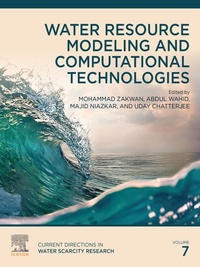
Water Resource Modeling and Computational Technologies
Published on 22. October 2022
720 pages
978-0-323-98517-8 (ISBN)
Description

Water Resource Modeling and Computational Technologies, Seventh Edition provides the reader with a comprehensive overview of the applications that computational techniques have in various sectors of water resource engineering. The book explores applications of recent modeling and computational techniques in various sectors of water resource engineering, including hydroinformatics, irrigation engineering, climate change, hydrologic forecasting, floods, droughts, image processing, GIS, water quality, aquifer mapping, basin scale modeling, computational fluid dynamics, numerical modeling of surges and groundwater flow, river engineering, optimal reservoir operation, multipurpose projects, and water resource management. As such, this is a must read for hydrologists, civil engineers and water resource managers.
- Presents contributed chapters from global experts in the field of water resources from both a science and engineering perspective
- Includes case studies throughout, providing readers with an opportunity to understand how case specific challenges can help with computational techniques
- Provides basic concepts as well as a literature review on the application of computational techniques in various sectors of water resources
More details
Other editions
Additional editions
Mohammad Zakwan | Abdul Wahid | Majid Niazkar
Water Resource Modeling and Computational Technologies: Volume 7
Book
10/2022
Elsevier
€140.50
Shipment within 15-20 days
Content
Section I - Introduction1. Artificial intelligence and machine learning in water resources engineering
Section II - Application of Artificial Intelligence to Water Resources2. Demystifying Artificial Intelligence amidst Sustainable Agricultural Water Management3. Bidirectional Long Short-Term Memory Based Empirical Wavelet Transform: a New Hybrid Artificial Intelligence Model for Robust Prediction of Soil Moisture Content4. Fuzzy logic modeling of groundwater potential in Marinduque, Philippines5. Soft-computing approach to scour depth prediction under wall jets
Section III - Image Processing Applications in Water Resources6. Assessment of Water Resources using Remote Sensing and GIS Techniques7. Establishing Spatial Relationships Between Land Use and Water Quality Influenced by Urbanization8. Satellite sensors, machine learning and river channel unit types: A review9. Geospatial modeling in the assessment of environmental resources for sustainable water resource management in a semi-arid region: A GIS approach10. Study of morphologic changes of Arvand River in the past and predicting its future changes11. Rainfall runoff modelling using GIS: a case study of Gonbad Kavous, Iran12. GIS-Based Hydrological Models for a Sustainable Groundwater Management: An Overview13. Development of Rainfall-Runoff Model Using ANFIS with an Integration of GIS: A Case Study14. Assessing the impact of land use and land cover changes on the water balances in an urbanized peninsular region of India
Section IV - Advances in Hydroinformatics mitigation15. Random Vector Functional Link Network based On Variational Mode Decomposition for Accurate Prediction of River Water Turbidity16. Water Quality Management: Development of a Fuzzy based index in Hydroinformatics platform17. Appraisal Of Multi-Gene Genetic Programming For Estimating Optimal Properties Of Lined Open Channels With Circular Shapes Incorporating Constant And Variable Roughness Scenarios18. Geoinformatics based assessment of gross irrigation requirement of different crops grown in the south-western region of Haryana, India
Section V - Advances in Watershed Modelling19. Theorical background and application of numerical models to surface water resources20. Prophecy of groundwater fluctuation through SVM-FFA hybrid approaches in arid watershed, India21. Basin-scale Subsurface Hydrology: Modelling of a stressed and data-scarce aquifer using hillslope-based approach
Section VI - Advances in Numerical Modelling in Water Resources22. Multiphysics modelling of groundwater flow on the example of a coupled thermo-hydro-mechanical model of infiltration of water warmer or cooler than the surroundings.23. Hydro-Salinity Modeling of Water and Salt Dynamics in Irrigated Soil Groundwater Systems
Section VII - Optimization Techniques and Analytical Formulations in Water Resource24. Multi-objective optimization techniques for urban water management: An Agent Modeling Approach25. Hybrid Extreme Learning Machine Optimized Bat Algorithm based on Ensemble Empirical Mode Decomposition for Modelling Dissolved Oxygen in River26. Application of machine learning models to side-weir discharge coefficient estimations in trapezoidal and rectangular open channels
Section VIII - Advances in Sediment Transport Modelling and River Engineering27. The hole size analysis of bursting events around mid-channel bar using the conditional method approach28. Magnitude Frequency Analysis of Sediment Transport: Concept, Review and Application29. Last Century Evolution of Local Scour Measuring Techniques
Section IX - Computational Intelligence in Extreme Hydrology: Flood and Droughts30. Understanding trends and its variability of rainfall and temperature over Patna (Bihar)31. A review of climate change trends and scenarios (2011-2021)32. Climate change and trend analysis of precipitation and temperature: a case study of Gilan, Iran33. Innovative Triangular Trend analysis of monthly precipitation at Shiraz station, Iran34.
