

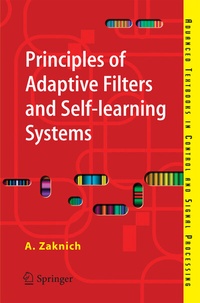
Principles of Adaptive Filters and Self-learning Systems
Description

Reviews / Votes
From the reviews:
"An excellent tutorial for graduate students and a comprehensive introduction for researchers working in adaptive systems.
Summing Up:
Highly Recommended."
(J. Y. Cheung, Choice, February, 2006)
More details
Other editions
Additional editions
Person
Anthony Zaknich (M'87-'00) was born in Vela Luka, Croatia, and immigrated to Australia in the 1950s. He received the B.E. (Electronics) and M.E.Sc. degrees from the University of Western Australia (UWA), Nedlands in 1974 and 1986, respectively; the B.A. and B.Sc. (Psychology) degrees from Ambassador University, Pasadena, CA, USA, both in 1978; and the Ph.D. degree from UWA in 1996.
He is currently an Adjunct Associate Professor at UWA, Centre for Intelligent Information Processing Systems (CIIPS) and also at Murdoch University, Perth Western Australia (Division of Science and Engineering). From 1990 to 1999 he held the position of Technical Manager for Industry Projects working as a Research Fellow and Lecturer at CIIPS in the Electrical and Electronics Engineering Department, UWA. His main work at CIIPS was involved with supervision, teaching, research and development related to signal processing and artificial neural networks at the undergraduate, postgraduate and professional-development levels. Previously, he was involved in the research and development of underwater control and acoustic signalling systems in private enterprise, and also in the establishment of a public company, Nautronix Ltd, producing and marketing products in these areas for the international market. He has supervised numerous Honours and ten postgraduate research projects, including three Ph.Ds. He has also authored/co-authored more than 56 refereed papers in technical journals and conference proceedings, has contributed five research book chapters, and authored two books in his areas of interest since 1988. His special research interest is related to integrated sensory-intelligent systems (ISIS): The philosophy, theory and applications of, intelligent signal processing; learning theory; self-learning systems; artificial neural networks; adaptive systems; time-frequency filters and signal analysis; time delay spectrometry; adaptive space-time-frequency signal processing; audio andHi-Fi, and underwater acoustic communications systems.
Dr Zaknich is a Member of the Audio Engineering Society (AES). He served on the IEEE Western Australian Regional Interest Group Committee on Neural Networks at various times since 1993. In 1998 he won the 1996-98, UWA Electrical and Electronics Engineering Department's Outstanding Early Researcher Award, which is given to the best researcher below Senior Lecturer level over any three year period.
