

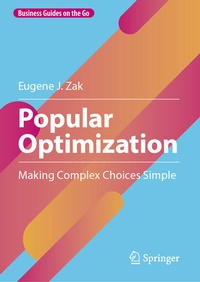
Popular Optimization
Description

This book uniquely explores popular optimization, presenting fundamental problems from diverse sources. It aims to cultivate a non-traditional problem-solving approach applicable to both optimization and broader contexts. The author introduces optimization models for well-known problems and proposes several new ones. Additionally, familiar problems from various fields are reformulated into optimization frameworks.
The book serves as a curated collection of intriguing problems, most of which have clear practical applications. For each problem, multiple solution techniques are provided, typically offering at least two distinct approaches. It also demonstrates how AI can assist readers in formulating and formalizing problems that require robust mathematical models. AI's benefits are highlighted throughout the decision-making process, from fine-tuning input data to effectively presenting results. The selected optimization problems span both continuous and discrete domains, including linear and nonlinear formulations.
The richness and depth of the content will be appreciated by both students and practitioners as they explore the variety of methods that can be applied to solve more complex, real-world problems.
More details
Other editions
Additional editions
Person
Dr. Eugene J. Zak is an experienced operations research practitioner with a strong mathematical background. He holds a Ph.D. in Applied Mathematics and was awarded the INFORMS 2011 Edelman Prize in Operations Research and Analytics. His areas of expertise include mathematical modeling, optimization, and software design and development. Eugene worked in several large companies such as IBM, Alstom Grid (GE), and Amazon, and a few startup companies. His software has been successfully deployed and worked in many customer enterprises. Eugene has published more than 30 papers and books on the practical implementation of operations research models and algorithms.
Content
Geometry.- Logistics.- Area.- Volume.- Packing and Covering.- Algebra.- Fake coins.- Chess.
