

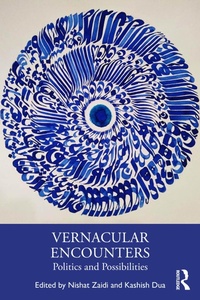
Vernacular Encounters
Politics and Possibilities
Published on 29. December 2025
218 pages
978-1-040-81263-1 (ISBN)
Description

This book offers new insights into the debates of vernacularity, language ideologies, and the decolonial turn. It identifies 'vernacular encounters' as nuanced interactions of languages that are often termed as 'local' with culture and power, across varied media and temporalities.
Drawing from rich literary and cultural productions across various geopolitical contexts, the book reveals how vernacular expressions serve as powerful vehicles for political negotiation and cultural transformation. It explores how vernacular encounters actively challenge power structures at various levels by asserting their own cultural authority, thereby creating spaces for alternative perspectives within dominant discourse and challenging hegemonic forces. It also illuminates the role of language as more than just a communication tool, arguing that it also functions as a vital marker of identity and cultural continuity that actively resists homogenization and erasure. This resistance, in the case of the vernacular languages of India, challenges both colonial and global hegemonic forces and sets the tone for affirming diverse cultural narratives. The volume offers a historically grounded analysis that traces the resilience, adaptation and negotiations of vernacular languages across changing socio-political landscapes.
This book will be of interest to students and researchers of language, literature, linguistics, literary and cultural studies, Indian literature, translation studies, and to those with an interest in South Asian history, culture, politics and society.
Drawing from rich literary and cultural productions across various geopolitical contexts, the book reveals how vernacular expressions serve as powerful vehicles for political negotiation and cultural transformation. It explores how vernacular encounters actively challenge power structures at various levels by asserting their own cultural authority, thereby creating spaces for alternative perspectives within dominant discourse and challenging hegemonic forces. It also illuminates the role of language as more than just a communication tool, arguing that it also functions as a vital marker of identity and cultural continuity that actively resists homogenization and erasure. This resistance, in the case of the vernacular languages of India, challenges both colonial and global hegemonic forces and sets the tone for affirming diverse cultural narratives. The volume offers a historically grounded analysis that traces the resilience, adaptation and negotiations of vernacular languages across changing socio-political landscapes.
This book will be of interest to students and researchers of language, literature, linguistics, literary and cultural studies, Indian literature, translation studies, and to those with an interest in South Asian history, culture, politics and society.
More details
Language
English
Place of publication
London
United Kingdom
Publishing group
Taylor & Francis Ltd
Target group
College/higher education
Product notice
Reflowable
Illustrations
13 Halftones, black and white; 13 Illustrations, black and white
File size
17,95 MB
ISBN-13
978-1-040-81263-1 (9781040812631)
Copyright in bibliographic data and cover images is held by Nielsen Book Services Limited or by the publishers or by their respective licensors: all rights reserved.
Schweitzer Classification
Other editions
Additional editions

Book
approx. 12/2025
1st Edition
Routledge India
€64.60
Not yet published
Book
approx. 12/2025
1st Edition
Routledge India
€211.20
Not yet published
Persons
Nishat Zaidi is Professor of English and former chair at the Department of English, Jamia Millia Islamia. She is currently the Hony Director of Sarojini Naidu Centre for Women's Studies, Jamia Millia Islamia.
Kashish Dua is Assistant Professor of English at Jesus and Mary College, University of Delhi. She was a Fulbright-Nehru Doctoral Fellow at the University of California, Berkeley and earned her PhD from the Department of English, Jamia Millia Islamia.
Kashish Dua is Assistant Professor of English at Jesus and Mary College, University of Delhi. She was a Fulbright-Nehru Doctoral Fellow at the University of California, Berkeley and earned her PhD from the Department of English, Jamia Millia Islamia.
Content
Introduction - The Vernacular as Method: Encounters, Politics, and Possibilities of Decolonial Futures
Part I: Language and Identity in Vernacular Contexts
1. The Ghostly Vernacular: Language in Indo-Fijian Poetry
2. Language Ideologies of a Goan Desk Calendar
3. Becoming Assamese: Language, Identity and Anxiety
Part II: Vernacular Literatures and Community Narratives
4. Interrogating Colonial Historiography: Traditions of 'Vernacular' and the Case of Sikh Community Periodicals (1890-1910)
5. Rendering Visibility to the Public: Examining Satire and Critique in the Vernacular through the Newspaper Navashakti
6. 'Qaum' and its Complex Genealogies: Perspectives from Urdu Digests in Post-Partition India
Part III: Evolution and Contention of Language Cultures
7. Indigenous Voices: An Exploration of Native Translators and Preachers in the Khasi and Jaintia Hills
8. The Colonial and the Vernacular: Three Moments of Encounter
9. Towards a Republic of Vernacular (World) Letters: On How to Planetarize "World Literature"
10. Internet and its Vernacular Encounters: Contested Terrain of Digital Folk Video Culture(s) in India
Part I: Language and Identity in Vernacular Contexts
1. The Ghostly Vernacular: Language in Indo-Fijian Poetry
2. Language Ideologies of a Goan Desk Calendar
3. Becoming Assamese: Language, Identity and Anxiety
Part II: Vernacular Literatures and Community Narratives
4. Interrogating Colonial Historiography: Traditions of 'Vernacular' and the Case of Sikh Community Periodicals (1890-1910)
5. Rendering Visibility to the Public: Examining Satire and Critique in the Vernacular through the Newspaper Navashakti
6. 'Qaum' and its Complex Genealogies: Perspectives from Urdu Digests in Post-Partition India
Part III: Evolution and Contention of Language Cultures
7. Indigenous Voices: An Exploration of Native Translators and Preachers in the Khasi and Jaintia Hills
8. The Colonial and the Vernacular: Three Moments of Encounter
9. Towards a Republic of Vernacular (World) Letters: On How to Planetarize "World Literature"
10. Internet and its Vernacular Encounters: Contested Terrain of Digital Folk Video Culture(s) in India
