

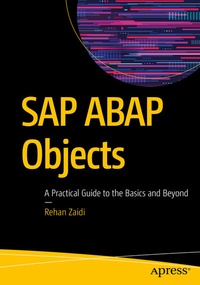
SAP ABAP Objects
Description

Understand ABAP objects-the object-oriented extension of the SAP language ABAP-in the latest release of SAP NetWeaver 7.5, and its newest advancements. This book begins with the programming of objects in general and the basics of the ABAP language that a developer needs to know to get started. The most important topics needed to perform daily support jobs and ensure successful projects are covered.
ABAP is a vast community with developers working in a variety of functional areas. You will be able to apply the concepts in this book to your area. SAP ABAP Objects is goal directed, rather than a collection of theoretical topics. It doesn't just touch on the surface of ABAP objects, but goes in depth from building the basic foundation (e.g., classes and objects created locally and globally) to the intermediary areas (e.g., ALV programming, method chaining, polymorphism, simple and nested interfaces), and then finally into the advanced topics (e.g., shared memory, persistent objects). You will know how to use best practices to make better programs via ABAP objects.
What You'll Learn
-
Know the latest advancements in ABAP objects with the new SAP Netweaver system
-
Understand object-oriented ABAP classes and their components
-
Use object creation and instance-methods calls
-
Be familiar with the functions of the global class builder
-
Be exposed to advanced topics
-
Incorporate best practices for making object-oriented ABAP programs
Who This Book Is For
ABAP developers, ABAP programming analysts, and junior ABAP developers. Included are: ABAP developers for all modules of SAP, both new learners and developers with some experience or little programming experience in general; students studying ABAP at the college/university level; senior non-ABAP programmers with considerable experience who are willing to switch to SAP/ABAP; and any functional consultants who want or have recently switched to ABAP technical.
More details
Other editions
Additional editions
Person
Rehan Zaidi is a consultant for several international SAP clients. He started working with SAP in 1999 and writing about his experiences in 2001. He has written several articles for both SAP Professional Journal and HR Expert, and also has a number of popular SAP- and ABAP-related books to his credit.
He provides SAP consulting to companies and helps clients (both on-site and remote) with their SAP technical requirements (ABAP, Workflow, Quick development of Fiori apps, and S/4 HANA-related requirements). Rehan also creates documentation and training manuals for a number of companies based in the United States.
Rehan is interested in providing publicity options to ERP consulting firms. His clients are located in a number of countries and continents, including the Middle East (GCC region) as well as North America and Europe. He also is currently working on a new ERP programmer magazine.Content
Chapter 1: Creating Classes and Objects.- Chapter 2: Class Components in Detail.- Chapter 3: More on Object-Oriented ABAP.- Chapter 4: Class Builder.- Chapter 5: Exceptions, Shared, and Persistent Objects.- Chapter 6: More Topics in Object-Oriented ABAP .- Chapter 7: ABAP Unit Test-Driven Development.- Chapter 8: Creating ABAP Classes Using Eclipse.
