

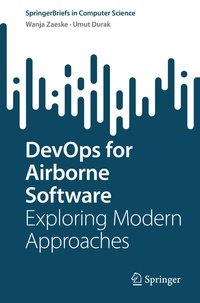
DevOps for Airborne Software
Description

This Springer Brief presents a selection of tools and techniques which either enable or improve the use of DevOps for airborne software engineering. They are evaluated against the unique challenges of the aviation industry such as safety and airworthiness, and exercised using a demonstrator in order to gather first experience.
The book is structured as follows: after a short introduction to the main topics of the work in chapter 1, chapter 2 provides more information on the tools, techniques, software and standards required to implement the subsequently presented ideas. In particular, the development practice BDD, the relation between DevOps, CI & CD and both the Rust & the Nix programming language are introduced. In chapter 3 the authors explain and justify their ideas towards advancing the state of the art, mapping the aforementioned tools and techniques to the DevOps Cycle while considering aspects of Do-178C. Next, in chapter 4 the experiences gathered while implementinga demonstrator using the tools and techniques are described. Eventually, chapter 5 briefly summarizes the findings and presents a compilation of open points and missing pieces which are yet to be resolved.
The book targets three different reader groups. The first one are development managers from the aerospace industry who need to see examples and experience reports for the application of DevOps for airborne software. The second group are investigators in the safety-critical embedded systems domain who look for benchmarks at various application domains. And the third group are lecturers who offer graduate level software engineering courses for safety-critical software engineering.
More details
Other editions
Additional editions
Persons
Wanja Zaeske is a research scientist at the Assured Embedded Systems group of the German Aerospace Center (DLR). His research is focused on modern software engineering practices for developing safe and secure airborne systems.
Umut Durak is an Adjunct Professor of Aeronautical Informatics, leading research groups at the German Aerospace Center (DLR) and Clausthal University of Technology. His research interests concentrate on engineering approaches for developing smart and connected airborne systems. He is an associate fellow of the American Institute of Aeronautics and Astronautics (AIAA) and has published 4 books and more than 80 papers in conference proceedings and journals.
