

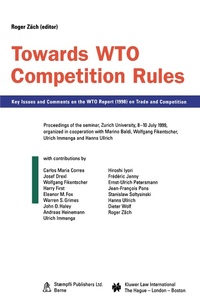
Towards WTO Competition Rules
Key Issues and Comments on the WTO Report (1998) on Trade and Competition
Published on 1. October 1999
420 pages
978-90-411-8153-4 (ISBN)
Description

The progressive elimination of formal, governmentally imposed trade barriers under the General Agreement on Tariffs and Trade ('GATT') and - since 1995 - the World Trade Organization ('WTOs') brought competition policy on the agenda of the WTO. In November 1998 a WTO working group presented a comprehensive report on the ((Interaction between Trade and Competition Policy, (Jenny Report).
In July 1999, a group of internationally recognized competition law experts, together with high ranking officials from the WTO, Geneva, the European Commission, and the German Bundeskartellamt met in a seminar at Zurich University with the aim to comment on the Jenny Report, to identify key issues for international competition rules and to present proposals for such rules. The results are presented in this volume.
Due to evident differences between the U.S. and Europe/Japan on the goals and features of rules protecting international competition, negotiations in this area will be difficult. The contributions contained in this volume offer new approaches and proposals that might help to overcome these difficulties.
In July 1999, a group of internationally recognized competition law experts, together with high ranking officials from the WTO, Geneva, the European Commission, and the German Bundeskartellamt met in a seminar at Zurich University with the aim to comment on the Jenny Report, to identify key issues for international competition rules and to present proposals for such rules. The results are presented in this volume.
Due to evident differences between the U.S. and Europe/Japan on the goals and features of rules protecting international competition, negotiations in this area will be difficult. The contributions contained in this volume offer new approaches and proposals that might help to overcome these difficulties.
More details
Other editions
Additional editions
Roger Zach
Towards WTO Competition Rules:Key Issues and Comments on the WTO Report (1998) on Trade and Competition : Proceedings of the Seminar, Zurich University, 8-10 July 1999
Key Issues and Comments on the WTO Report (1998) on Trade and Competition
Book
10/1999
1st Edition
Kluwer Law International
€96.30
Shipment within 10-20 days
Content
- Cover
- Half Title Page
- Title Page
- Copyright Page
- Preface
- Table of Contents
- The Authors
- Sponsors
- List of Abbreviations
- I. Fundamentals
- Globalization, Competition and Trade Policy: Issues and Challenges
- I. The goals and benefits of trade liberalization
- II. The goals and benefits of regulatory reforms
- III. The goals and benefits of competition policy
- IV. The challenges of globalization
- V. The complementarity between trade policy, domestic deregulation and competition policy in the perspective of globalization
- VI. Competition policy and economic development
- VII. Options for the future
- VIII. Conclusion
- Competition-oriented Reforms of the WTO World Trade System Proposals and Policy Options
- I. The WTO Working Group on the Interaction Between Trade and Competition Policy
- II. Proposals For Negotiating Multilateral Competition Rules in the WTO
- III. Policy Options For Negotiating International Competition Rules
- IV. Policy Problems Requiring Particular Attention
- Antitrust, Market Conceptualization and the World Trade Organization - The Convention Approach
- I.
- II.
- III.
- IV.
- V.
- VI.
- Annex: A Bibliography on the Draft International Antitrust Code
- Towards An International Common Law of Competition
- I. Introduction
- II. Three Models of International Antitrust
- III. Towards an International Common Law of Competition
- IV. Conclusion
- Bibliography
- Competition Culture and the Aims of Competition Law
- I. Outline of WTO Working Group's Report on Competition Culture
- II. Competition Culture in Japanese Experience
- III. Aims of Competition Law from the Viewpoint of Competition Culture
- Harmonized Rules, Peculiar Law: Recent Developments in Japanese Law
- I. Introduction
- II. The Peculiarities of Japanese Competition Law
- III. The Amendments and their Probable Effects
- IV. Conclusion
- Lessons From A Century of Change - The Political, Social, and Economic Forces Shaping United States' Law Governing Vertical Restraints on Retail Price Competition
- I. An Historical Overview of the U.S. Law Governing Vertically Imposed Restraints on Retail Pricing
- II. Current U.S. Law Governing Vertical Restraints on Retail Competition
- III. Lessons for the Internationalization of Antitrust
- Legal Appraisal of Restrictive Agreements - Proposals for Statutory Provisions
- I. Problem and Approach
- II. Restrictive Agreements: Those with obvious and those with ambiguous impacts on competition
- III. Legality Test
- IV. Applicability to Abusive Practice Legislation?
- V. Proposal for Statutory Provisions
- Bibliography
- II. Competition Policy for International Markets
- International Co-operation in Competition Matters - Where Are We Four Years After the Van Miert Report?
- I. Introduction
- II. Bilateral Co-operation
- III. Multilateral Co-operation
- Conclusions
- International Mergers
- Control of Mergers and Acquisitions under Polish Law
- I. Introduction
- II. Legislative Framework
- III. Merger control laws in action: a brief review of case law
- IV. Transnational mergers
- V. Concluding remarks
- Bibliography
- Trade-Related Restraints of Competition - The Competition Policy Approach
- I. International Trade and Competition
- II. WTO Approach v. Antitrust Approach: Do We Need a WTO Competition Law?
- III. Trade-Related Restraints of Competition
- IV. Competition Policy and Harmonization of Competition Laws
- V. Conclusions
- Bibliography
- Antitrust Law Relating to High Technology Industries -A Case for or Against International Rules?
- I. Introduction
- II. Innovation-related Restraints of Competition: Basic Approaches
- III. Conclusion: Antitrust Law for Both Innovation and Domination?
- Intellectual Property Rights and Competition Policy The Approach of the WTO Working Group on Trade and Competition
- I. Competition Law of Intellectual Property in the TRIPs Agreement
- II. The interface of Competition Law and Intellectual Property Rights
- III. Economic Foundations of the Interface Problem
- IV. Approach of the WTO Working Group to the Interface Problem
- V. Approach of UNCTAD to the Interface Problem
- VI. Comparison and Conclusions
- Bibliography
- The Problem of State Action that Blesses Private Action that Harms "the Foreigners
- I. Introduction
- II. State Protection of Anticompetitive Acts
- III. Two Vignettes
- IV. Analysis
- V. Solutions
- VI. Conclusion
- Bibliography
- III. Antitrust and the Public Interest
- Conflicts between Competition Policy and Industrial Policy: A Comparative View on Potential Responses
- I. Introduction
- II. Relevant Cases
- III. The Meaning of Industrial Policy
- IV. Antitrust Legislations and Industrial Policy
- V. Conclusions
- Bibliography
- Competition Law and Development Policies
- I. Introduction
- II. The concept of competition policy
- III. Competition laws in developing countries
- IV. Liberalization and competition
- V. International initiatives
- VI. Competition issues in current WTO agreements
- VII. Towards a multilateral regime on competition?
- VIII. Limitations of WTO agreements and problems to be faced
- IX. Options for developing countries
- Bibliography
- Competition Law as Comparative Advantage
- I. Introduction
- II. WTO Framework and Consequences
- III. Consequences for Domestic Competition Policy
- Bibliography
- Back Cover
