

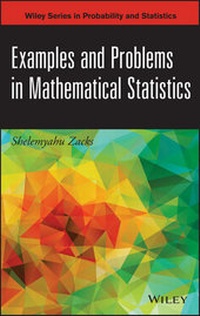
Examples and Problems in Mathematical Statistics
Description

More details
Other editions
Additional editions

Person
Content
Preface xv
List of Random Variables xvii
List of Abbreviations xix
1 Basic Probability Theory 1
Part I: Theory 1
1.1 Operations on Sets 1
1.2 Algebra and s-Fields 2
1.3 Probability Spaces 4
1.4 Conditional Probabilities and Independence 6
1.5 Random Variables and Their Distributions 8
1.6 The Lebesgue and Stieltjes Integrals 12
1.6.1 General Definition of Expected Value: The Lebesgue Integral 12
1.6.2 The Stieltjes-Riemann Integral 17
1.6.3 Mixtures of Discrete and Absolutely Continuous Distributions 19
1.6.4 Quantiles of Distributions 19
1.6.5 Transformations 20
1.7 Joint Distributions Conditional Distributions and Independence 21
1.7.1 Joint Distributions 21
1.7.2 Conditional Expectations: General Definition 23
1.7.3 Independence 26
1.8 Moments and Related Functionals 26
1.9 Modes of Convergence 35
1.10 Weak Convergence 39
1.11 Laws of Large Numbers 41
1.11.1 The Weak Law of Large Numbers (WLLN) 41
1.11.2 The Strong Law of Large Numbers (SLLN) 42
1.12 Central Limit Theorem 44
1.13 Miscellaneous Results 47
1.13.1 Law of the Iterated Logarithm 48
1.13.2 Uniform Integrability 48
1.13.3 Inequalities 52
1.13.4 The Delta Method 53
1.13.5 The Symbols op and Op55
1.13.6 The Empirical Distribution and Sample Quantiles 55
Part II: Examples 56
Part III: Problems 73
Part IV: Solutions to Selected Problems 93
2 Statistical Distributions 106
Part I: Theory 106
2.1 Introductory Remarks 106
2.2 Families of Discrete Distributions 106
2.2.1 Binomial Distributions 106
2.2.2 Hypergeometric Distributions 107
2.2.3 Poisson Distributions 108
2.2.4 Geometric Pascal and Negative Binomial Distributions 108
2.3 Some Families of Continuous Distributions 109
2.3.1 Rectangular Distributions 109
2.3.2 Beta Distributions 111
2.3.3 Gamma Distributions 111
2.3.4 Weibull and Extreme Value Distributions 112
2.3.5 Normal Distributions 113
2.3.6 Normal Approximations 114
2.4 Transformations 118
2.4.1 One-to-One Transformations of Several Variables 118
2.4.2 Distribution of Sums 118
2.4.3 Distribution of Ratios 118
2.5 Variances and Covariances of Sample Moments 120
2.6 Discrete Multivariate Distributions 122
2.6.1 The Multinomial Distribution 122
2.6.2 Multivariate Negative Binomial 123
2.6.3 Multivariate Hypergeometric Distributions 124
2.7 Multinormal Distributions 125
2.7.1 Basic Theory 125
2.7.2 Distribution of Subvectors and Distributions of Linear Forms 127
2.7.3 Independence of Linear Forms 129
2.8 Distributions of Symmetric Quadratic Forms of Normal Variables 130
2.9 Independence of Linear and Quadratic Forms of Normal Variables 132
2.10 The Order Statistics 133
2.11 t-Distributions 135
2.12 F-Distributions 138
2.13 The Distribution of the Sample Correlation 142
2.14 Exponential Type Families 144
2.15 Approximating the Distribution of the Sample Mean: Edgeworth and Saddlepoint Approximations 146
2.15.1 Edgeworth Expansion 147
2.15.2 Saddlepoint Approximation 149
Part II: Examples 150
Part III: Problems 167
Part IV: Solutions to Selected Problems 181
3 Sufficient Statistics and the Information in Samples 191
Part I: Theory 191
3.1 Introduction 191
3.2 Definition and Characterization of Sufficient Statistics 192
3.2.1 Introductory Discussion 192
3.2.2 Theoretical Formulation 194
3.3 Likelihood Functions and Minimal Sufficient Statistics 200
3.4 Sufficient Statistics and Exponential Type Families 202
3.5 Sufficiency and Completeness 203
3.6 Sufficiency and Ancillarity 205
3.7 Information Functions and Sufficiency 206
3.7.1 The Fisher Information 206
3.7.2 The Kullback-Leibler Information 210
3.8 The Fisher Information Matrix 212
3.9 Sensitivity to Changes in Parameters 214
3.9.1 The Hellinger Distance 214
Part II: Examples 216
Part III: Problems 230
Part IV: Solutions to Selected Problems 236
4 Testing Statistical Hypotheses 246
Part I: Theory 246
4.1 The General Framework 246
4.2 The Neyman-Pearson Fundamental Lemma 248
4.3 Testing One-Sided Composite Hypotheses in MLR Models 251
4.4 Testing Two-Sided Hypotheses in One-Parameter Exponential Families 254
4.5 Testing Composite Hypotheses with Nuisance Parameters-Unbiased Tests 256
4.6 Likelihood Ratio Tests 260
4.6.1 Testing in Normal Regression Theory 261
4.6.2 Comparison of Normal Means: The Analysis of Variance 265
4.7 The Analysis of Contingency Tables 271
4.7.1 The Structure of Multi-Way Contingency Tables and the Statistical Model 271
4.7.2 Testing the Significance of Association 271
4.7.3 The Analysis of 2 × 2 Tables 273
4.7.4 Likelihood Ratio Tests for Categorical Data 274
4.8 Sequential Testing of Hypotheses 275
4.8.1 The Wald Sequential Probability Ratio Test 276
Part II: Examples 283
Part III: Problems 298
Part IV: Solutions to Selected Problems 307
5 Statistical Estimation 321
Part I: Theory 321
5.1 General Discussion 321
5.2 Unbiased Estimators 322
5.2.1 General Definition and Example 322
5.2.2 Minimum Variance Unbiased Estimators 322
5.2.3 The Cramér-Rao Lower Bound for the One-Parameter Case 323
5.2.4 Extension of the Cramér-Rao Inequality to Multiparameter Cases 326
5.2.5 General Inequalities of the Cramér-Rao Type 327
5.3 The Efficiency of Unbiased Estimators in Regular Cases 328
5.4 Best Linear Unbiased and Least-Squares Estimators 331
5.4.1 BLUEs of the Mean 331
5.4.2 Least-Squares and BLUEs in Linear Models 332
5.4.3 Best Linear Combinations of Order Statistics 334
5.5 Stabilizing the LSE: Ridge Regressions 335
5.6 Maximum Likelihood Estimators 337
5.6.1 Definition and Examples 337
5.6.2 MLEs in Exponential Type Families 338
5.6.3 The Invariance Principle 338
5.6.4 MLE of the Parameters of Tolerance Distributions 339
5.7 Equivariant Estimators 341
5.7.1 The Structure of Equivariant Estimators 341
5.7.2 Minimum MSE Equivariant Estimators 343
5.7.3 Minimum Risk Equivariant Estimators 343
5.7.4 The Pitman Estimators 344
5.8 Estimating Equations 346
5.8.1 Moment-Equations Estimators 346
5.8.2 General Theory of Estimating Functions 347
5.9 Pretest Estimators 349
5.10 Robust Estimation of the Location and Scale Parameters of Symmetric Distributions 349
Part II: Examples 353
Part III: Problems 381
Part IV: Solutions of Selected Problems 393
6 Confidence and Tolerance Intervals 406
Part I: Theory 406
6.1 General Introduction 406
6.2 The Construction of Confidence Intervals 407
6.3 Optimal Confidence Intervals 408
6.4 Tolerance Intervals 410
6.5 Distribution Free Confidence and Tolerance Intervals 412
6.6 Simultaneous Confidence Intervals 414
6.7 Two-Stage and Sequential Sampling for Fixed Width Confidence Intervals 417
Part II: Examples 421
Part III: Problems 429
Part IV: Solution to Selected Problems 433
7 Large Sample Theory for Estimation and Testing 439
Part I: Theory 439
7.1 Consistency of Estimators and Tests 439
7.2 Consistency of the MLE 440
7.3 Asymptotic Normality and Efficiency of Consistent Estimators 442
7.4 Second-Order Efficiency of BAN Estimators 444
7.5 Large Sample Confidence Intervals 445
7.6 Edgeworth and Saddlepoint Approximations to the Distribution of the MLE: One-Parameter Canonical Exponential Families 446
7.7 Large Sample Tests 448
7.8 Pitman's Asymptotic Efficiency of Tests 449
7.9 Asymptotic Properties of Sample Quantiles 451
Part II: Examples 454
Part III: Problems 475
Part IV: Solution of Selected Problems 479
8 Bayesian Analysis in Testing and Estimation 485
Part I: Theory 485
8.1 The Bayesian Framework 486
8.1.1 Prior Posterior and Predictive Distributions 486
8.1.2 Noninformative and Improper Prior Distributions 487
8.1.3 Risk Functions and Bayes Procedures 489
8.2 Bayesian Testing of Hypothesis 491
8.2.1 Testing Simple Hypothesis 491
8.2.2 Testing Composite Hypotheses 493
8.2.3 Bayes Sequential Testing of Hypotheses 495
8.3 Bayesian Credibility and Prediction Intervals 501
8.3.1 Credibility Intervals 501
8.3.2 Prediction Intervals 501
8.4 Bayesian Estimation 502
8.4.1 General Discussion and Examples 502
8.4.2 Hierarchical Models 502
8.4.3 The Normal Dynamic Linear Model 504
8.5 Approximation Methods 506
8.5.1 Analytical Approximations 506
8.5.2 Numerical Approximations 508
8.6 Empirical Bayes Estimators 513
Part II: Examples 514
Part III: Problems 549
Part IV: Solutions of Selected Problems 557
9 Advanced Topics in Estimation Theory 563
Part I: Theory 563
9.1 Minimax Estimators 563
9.2 Minimum Risk Equivariant Bayes Equivariant and Structural Estimators 565
9.2.1 Formal Bayes Estimators for Invariant Priors 566
9.2.2 Equivariant Estimators Based on Structural Distributions 568
9.3 The Admissibility of Estimators 570
9.3.1 Some Basic Results 570
9.3.2 The Inadmissibility of Some Commonly Used Estimators 575
9.3.3 Minimax and Admissible Estimators of the Location Parameter 582
9.3.4 The Relationship of Empirical Bayes and Stein-Type Estimators of the Location Parameter in the Normal Case 584
Part II: Examples 585
Part III: Problems 592
Part IV: Solutions of Selected Problems 596
References 601
Author Index 613
Subject Index 617
CHAPTER 1
Basic Probability Theory
PART I: THEORY
It is assumed that the reader has had a course in elementary probability. In this chapter we discuss more advanced material, which is required for further developments.
1.1 OPERATIONS ON SETS
Let denote a sample space. Let E1, E2 be subsets of . We denote the union by E1 E2 and the intersection by E1 E2. = − E denotes the complement of E. By DeMorgan’s laws = 1 2 and = 1 2.
Given a sequence of sets {En, n ≥ 1} (finite or infinite), we define
(1.1.1)
Furthermore, and are defined as
(1.1.2)
If a point of belongs to En, it belongs to infinitely many sets En. The sets , En and , En always exist and
(1.1.3)
If , En = , En, we say that a limit of {En, n ≥ 1} exists. In this case,
(1.1.4)
A sequence {En, n ≥ 1} is called monotone increasing if En En+1 for all n ≥ 1. In this case . The sequence is monotone decreasing if En En+1, for all n ≥ 1. In this case . We conclude this section with the definition of a partition of the sample space. A collection of sets = {E1, …, Ek} is called a finite partition of if all elements of are pairwise disjoint and their union is , i.e., Ei Ej = for all i ≠ j; Ei, Ej ; and . If contains a countable number of sets that are mutually exclusive and , we say that is a countable partition.
1.2 ALGEBRA AND σ–FIELDS
Let be a sample space. An algebra is a collection of subsets of satisfying
(1.2.1)
We consider = . Thus, (i) and (ii) imply that . Also, if E1, E2 then E1 E2 .
The trivial algebra is 0 = {, }. An algebra 1 is a subalgebra of 2 if all sets of 1 are contained in 2. We denote this inclusion by 1 2. Thus, the trivial algebra 0 is a subalgebra of every algebra . We will denote by (), the algebra generated by all subsets of (see Example 1.1).
If a sample space has a finite number of points n, say 1 ≤ n < ∞, then the collection of all subsets of is called the discrete algebra generated by the elementary events of . It contains 2n events.
Let be a partition of having k, 2 ≤ k, disjoint sets. Then, the algebra generated by , (), is the algebra containing all the 2k − 1 unions of the elements of and the empty set.
An algebra on is called a σ–field if, in addition to being an algebra, the following holds.
(iv) If En , n ≥ 1, then En .We will denote a σ–field by . In a σ–field the supremum, infinum, limsup, and liminf of any sequence of events belong to . If is finite, the discrete algebra () is a σ–field. In Example 1.3 we show an algebra that is not a σ–field.
The minimal σ–field containing the algebra generated by {(-∞, x], -∞ < x < ∞ } is called the Borel σ–field on the real line .
A sample space , with a σ–field , (, ) is called a measurable space.
The following lemmas establish the existence of smallest σ–field containing a given collection of sets.
Lemma 1.2.1 Let be a collection of subsets of a sample space . Then, there exists a smallest σ–field (), containing the elements of .
Proof. The algebra of all subsets of , () obviously contains all elements of . Similarly, the σ–field containing all subsets of , contains all elements of . Define the σ–field () to be the intersection of all σ–fields, which contain all elements of . Obviously, () is an algebra. QED
A collection of subsets of is called a monotonic class if the limit of any monotone sequence in belongs to .
If is a collection of subsets of , let * () denote the smallest monotonic class containing .
Lemma 1.2.2. A necessary and sufficient condition of an algebra to be a σ–field is that it is a monotonic class.
Proof. (i) Obviously, if is a σ–field, it is a monotonic class.
(ii) Let be a monotonic class.
Let En , n ≥ 1. Define . Obviously Bn Bn+1 for all n ≥ 1. Hence . But . Thus, , En . Similarly, En . Thus, is a σ–field. QED
Theorem 1.2.1. Let be an algebra. Then * () = (), where () is the smallest σ–field containing .
Proof. See Shiryayev (1984, p. 139).
The measurable space (, ), where is the real line and = (), called the Borel measurable space, plays a most important role in the theory of statistics. Another important measurable space is (n, n), n ≥ 2, where n = × × ··· × is the Euclidean n–space, and n = × ··· × is the smallest σ–field containing n, , and all n–dimensional rectangles I = I1 × ··· × In, where
The measurable space (∞, ∞) is used as a basis for probability models of experiments with infinitely many trials. ∞ is the space of ordered sequences x = (x1, x2, …), −∞ < xn < ∞, n = 1, 2, …. Consider the cylinder sets
and
where Bi are Borel sets, i.e., Bi . The smallest σ–field containing all these cylinder sets, n ≥ 1, is (∞). Examples of Borel sets in (∞) are
(a) {x: x ∞, , xn > a}or
(b) {x: x ∞, , xn ≤ a}.1.3 PROBABILITY SPACES
Given a measurable space (, ), a probability model ascribes a countably additive function P on , which assigns a probability P{A} to all sets A . This function should satisfy the following properties.
(1.3.1)
(1.3.2)
Recall that if A B then P {A} ≤ P{B}, and P{} = 1 − P{A}. Other properties will be given in the examples and problems. In the sequel we often write AB for A B.
Theorem 1.3.1. Let (, , P) be a probability space, where is a σ–field of subsets of and P a probability function....
