

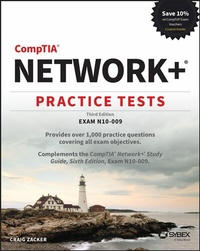
CompTIA Network+ Practice Tests
Description

In the freshly revised Third Edition of CompTIA Network+ Practice Tests Exam N10-009, IT expert and author Craig Zacker delivers a set of accessible and useful practice tests for the updated Network+ Exam N10-009. You'll prepare for the exam, learn the information you need in an industry interview, and get ready to excel in your first networking role.
These practice tests gauge your skills in deploying wired and wireless devices; understanding network documentation and the purpose of network services; work with datacenter, cloud, and virtual networking concepts; monitor network activity; and more.
This book also offers:
* Comprehensive coverage of all five domain areas of the updated Network+ exam, including network concepts, implementation, operations, security, and troubleshooting
* Practical and efficient preparation for the Network+ exam with hundreds of domain-by-domain questions
* Access to the Sybex interactive learning environment and online test bank
Perfect for anyone preparing for the CompTIA Network+ Exam N10-009, the CompTIA Network+ Practice Tests Exam N10-009 is also an indispensable resource for network administrators seeking to enhance their skillset with new, foundational skills in a certification endorsed by industry leaders around the world.
More details
Other editions
Additional editions
Person
ABOUT THE AUTHOR
Craig Zacker, is the author or co-author of dozens of books, manuals, articles, and web sites on computer and networking topics.
Content
Introduction xiii
Chapter 1 Networking Concepts 1
1.1 Explain concepts related to the Open Systems Interconnection (OSI) reference model 8
1.2 Compare and contrast networking appliances, applications, and functions 15
1.3 Summarize cloud concepts and connectivity options 25
1.4 Explain common networking ports, protocols, services, and traffic types 29
1.5 Compare and contrast transmission media and transceivers 37
1.6 Compare and contrast network topologies, architectures, and types 48
1.7 Given a scenario, use appropriate IPv4 network addressing 53
1.8 Summarize evolving use cases for modern network environments 59
Chapter 2 Network Implementation 63
2.1 Explain characteristics of routing technologies 66
2.2 Given a scenario, configure switching technologies and features 73
2.3 Given a scenario, select and configure wireless devices and technologies 83
2.4 Explain important factors of physical installations 94
Chapter 3 Network Operations 103
3.1 Explain the purpose of organizational processes and procedures 108
3.2 Given a scenario, use network monitoring technologies 118
3.3 Explain disaster recovery (DR) concepts 124
3.4 Given a scenario, implement IPv4 and IPv 6 network services 131
3.5 Compare and contrast network access and management methods 138
Chapter 4 Network Security 145
4.1 Explain the importance of basic network security concepts 148
4.2 Summarize various types of attacks and their impact to the network 160
4.3 Given a scenario, apply network security features, defense techniques, and solutions 167
Chapter 5 Network Troubleshooting 177
5.1 Explain the troubleshooting methodology 181
5.2 Given a scenario, troubleshoot common cabling and physical interface issues 187
5.3 Given a scenario, troubleshoot common issues with network services 201
5.4 Given a scenario, troubleshoot common performance issues 211
5.5 Given a scenario, use the appropriate tool or protocol to solve networking issues 219
Chapter 6 Practice Test 1 241
Chapter 7 Practice Test 2 267
Appendix Answers to Review Questions 293
Chapter 1: Networking Concepts 294
Chapter 2: Network Implementation 328
Chapter 3: Network Operations 351
Chapter 4: Network Security 375
Chapter 5: Network Troubleshooting 396
Chapter 6: Practice Test 1 428
Chapter 7: Practice Test 2 443
Index 457
Chapter 1
Networking Concepts
THE COMPTIA NETWORK+ EXAM N10-009 TOPICS COVERED IN THIS CHAPTER INCLUDE THE FOLLOWING:
- 1.1 Explain concepts related to the Open Systems Interconnection (OSI) reference model.
- Layer 1 - Physical
- Layer 2 - Data link
- Layer 3 - Network
- Layer 4 - Transport
- Layer 5 - Session
- Layer 6 - Presentation
- Layer 7 - Application
- 1.2 Compare and contrast networking appliances, applications, and functions.
- Physical and virtual appliances
- Router
- Switch
- Firewall
- Intrusion detection system (IDS)/intrusion prevention system (IPS)
- Load balancer
- Proxy
- Network-attached storage (NAS)
- Storage area network (SAN)
- Wireless
- Access point (AP)
- Controller
- Applications
- Content delivery network (CDN)
- Functions
- Virtual private network (VPN)
- Quality of service (QoS)
- Time to live (TTL)
- Physical and virtual appliances
- 1.3 Summarize cloud concepts and connectivity options.
- Network functions virtualization (NFV)
- Virtual private cloud (VPC)
- Network security groups
- Network security lists
- Cloud gateways
- Internet gateway
- Network address translation (NAT) gateway
- Cloud connectivity options
- VPN
- Direct Connect
- Deployment models
- Public
- Private
- Hybrid
- Service models
- Software as a service (SaaS)
- Infrastructure as a service (IaaS)
- Platform as a service (PaaS)
- Scalability
- Elasticity
- Multitenancy
- 1.4 Explain common networking ports, protocols, services, and traffic types. Protocols Ports File Transfer Protocol (FTP) 20/21 Secure File Transfer Protocol (SFTP) 22 Secure Shell (SSH) 22 Telnet 23 Simple Mail Transfer Protocol (SMTP) 25 Domain Name System (DNS) 53 Dynamic Host Configuration Protocol (DHCP) 67/68 Trivial File Transfer Protocol (TFTP) 69 Hypertext Transfer Protocol (HTTP) 80 Network Time Protocol (NTP) 123 Simple Network Management Protocol (SNMP) 161/162 Lightweight Directory Access Protocol (LDAP) 389 Hypertext Transfer Protocol Secure (HTTPS) 443 Server Message Block (SMB) 445 Syslog 514 Simple Mail Transfer Protocol Secure (SMTPS) 587 Lightweight Directory Access Protocol over SSL (LDAPS) 636 Structured Query Language (SQL) Server 1433 Remote Desktop Protocol (RDP) 3389 3389 Session Initiation Protocol (SIP) 5060/5061
- Internet Protocol (IP) types
- Internet Control Message Protocol (ICMP)
- Transmission Control Protocol (TCP)
- User Datagram Protocol (UDP)
- Generic Routing Encapsulation (GRE)
- Internet Protocol Security (IPSec)
- Authentication Header (AH)
- Encapsulating Security Payload (ESP)
- Internet Key Exchange (IKE)
- Traffic types
- Unicast
- Multicast
- Anycast
- Broadcast
- Internet Protocol (IP) types
- 1.5 Compare and contrast transmission media and transceivers.
- Wireless
- 802.11 standards
- Cellular
- Satellite
- Wired
- 802.3 standards
- Single-mode vs. multimode fiber
- Direct attach copper (DAC) cable
- Twinaxial cable
- Coaxial cable
- Cable speeds
- Plenum vs. non-plenum cable
- Transceivers
- Protocol
- Ethernet
- Fibre Channel (FC)
- Form factors
- Small form-factor pluggable (SFP)
- Quad small form-factor pluggable (QSFP)
- Protocol
- Connector types
- Subscriber connector (SC)
- Local connector (LC)
- Straight tip (ST)
- Multi-fiber push on (MPO)
- Registered jack (RJ)11
- RJ45
- F-type
- Bayonet Neill-Concelman (BNC)
- Wireless
- 1.6 Compare and contrast network topologies, architectures, and types.
- Mesh
- Hybrid
- Star/hub and spoke
- Spine and leaf
- Point to point
- Three-tier hierarchical model
- Core
- Distribution
- Access
- Collapsed core
- Traffic flows
- North-south
- East-west
- 1.7 Given a scenario, use appropriate IPv4 network addressing.
- Public vs. private
- Automatic Private IP Addressing (APIPA)
- RFC1918
- Loopback/localhost
- Subnetting
- Variable Length Subnet Mask (VLSM)
- Classless Inter-domain Routing (CIDR)
- IPv4 address classes
- Class A
- Class B
- Class C
- Class D
- Class E
- Public vs. private
- 1.8 Summarize evolving use cases for modern network environments.
- Software-defined network (SDN) and software-defined wide area network (SD-WAN)
- Application aware
- Zero-touch provisioning
- Transport agnostic
- Central policy management
- Virtual Extensible Local Area Network (VXLAN)
- Data center interconnect (DCI)
- Layer 2 encapsulation
- Zero trust architecture (ZTA)
- Policy-based authentication
- Authorization
- Least privilege access
- Secure Access Secure Edge (SASE)/Security Service Edge (SSE)
- Infrastructure as code (IaC)
- Automation
- Playbooks/templates/reusable tasks
- Configuration drift/compliance
- Upgrades
- Dynamic inventories
- Source control
- Version control
- Central repository
- Conflict identification
- Branching
- Automation
- IPv6 addressing
- Mitigating address exhaustion
- Compatibility requirements
- Tunneling
- Dual stack
- NAT64
- Software-defined network (SDN) and software-defined wide area network (SD-WAN)
1.1 Explain concepts related to the Open Systems Interconnection (OSI) reference model.
- At which of the following layers of the Open Systems Interconnection (OSI) model do the protocols on a typical local area network (LAN) use media access control (MAC) addresses to identify other computers on the network?
- Physical
- Data link
- Network
- Transport
- Which of the following organizations developed the Open Systems Interconnection (OSI) model?
- International Telecommunication Union (ITU-T)
- Comité Consultatif International Télégraphique et Téléphonique (CCITT)
- American National Standards Institute (ANSI)
- Institute of Electrical and Electronics Engineers (IEEE)
- International Organization for Standardization (ISO)
- Which layer of the Open Systems Interconnection (OSI) model is responsible for the logical addressing of end systems and the routing of datagrams on a network?
- Physical
- Data link
- Network
- Transport
- Session
- Presentation
- Application
- On a TCP/IP network, which layers of the Open Systems Interconnection (OSI) model contain protocols that are responsible for encapsulating the data generated by an application, creating the payload for a packet that will be transmitted over a network? (Choose all that apply.)
- Physical
- Data link
- Network
- Transport
- Session
- Presentation
- Application
- Which layer of the Open Systems Interconnection (OSI) model is responsible for translating and formatting information?
- Physical
- Data link
- Network
- Transport
- Session
- Presentation
- Application
- Which of the following devices typically operates at the Network layer of the Open Systems Interconnection (OSI) model?
- Proxy server
- Network interface adapter
- Hub
- Router
- Which layer of the Open Systems Interconnection (OSI) model provides an entrance point to the protocol stack for applications?
- Physical
- Data link
- Network
- Transport
- Session
- Presentation
- Application
- Which layer of the Open Systems Interconnection (OSI) model is responsible for dialogue control between two communicating end...
