

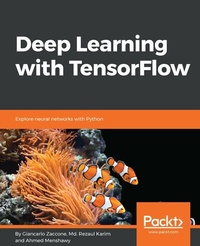
Deep Learning with TensorFlow
Explore neural networks with Python
1st Edition
Published on 3. June 2024
320 pages
978-1-78646-012-7 (ISBN)
Description

Delve into neural networks, implement deep learning algorithms, and explore layers of data abstraction with the help of this comprehensive TensorFlow guideKey Features - [*] Learn how to implement advanced techniques in deep learning with Google's brainchild, TensorFlow
- [*] Explore deep neural networks and layers of data abstraction with the help of this comprehensive guide
- [*] Real-world contextualization through some deep learning problems concerning research and application
Book DescriptionDeep learning is the step that comes after machine learning, and has more advanced implementations. Machine learning is not just for academics anymore, but is becoming a mainstream practice through wide adoption, and deep learning has taken the front seat. As a data scientist, if you want to explore data abstraction layers, this book will be your guide. This book shows how this can be exploited in the real world with complex raw data using TensorFlow 1.x. Throughout the book, you'll learn how to implement deep learning algorithms for machine learning systems and integrate them into your product offerings, including search, image recognition, and language processing. Additionally, you'll learn how to analyze and improve the performance of deep learning models. This can be done by comparing algorithms against benchmarks, along with machine intelligence, to learn from the information and determine ideal behaviors within a specific context. After finishing the book, you will be familiar with machine learning techniques, in particular the use of TensorFlow for deep learning, and will be ready to apply your knowledge to research or commercial projects.What you will learn - [*]Learn about machine learning landscapes along with the historical development and progress of deep learning
- [*]Learn about deep machine intelligence and GPU computing with the latest TensorFlow 1.x
- [*] Access public datasets and utilize them using TensorFlow to load, process, and transform data
- [*] Use TensorFlow on real-world datasets, including images, text, and more
- [*] Learn how to evaluate the performance of your deep learning models
- [*] Using deep learning for scalable object detection and mobile computing
- [*]Train machines quickly to learn from data by exploring reinforcement
- learning techniques
- [*]Explore active areas of deep learning research and applications
Who this book is forThe book is intended for a general audience of people interested in machine learning and machine intelligence. A rudimentary level of programming in one language is assumed, as is a basic familiarity with computer science techniques and technologies, including a basic awareness of computer hardware and algorithms. Some competence in mathematics is needed to the level of elementary linear algebra and calculus.
- [*] Explore deep neural networks and layers of data abstraction with the help of this comprehensive guide
- [*] Real-world contextualization through some deep learning problems concerning research and application
Book DescriptionDeep learning is the step that comes after machine learning, and has more advanced implementations. Machine learning is not just for academics anymore, but is becoming a mainstream practice through wide adoption, and deep learning has taken the front seat. As a data scientist, if you want to explore data abstraction layers, this book will be your guide. This book shows how this can be exploited in the real world with complex raw data using TensorFlow 1.x. Throughout the book, you'll learn how to implement deep learning algorithms for machine learning systems and integrate them into your product offerings, including search, image recognition, and language processing. Additionally, you'll learn how to analyze and improve the performance of deep learning models. This can be done by comparing algorithms against benchmarks, along with machine intelligence, to learn from the information and determine ideal behaviors within a specific context. After finishing the book, you will be familiar with machine learning techniques, in particular the use of TensorFlow for deep learning, and will be ready to apply your knowledge to research or commercial projects.What you will learn - [*]Learn about machine learning landscapes along with the historical development and progress of deep learning
- [*]Learn about deep machine intelligence and GPU computing with the latest TensorFlow 1.x
- [*] Access public datasets and utilize them using TensorFlow to load, process, and transform data
- [*] Use TensorFlow on real-world datasets, including images, text, and more
- [*] Learn how to evaluate the performance of your deep learning models
- [*] Using deep learning for scalable object detection and mobile computing
- [*]Train machines quickly to learn from data by exploring reinforcement
- learning techniques
- [*]Explore active areas of deep learning research and applications
Who this book is forThe book is intended for a general audience of people interested in machine learning and machine intelligence. A rudimentary level of programming in one language is assumed, as is a basic familiarity with computer science techniques and technologies, including a basic awareness of computer hardware and algorithms. Some competence in mathematics is needed to the level of elementary linear algebra and calculus.
More details
Other editions
New editions
Giancarlo Zaccone | Vihan Jain | Md. Rezaul Karim
Deep Learning with TensorFlow
Explore neural networks and build intelligent systems with Python
E-Book
06/2024
2nd Edition
Packt Publishing Limited
€28.99
Available for download
Additional editions
Giancarlo Zaccone | Md. Rezaul Karim | Ahmed Menshawy
Deep Learning with TensorFlow
Explore neural networks with Python
Book
04/2017
Packt Publishing
€63.10
Shipment within 3-4 weeks
Persons
Zaccone Giancarlo :
Giancarlo Zaccone has over fifteen years' experience of managing research projects in the scientific and industrial domains. He is a software and systems engineer at the European Space Agency (ESTEC), where he mainly deals with the cybersecurity of satellite navigation systems. Giancarlo holds a master's degree in physics and an advanced master's degree in scientific computing. Giancarlo has already authored the following titles, available from Packt: Python Parallel Programming Cookbook (First Edition), Getting Started with TensorFlow, Deep Learning with TensorFlow (First Edition), and Deep Learning with TensorFlow (Second Edition).Karim Md. Rezaul :
Md. Rezaul Karim is a researcher, author, and data science enthusiast with a strong computer science background, coupled with 10 years of research and development experience in machine learning, deep learning, and data mining algorithms to solve emerging bioinformatics research problems by making them explainable. He is passionate about applied machine learning, knowledge graphs, and explainable artificial intelligence (XAI). Currently, he is working as a research scientist at Fraunhofer FIT, Germany. He is also a PhD candidate at RWTH Aachen University, Germany. Before joining FIT, he worked as a researcher at the Insight Centre for Data Analytics, Ireland. Previously, he worked as a lead software engineer at Samsung Electronics, Korea.Menshawy Ahmed :
Ahmed Menshawy is a Research Engineer at the Trinity College Dublin, Ireland. He has more than 5 years of working experience in the area of ML and NLP. He holds an MSc in Advanced Computer Science. He started his Career as a Teaching Assistant at the Department of Computer Science, Helwan University, Cairo, Egypt. He taught several advanced ML and NLP courses such as ML, Image Processing, and so on. He was involved in implementing the state-of-the-art system for Arabic Text to Speech. He was the main ML specialist at the Industrial research and development lab at IST Networks, based in Egypt.
Giancarlo Zaccone has over fifteen years' experience of managing research projects in the scientific and industrial domains. He is a software and systems engineer at the European Space Agency (ESTEC), where he mainly deals with the cybersecurity of satellite navigation systems. Giancarlo holds a master's degree in physics and an advanced master's degree in scientific computing. Giancarlo has already authored the following titles, available from Packt: Python Parallel Programming Cookbook (First Edition), Getting Started with TensorFlow, Deep Learning with TensorFlow (First Edition), and Deep Learning with TensorFlow (Second Edition).Karim Md. Rezaul :
Md. Rezaul Karim is a researcher, author, and data science enthusiast with a strong computer science background, coupled with 10 years of research and development experience in machine learning, deep learning, and data mining algorithms to solve emerging bioinformatics research problems by making them explainable. He is passionate about applied machine learning, knowledge graphs, and explainable artificial intelligence (XAI). Currently, he is working as a research scientist at Fraunhofer FIT, Germany. He is also a PhD candidate at RWTH Aachen University, Germany. Before joining FIT, he worked as a researcher at the Insight Centre for Data Analytics, Ireland. Previously, he worked as a lead software engineer at Samsung Electronics, Korea.Menshawy Ahmed :
Ahmed Menshawy is a Research Engineer at the Trinity College Dublin, Ireland. He has more than 5 years of working experience in the area of ML and NLP. He holds an MSc in Advanced Computer Science. He started his Career as a Teaching Assistant at the Department of Computer Science, Helwan University, Cairo, Egypt. He taught several advanced ML and NLP courses such as ML, Image Processing, and so on. He was involved in implementing the state-of-the-art system for Arabic Text to Speech. He was the main ML specialist at the Industrial research and development lab at IST Networks, based in Egypt.
Content
Table of Contents - Getting Started with Deep Learning
- First look at Tensorflow: Session & Graphs
- Using TensorFlow on a Feed Forward Neural Network
- TensorFlow on a Convolutional Neural Network
- Optimizing TensorFlow Autoencoders
- Recurrent Neural Networks
- GPU Computing
- Advanced TensorFlow Programming
- Advanced Multimedia Programming with TensorFlow
- Reinforcement Learning
- First look at Tensorflow: Session & Graphs
- Using TensorFlow on a Feed Forward Neural Network
- TensorFlow on a Convolutional Neural Network
- Optimizing TensorFlow Autoencoders
- Recurrent Neural Networks
- GPU Computing
- Advanced TensorFlow Programming
- Advanced Multimedia Programming with TensorFlow
- Reinforcement Learning
