

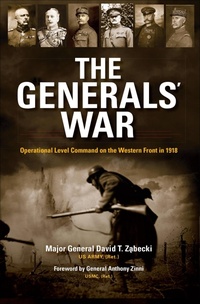
The Generals' War
Description

Known as the War to End all Wars and the Great War, World War I introduced new forms of mass destruction and modern technological warfare. When the Bolsheviks pulled Russia out of the war in late 1917, the Germans turned their offensive efforts to the Western Front in an attempt to win the war in 1918. But as fresh American troops entered Europe, the strategic scales tipped against Germany.
Much of how World War I played out turned on the plans and decisions of the senior-most German and Allied commanders. The Generals' War explores the military strategies of those generals during the last year of the Great War. These six very different men included Germany's Field Marshal Paul von Hindenburg and General Erich Ludendorff; France's Marshals Ferdinand Foch and Philippe Pétain; Great Britain's Field Marshal Sir Douglas Haig; and the United States' General John Pershing. Although history remembers none of them as great captains, these six officers determined for better or worse how World War I was fought on the battlefields of the Western Front between November 1917 and November 1918.
The Generals' War is a landmark exploration of the generalship that shaped the very framework of modern warfare as we know it today and provides a comprehensive and detailed analysis on the senior commanders of the Great War.
More details
Person
David T. Zabecki (Lt. Gen. Ret) is author or editor of nine military history books, including The German 1918 Offensives: A Case Study in the Operational Level of War, and the assistant editor of several military history encyclopedias. He is editor of Vietnam Magazine, the Senior Historian of the Weider History Group, the world's largest publisher of history magazines, and author of numerous articles, book reviews, and encyclopedia entries, all dealing with military topics.
Content
Foreword by General Anthony Zinni, USMC (Ret)
Table and Maps
Glossary
I. Generalship in the Great War
II. Battlefield Realities
- The Calculus of War
- The Technological Revolution in Military Affairs
- The Three Paradigm Shifts
- The Vast New Scope of Warfare
- Fire, Maneuver, and Combined Arms
- Tanks
- Artillery
- The Defensive
- The Offensive
III. The Strategic Situation
- Germany
- France
- Britain
IV. The Commanders-in-Chief
- Reputations One Hundred Years On
- Powers and Responsibilities
- Military Concepts
- Adaptability and Risk
- Personal Backgrounds
- Political Supporters and Critics
- The Political and the Strategic
- Military Allies and Rivals
V. The Yanks are Coming
VI. Two Conferences in November 1917
- The Allied Supreme War Council, Rapallo, 7 November
- The German Planning Conference, Mons, 11 November
VII. The Gathering Storm
- Vital Arteries and Jugulars
- Bracing for the Deluge as Pétain and Foch Spar
- Haig's Enemies, Front and Rear
- Pershing Digs in His Heels
- The Elusive General Reserve
- Haig Spread Thin
- Steel Wind Rising
VIII. MICHAEL and GEORGETTE
- MICHAEL: 21 March to 5 April 1918
- GEORGETTE: 9 to 29 April 1918
IX. GNEISENAU and BLÜCHER
- Ludendorff Gropes for Plan B
- The Allies Brace for Round Three
- BLÜCHER: 27 May - 5 June 1918
- GNEISENAU: 9 - 15 June 1918
X. MARNESCHUTZ-REIMS and the Second Battle of the Marne
- Ludendorff Attacks Again: MARNESCHUTZ-REIMS (15-18 July 1918)
- Foch Hits Back Hard: The Second Battle of the Marne (18 July - 5 August 1918)
- Ludendorff vs. Foch
- Foch vs Ludendorff
XI. Le Hamel to Mount St. Quentin
- The Battle of Hamel (4 July 1918)
- The Battle of Amiens (8-14 August)
- The Battle of Montdidier (18-30 August)
- The Second Battle of Bapaume (21 August-1 September)
- The Battle of the Scarpe (26 August-2 September 1918)
- The Battle of Péronne-Mont St. Quentin (31 August-4 September)
- The Withdraw to the Hindenburg Line (2-9 September)
XII. Closing to the Hindenburg Line
- The Saint-Mihiel Offensive (12-15 September)
- The Battle of Havrincourt (12 September 1918)
- The Battle of Épehy (18 September)
XIII. The Allied General Offensive
- The Meuse-Argonne Offensive, Phase I (26 September-3 October)
- The Battle of Canal du Nord (27 September-1 October)
- The Fifth Battle of Ypres (28 September-2 October)
- The Battles of the St Quentin Canal and the Beaurevoir Line (29 September-6 October)
- The Meuse-Argonne Offensive, Phase II (4-28 October)
- The Second Battle of Cambrai (8-10 October)
- The Battle of Courtrai and the Closure to the Dutch Border (14-27 October)
- The French First Army Attacks Across the Serre River (15-27 October)
- The Battle of the Selle (17-27 October)
- Foch Maps Out Future Allied Operations (19 October-14 November)
- Exit Ludendorff (26 October)
- The Battle of Valenciennes (1-3 November)
- The Second Battle of the Sambre and the Final British Drive (4-11 November)
- The Final French Drive on the Western Front (1-11 November)
- The Meuse-Argonne Offensive, Phase III (28 October-11 November)
- Retrospective
XIV. The Armistice
XV. The Fluctuating Verdict of History
- Hindenburg
- Ludendorff
- Foch
- Pétain
- Pershing
- Haig
- If NotThen Who?
Appendix I: Biographical Chronologies
Appendix II: Note on General Officer Ranks
