

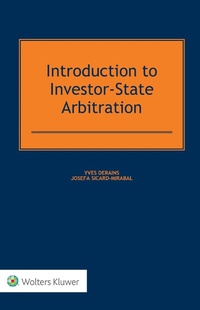
Introduction to Investor-State Arbitration
Published on 17. October 2018
304 pages
978-90-411-8401-6 (ISBN)
Description

Today thousands of investors act globally in markets providing services, technology or capital in countries all around the world. This activity can be peacefully accomplished when both the investor and the host State know that the disputes will be resolved under the aegis of the investor-State arbitration regime, wherein an investor is provided with a direct right of action against a State, most commonly stemming from a bilateral or multilateral investment treaty. This book approaches the substantive and sometimes difficult concepts of investor-State arbitration in a clear and concise explanatory fashion.
In the course of acquainting the reader with the basic legal concepts and policies of the regime, the authors address such issues as the following:
- consent to jurisdiction;
- State responsibility;
- possible conflict of interests;
- mechanisms for reviewing an award;
- damages and costs; and
- enforcement.
The book examines a number of arbitration procedures arising from various perspectives with differing underlying assumptions while highlighting important cases.
Given that investor-State arbitration is now under the public watch and facing many challenges, this remarkably clear and concise overview of the regime will prove to be of great value to in-house counsel and other practitioners, as well as to government policymakers and students.x`
In the course of acquainting the reader with the basic legal concepts and policies of the regime, the authors address such issues as the following:
- consent to jurisdiction;
- State responsibility;
- possible conflict of interests;
- mechanisms for reviewing an award;
- damages and costs; and
- enforcement.
The book examines a number of arbitration procedures arising from various perspectives with differing underlying assumptions while highlighting important cases.
Given that investor-State arbitration is now under the public watch and facing many challenges, this remarkably clear and concise overview of the regime will prove to be of great value to in-house counsel and other practitioners, as well as to government policymakers and students.x`
More details
Other editions
Additional editions
Yves Derains | Josefa Sicard-Mirabal
Introduction to Investor-State Arbitration
Book
10/2018
Kluwer Law International
€194.62
Shipment within 10-20 days
Content
- Intro
- Title Page
- Copyright Page
- Contents
- Foreword
- List of Abbreviations
- Acknowledgements
- Chapter 1: Introduction to Investor-State Arbitration
- §1.01 Introduction
- §1.02 Institutional Arbitration Versus Ad Hoc Arbitration
- [A] Institutional Arbitration
- [B] Ad Hoc Arbitration
- §1.03 International Commercial Arbitration Versus Investor-State Arbitration
- §1.04 Brief Overview of Sources of Investment Law
- [A] International Law
- [B] Investment Contracts
- [C] Foreign Investment Laws
- Chapter 2: Investment and Investor
- §2.01 Introduction
- §2.02 The Concept of Investment
- [A] The Absence of a Uniform Definition of the Concept of 'Investment' in Legal Instruments
- [1] The Absence of a Definition under Article 25 of the ICSID Convention
- [2] The Definitions in Other Multilateral Treaties
- [a] NAFTA
- [b] The Energy Charter Treaty
- [3] The Various Definitions in Bilateral Treaties
- [B] The Investment in Arbitration Jurisprudence
- [1] The ICSID Jurisprudence
- [a] The Objective Approach
- [b] The Subjective Approach
- [2] The Jurisprudence of Non-ICSID Tribunals
- §2.03 The Protected Investor
- [A] Natural Persons
- [B] Legal or Juridical Persons
- [C] Date of Nationality
- [1] Jurisdiction Ratione Temporis
- [2] Changes in Investor Nationality
- §2.04 Conclusion
- Questions
- Chapter 3: Jurisdiction of the Arbitral Tribunal
- §3.01 Introduction
- §3.02 Consent
- [A] Modalities for Expressing Consent
- [1] Agreement Between the Host State and the Investor
- [2] Consent to Arbitration Contained in Host State Legislation
- [3] Consent Through Bilateral or Multilateral Investment Treaties
- [4] Exclusive Choice-of-Forum Clause
- [5] Consent of Constituent Subdivisions or Agencies of the State
- [B] The Moment When Consent Becomes Perfected and Irrevocable
- §3.03 Preconditions to Arbitration
- [A] Cooling-Off Period
- [B] Exhaustion of Local Remedies
- [1] The Principle
- [2] Bypassing the Exhaustion of Local Remedies Requirement Based on Futility Exception
- [C] The Application of MFN Provisions to Jurisdiction
- [D] Procedural, Jurisdictional or Admissibility Nature of the Preconditions to Arbitration
- §3.04 The Scope of Consent to Jurisdiction
- [A] Breaches of Treaty and Breaches of Contract
- [B] Umbrella Clause
- §3.05 Parallel Proceedings
- [A] Fork-in-the-Road
- [B] Waiver
- [C] Res Judicata and Lis Pendens
- §3.06 Conclusion
- Questions
- Chapter 4: Commencing the Arbitration
- §4.01 Introduction
- §4.02 Forum Selection
- [A] National Courts
- [B] Ad Hoc Arbitration
- [C] Institutional Arbitration
- [1] International Centre for Settlement of Investment Disputes (ICSID)
- [a] The Centre
- [b] ICSID Additional Facility Rules
- §4.03 Applicable Law
- [A] Procedural Law
- [1] Party Autonomy
- [2] Lex Arbitri
- [B] Substantive Law
- [1] Determination by the Parties
- [2] The Arbitrator's Role
- [3] Complementary Function of Municipal and International Laws
- §4.04 Constitution of the Arbitral Tribunal
- [A] Independence and Impartiality of Arbitrators
- [1] Nature of Independence and Impartiality
- [2] Textual Sources
- [B] Duty to Disclose
- [1] Burden on the Arbitrator
- [2] Scope of Disclosure
- [a] Arbitrator's Relationship with a Party or Parties
- [b] Arbitrator's Relationship with an Entity Linked to a Party
- [c] Arbitrator's Relationship with Counsel or an Entity Linked to Counsel
- [d] Arbitrator's Relationship with a State
- [e] Arbitrator's Role in a Related Matter
- [3] Institutional Guidelines
- [a] IBA Guidelines on Conflicts of Interest in International Arbitration
- [b] New ICC Guidance Note for the Disclosure of Conflicts by Arbitrators
- [4] Institutional Disclosure Procedures
- [5] Flexibility after Disclosure
- [C] Challenges to Arbitrators
- [1] ICSID Grounds for Disqualification
- [a] Procedure
- [b] Applicable Legal Standard
- [2] Confirmation and Challenge of an Arbitrator under the ICC Arbitration Rules
- [a] Confirmation
- [b] Challenges
- [c] Replacement
- §4.05 Conclusion
- Questions
- Chapter 5: Expropriation
- §5.01 Introduction
- §5.02 Definition of Expropriation
- [A] Nationalization
- [B] Direct and Indirect Expropriation
- [1] Direct Expropriation
- [2] Indirect Expropriation
- [a] 'Sole Effects' Doctrine
- [b] Investor's Legitimate Expectations
- [c] Police Powers Doctrine
- [d] Substantial Deprivation Test
- [e] Proportionality
- §5.03 Lawfulness of Expropriation
- [A] Public Purpose or Interest
- [B] Due Process
- [C] Non-discriminatory Nature
- [D] Compensation
- §5.04 Conclusion
- Questions
- Chapter 6: Standards of Protection
- §6.01 Introduction
- §6.02 Fair and Equitable Treatment
- [A] Examples of FET Clauses
- [B] FET as Developed by Reference to the Minimum Standard of Treatment
- [C] Examples of Minimum Standard of Treatment Clauses
- [D] FET as Developed by Arbitral Tribunals
- [1] Denial of Justice and Due Process
- [2] Manifest Arbitrariness in Decision-Making and Discrimination
- [3] Abusive Treatment of Investors, Including Coercion, Duress and Harassment
- [4] Investors' Legitimate Expectations
- [5] Balance Between Investors' Legitimate Expectations and Reasonable Regulatory Actions of the Host State
- §6.03 Full Protection and Security
- [A] The Extent of the FPS Provision
- §6.04 Most-Favored-Nation
- [A] Historical Background of the Development of the MFN Clause and Its Current Relevance
- [B] Examples of MFN Clauses
- [C] A Few Cases Dealing with MFN Clauses
- [1] Maffezini v. Spain
- [2] Siemens v. Argentina
- [3] Salini v. Jordan
- [4] Plama v. Bulgaria
- §6.05 National Treatment
- [A] Examples of NT Clauses
- [B] 'Like Circumstances'
- [C] 'Comparable'
- [D] 'Like Situation'
- [E] Discriminatory
- §6.06 Conclusion
- Questions
- Chapter 7: General Defenses on the Merits
- §7.01 Defenses
- §7.02 Force Majeure
- §7.03 The State of Necessity
- [A] Necessity under Customary International Law
- [B] State of Necessity under Treaty Clauses
- [C] ICSID Jurisprudence on Necessity
- §7.04 Self-defense or National Security Defense
- §7.05 Distress
- §7.06 Corruption
- §7.07 Lack of Good Faith
- §7.08 Conclusion
- Questions
- Chapter 8: Evidence, Burden of Proof and Document Production
- §8.01 Introduction
- §8.02 General Differences Between the Common Law and Civil Law Approach on Evidence
- [A] Oral or Documentary Evidence?
- [B] Who Can Be Witnesses?
- [C] Is Hearsay Evidence Admissible?
- §8.03 Guiding Provisions on Evidence and Their Application by International Tribunals
- [A] Party Autonomy
- [B] 2010 IBA Rules on the Taking of Evidence
- [C] Additional Guidelines: ICSID, UNCITRAL, ICC, LCIA and ICDR
- [D] Obligation to Act in Good Faith
- §8.04 Burden and Standard of Proof
- [A] Burden of Proof: Who Must Produce Evidence?
- [B] Standard of Proof: How Much Evidence Must Be Produced?
- [1] Standards of Proof as Applied by Arbitral Tribunals
- §8.05 Forms of Evidence Admissible in Investor-State Arbitration
- [A] Documentary Evidence
- [B] Document Production
- [1] IBA Rules Concerning Document Requests
- [2] IBA Rules, Article 9 on Admissibility and Assessment of Evidence
- [3] Article 9(2)(b), (3): Privilege
- [4] Additional Institutional and Ad Hoc Rules Concerning Evidence Production
- [5] Failure to Disclose
- [6] Illegally Obtained Evidence and Evidence from Non-parties
- [C] Witness Testimony
- [1] Factual Witnesses
- [2] Expert Witnesses
- §8.06 Conclusion
- Questions
- Chapter 9: Damages and Costs
- §9.01 Introduction
- §9.02 Attribution
- [A] State Organs
- [B] State Entities
- §9.03 Causation
- §9.04 Reparation and Quantification of Damages
- [A] Reparation Standards
- [B] Calculation Methods
- [C] Grounds for Reducing Damages
- [D] Valuation Dates
- §9.05 Interest
- §9.06 Arbitration Costs
- §9.07 Conclusion
- Questions
- Chapter 10: The Award and Enforcement Issues
- §10.01 Introduction
- §10.02 Award Formalities, Supplementation or Rectification, Interpretation and Revision
- [A] ICSID Awards
- [B] Non-ICSID Awards
- §10.03 ICSID and Non-ICSID Annulment Proceedings
- [A] Annulment of ICSID Awards under Article 52 of the ICSID Convention
- [B] Annulment of Non-ICSID Awards
- §10.04 Award Recognition and Enforcement
- [A] ICSID Awards
- [B] Non-ICSID Awards: The New York Convention
- §10.05 Sovereign Immunity
- [A] Immunity from Jurisdiction and Arbitration-Related Exceptions
- [B] Waivers from State Immunity from Execution
- [C] Property with Use for Commercial Purposes
- §10.06 Conclusion
- Questions
- Annex IBA: Guidelines on Conflicts of Interest in International Arbitration
- Index
