

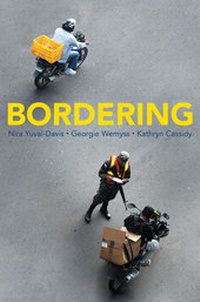
Bordering
Description

Controlling national borders has once again become a key concern of contemporary states and a highly contentious issue in social and political life. But controlling borders is about much more than patrolling territorial boundaries at the edges of states: it now comprises a multitude of practices that take place at different levels, some at the edges of states and some in the local contexts of everyday life - in workplaces, in hospitals, in schools - which, taken together, construct, reproduce and contest borders and the rights and obligations associated with belonging to a nation-state.
This book is a systematic exploration of the practices and processes that now define state bordering and the role it plays in national and global governance. Based on original research, it goes well beyond traditional approaches to the study of migration and racism, showing how these processes affect all members of society, not just the marginalized others. The uncertainties arising from these processes mean that more and more people find themselves living in grey zones, excluded from any form of protection and often denied basic human rights.
More details
Other editions
Persons
Nira Yuval-Davis is Professor Emeritus, Honorary Director of the Research Centre on Migration, Refugees and Belonging (CMRB) at the University of East London.
Georgie Wemyss is Senior lecturer and Co-Director of the CMRB at the University of East London.
Kathryn Cassidy is Associate Professor of Human Geography at Northumbria University.
Content
- Contents
- Acknowledgements
- Chapter 1 Introduction: Framing Bordering
- Introduction
- Bordering: in between the political and socio-cultural
- Bordering and neoliberal globalization
- Everyday intersectional bordering
- Outline of the book
- Chapter 2 Bordering, Governance and Belonging: An Historical Overview
- Introduction
- Pre-modern borderings
- Modernity and bordering: the long eighteenth century
- Bordering in the aftermath of WW1
- Bordering in the aftermath of WW2
- The collapse of state socialism and EU enlargement
- Neoliberalism and its crises
- The rise of absolutist movements
- Bordering in the context of violent conflicts, neoliberal developments and ecological crisis in the Global South
- Journeys towards the 'global migration crisis'
- Rebordering
- Brexit
- Conclusion
- Chapter 3 Firewall Bordering at State Managed Border Control Points
- Introduction
- Bordering-scape 1: 'external' border control points: visas, airports, train station, seaports
- Bordering-scape 2: firewall bordering at 'internal' border control point of registry offices
- Bordering-scape 3: firewall bordering, 'external' and 'internal' bordering encounters experienced by Eastern European Roma and Nepali army families.
- Conclusion
- Chapter 4 Everyday Bordering, Citizenship and Belonging
- Introduction
- Bordering-scape 4: employment
- Bordering-scape 5: accommodation
- Bordering scape 6: education
- Conclusion
- Chapter 5 Bordering and Grey Zones
- Introduction
- Bordering-scape 7: The 'Jungle' in Calais
- Bordering-scape 8: grey zones in Britain
- Bordering-scape 9: post-borderland Dover
- Conclusion
- Chapter 6 Conclusion: Understanding Bordering
- Introduction
- Bordering as central and constitutive of social processes
- Bordering as a political discourse and practice of governance and belonging
- Bordering as an outcome and cause of social inequalities
- Bordering as a situated endeavour
- Bordering and transversal political epistemology
- Resisting everyday bordering
- Notes
- Bibliography
- Index
