

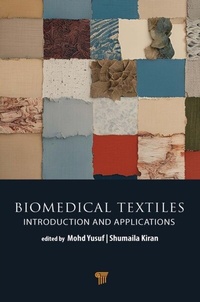
Biomedical Textiles
Introduction and Applications
1st Edition
Published on 6. August 2025
576 pages
978-1-040-40798-1 (ISBN)
Description

For millennia, textiles have been an integral part of human civilization, evolving from basic clothing to advanced applications catering to modern societal needs. The intersection of textiles and medical science has given rise to biomedical textiles, which are defined as fibrous textile structures prepared from synthetic or natural materials that are used internally or externally in a biological environment (inside or outside the body) as a medical or care device to improve health, hygiene, and medical conditions. The book discusses the need for flexibility and shape-transformation capabilities in today's textiles, such as being engineered for insertion through a small catheter or expanded within the vessels to allow minimally invasive delivery methods without sacrificing mechanical integrity and healthcare capabilities. It presents the recent research and developments that will benefit academicians, scientists, researchers, and post-graduate students in the field of textile science and technology. The book will prove to be a useful instrument in the rapid and efficient entry of new researchers into the emerging field of textile engineering and technology.
Reviews / Votes
"This book explores a significant area of technical textiles, integrating textile engineering with its applications in medical science, particularly through the use of bio-resources. For example, cotton bio-mordanted with gall nut and alum, subsequently dyed with catechu, and bio-finished using eucalyptus leaf extract with lemon juice as a catalyst, results in biomedical textiles with remarkable antimicrobial properties. Such fabrics can be utilized in doctors' surgical gowns, multilayer wound-healing antimicrobial patches, and sun-protective clothing for patients with vitamin D2 deficiency. The book addresses contemporary advancements in revolutionizing patient care through both implantable and external medical textile devices. It delves into the production, properties, and challenges of biomedical textiles as an interdisciplinary field at the forefront of global research and applications. It will be highly valuable for industry practitioners, manufacturers, and researchers working in this interdisciplinary domain."-Prof. Dr A. K. Samanta, Institute of Jute Technology (IJT), University of Calcutta, India.
"Meditech is an emerging field of biomedical sciences. It has plenty of medical applications. This book has comprehensively covered the fundamental information, properties, and applications of biomedical textiles. It explains the latest technologies used in this field and how to further their applications. The editors of the book have more than a decade of research experience in this field. Their domain knowledge, experimental studies, and constructive methodology have beautifully explained every topic. This book will prove a solid addition to the library of this field."
-Dr S. N. Zafar, Center for Translational Neuromedicine, University of Rochester, USA. "This book explores a significant area of technical textiles, integrating textile engineering with its applications in medical science, particularly through the use of bio-resources. For example, cotton bio-mordanted with gall nut and alum, subsequently dyed with catechu, and bio-finished using eucalyptus leaf extract with lemon juice as a catalyst, results in biomedical textiles with remarkable antimicrobial properties. Such fabrics can be utilized in doctors' surgical gowns, multilayer wound-healing antimicrobial patches, and sun-protective clothing for patients with vitamin D2 deficiency. The book addresses contemporary advancements in revolutionizing patient care through both implantable and external medical textile devices. It delves into the production, properties, and challenges of biomedical textiles as an interdisciplinary field at the forefront of global research and applications. It will be highly valuable for industry practitioners, manufacturers, and researchers working in this interdisciplinary domain."
Prof. Dr A. K. Samanta
Institute of Jute Technology (IJT), University of Calcutta, India
"Meditech is an emerging field of biomedical sciences. It has plenty of medical applications. This book has comprehensively covered the fundamental information, properties, and applications of biomedical textiles. It explains the latest technologies used in this field and how to further their applications. The editors of the book have more than a decade of research experience in this field. Their domain knowledge, experimental studies, and constructive methodology have beautifully explained every topic. This book will prove a solid addition to the library of this field."
Dr S. N. Zafar
Center for Translational Neuromedicine, University of Rochester, USA
More details
Language
English
Place of publication
London
United Kingdom
Target group
College/higher education
Professional and scholarly
Illustrations
31 Tables, black and white; 1 Line drawings, color; 60 Line drawings, black and white; 12 Halftones, color; 27 Halftones, black and white; 13 Illustrations, color; 87 Illustrations, black and white
File size
23,37 MB
ISBN-13
978-1-040-40798-1 (9781040407981)
Copyright in bibliographic data and cover images is held by Nielsen Book Services Limited or by the publishers or by their respective licensors: all rights reserved.
Schweitzer Classification
Other editions
Additional editions
Book
08/2025
1st Edition
Jenny Stanford Publishing
€308.30
Shipment within 3-4 weeks
Persons
Mohd Yusuf is the dean and an associate professor at Glocal University, Saharanpur, India. He earned his PhD in 2013 from Jamia Millia Islamia, New Delhi, India, on nature-derived products. Dr Yusuf has contributed significantly to academia with over 70 publications encompassing research articles, reviews, books, and chapters in internationally renowned outlets. His research spans green materials, biomaterials, nanomaterials, wastewater treatment, and energy storage technologies.
Shumaila Kiran is an associate professor in the Department of Applied Chemistry at Government College University Faisalabad, Pakistan. She earned her PhD in 2012 and has more than 10 years of teaching and research experience at the university level. Dr Kiran has worked on various research projects and published about 90 research articles and 30 international book chapters. She has also supervised 7 PhD scholars and about 50 UG/PG students.
Shumaila Kiran is an associate professor in the Department of Applied Chemistry at Government College University Faisalabad, Pakistan. She earned her PhD in 2012 and has more than 10 years of teaching and research experience at the university level. Dr Kiran has worked on various research projects and published about 90 research articles and 30 international book chapters. She has also supervised 7 PhD scholars and about 50 UG/PG students.
Content
1. Panoramic View of Biomedical Textiles and Their Synthetic Strategies 2. A Brief Overview of Diverse Applications of Biomedical Textiles: Versatility to Innovation 3. Structural and Mechanical Features of Biomedical Textiles 4. Applications of Biomedical Textiles in Physical and Chemical Treatments 5. Developmental Vistas for Bioactive Textile Engineering 6. Recent Advancement in Biomedical Textiles: A Brief Review 7. Cotton as a Healthcare Textiles 8. Revolutionizing Textile Coloration: Exploring Bio-Dyes for Biomedical Applications 9. Radiation-Based Treatments for the Improvement of Textile Products in Biomedical Applications 10. Nano-Enhanced Compression Bandages and Wound Care Biomedical Textiles 11. Biomedical Polymeric Fibers: Functionalization and Tissue Techniques 12. Infections and Wounds Caring Materials of Biomedical Textiles 13. Smart and Sustainable Approaches for Wound Care 14. Hybrid Composites Treatments of Textile Fibers to Develop Bio-Functional Properties 15. Nanotechnology: A Multidimensional and Robust Tool in Medical and Textile Technology 16. Exploring the Power of Nanotechnology: Enhancing Bio-Functional Properties in the Textiles Industry
