

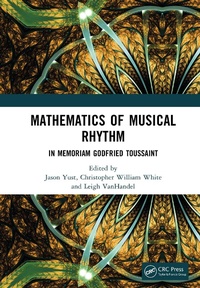
Mathematics of Musical Rhythm
In Memoriam Godfried Toussaint
1st Edition
Published on 6. September 2024
128 pages
978-1-040-12098-9 (ISBN)
Description

This book presents original research applying mathematics to musical rhythm, with a focus on computational methods, theoretical approaches, analysis of rhythm in folk and global music traditions, syncopation, and maximal evenness. It honours the legacy of computer scientist and music theorist Godfried Toussaint.
In addition to addressing a topic pioneered by Toussaint, application of mathematics to representation of musical rhythms, the volume also builds upon his interest in analysis of music traditions outside the European classical canon and the use of computational methods. Empirical contributions include a study of timing in Scandinavian polska performance showing that timing interacts with rhythmic features and a study of vocal melody rhythm in pre- and post-millennial popular music, showing significant differences in tempo, rhythmic density, and repetition in the two corpora. Theoretical contributions include a survey of timeline rhythms of African and African diasporic musics showing the prevalence of rhythms of a special type related to maximal evenness, an application of matrix algebra to rhythm and syncopation with analysis of clave rhythms, a ragtime corpus, and Balinese gong cycles, and a mathematical development of a new classification of smooth rhythms using a "shadow rhythm" algorithm suggested by Toussaint. The volume also includes an original composition by Tom Johnson and a personal recollection of Toussaint by Francisco Gomez-Martin.
This volume will be a key resource for academics, researchers, and advanced students of music, musicology, music analyses, mathematical music theory, computational musicology, and music informatics. It was originally published as a special issue of the Journal of Mathematics and Music.
In addition to addressing a topic pioneered by Toussaint, application of mathematics to representation of musical rhythms, the volume also builds upon his interest in analysis of music traditions outside the European classical canon and the use of computational methods. Empirical contributions include a study of timing in Scandinavian polska performance showing that timing interacts with rhythmic features and a study of vocal melody rhythm in pre- and post-millennial popular music, showing significant differences in tempo, rhythmic density, and repetition in the two corpora. Theoretical contributions include a survey of timeline rhythms of African and African diasporic musics showing the prevalence of rhythms of a special type related to maximal evenness, an application of matrix algebra to rhythm and syncopation with analysis of clave rhythms, a ragtime corpus, and Balinese gong cycles, and a mathematical development of a new classification of smooth rhythms using a "shadow rhythm" algorithm suggested by Toussaint. The volume also includes an original composition by Tom Johnson and a personal recollection of Toussaint by Francisco Gomez-Martin.
This volume will be a key resource for academics, researchers, and advanced students of music, musicology, music analyses, mathematical music theory, computational musicology, and music informatics. It was originally published as a special issue of the Journal of Mathematics and Music.
More details
Edition
1. Auflage
Language
English
Place of publication
London
United Kingdom
Publishing group
Taylor & Francis Ltd
Target group
College/higher education
ISBN-13
978-1-040-12098-9 (9781040120989)
Copyright in bibliographic data and cover images is held by Nielsen Book Services Limited or by the publishers or by their respective licensors: all rights reserved.
Schweitzer Classification
Other editions
Additional editions
Jason Yust | Christopher White | Leigh VanHandel
Mathematics of Musical Rhythm
In Memoriam Godfried Toussaint
Book
09/2024
1st Edition
Routledge
€206.90
Shipment within 10-20 days
Persons
Jason Yust is Associate Professor of Music, Music Theory and Director of Graduate Studies at Boston University. He is the former co-Editor-in-Chief of the Journal of Mathematics and Music, and an associate editor of Perspectives of New Music. He has served on the editorial board of Music Theory Online and in various capacities for the Society for Music Theory, the Society for Mathematics and Computation in Music, the New England Conference of Music Theorists, and the Northeast Music Cognition Group, and is founder and former chair of the Society for Music Theory's Mathematics of Music Analysis interest group. His work addresses a range of topics, from mathematical theories of rhythm and harmonic spaces to Schenkerian theory and eighteenth-century form to music perception and scale theory. His 2018 book, Organized Time: Rhythm, Tonality, and Form, was the winner of the Society for Music Theory's prestigious Wallace Berry Award in 2019.
Christopher William White is Associate Professor of Music Theory at the University of Massachusetts Amherst. Chris received his PhD from Yale and has also attended Queens College-CUNY, and Oberlin College Conservatory of Music. Chris's research uses big data techniques to study how we hear and write music. His book, The Music in The Data (2022), was given the Emerging Scholar Book Award by the Society For Music Theory in 2023. His articles have appeared in such venues as Music Perception, Music Theory Online, and Music Theory Spectrum and he has presented his work widely. He has also contributed essays to Slate, The Daily Beast, and The Chicago Tribune on a wide range of topics, including music analysis, computational modeling, and artificial intelligence. Chris remains an avid organist and has appeared on NBC's Today Show and America's Got Talent.
Leigh VanHandel is Associate Professor of Music Theory at the University of British Columbia. Her primary research areas are music theory pedagogy, music cognition, language and music, computer-assisted research, and how those things all relate to each other. She edited and contributed to the Routledge Companion to Music Theory Pedagogy (2020), which won the Society for Music Theory's award for Outstanding Multi-Author Collection in 2022. She has published in journals such as Music Perception, Music Theory Spectrum, Journal of New Music Research, Empirical Musicology Review, and Journal of Music Theory Pedagogy, and has presented numerous invited lectures, workshops, and conference papers at national and international conferences. Her blog, Ask Dr. Van, is an ongoing public music theory/music cognition project in which she answers music theory and music cognition questions from students who find her on the internet.
Christopher William White is Associate Professor of Music Theory at the University of Massachusetts Amherst. Chris received his PhD from Yale and has also attended Queens College-CUNY, and Oberlin College Conservatory of Music. Chris's research uses big data techniques to study how we hear and write music. His book, The Music in The Data (2022), was given the Emerging Scholar Book Award by the Society For Music Theory in 2023. His articles have appeared in such venues as Music Perception, Music Theory Online, and Music Theory Spectrum and he has presented his work widely. He has also contributed essays to Slate, The Daily Beast, and The Chicago Tribune on a wide range of topics, including music analysis, computational modeling, and artificial intelligence. Chris remains an avid organist and has appeared on NBC's Today Show and America's Got Talent.
Leigh VanHandel is Associate Professor of Music Theory at the University of British Columbia. Her primary research areas are music theory pedagogy, music cognition, language and music, computer-assisted research, and how those things all relate to each other. She edited and contributed to the Routledge Companion to Music Theory Pedagogy (2020), which won the Society for Music Theory's award for Outstanding Multi-Author Collection in 2022. She has published in journals such as Music Perception, Music Theory Spectrum, Journal of New Music Research, Empirical Musicology Review, and Journal of Music Theory Pedagogy, and has presented numerous invited lectures, workshops, and conference papers at national and international conferences. Her blog, Ask Dr. Van, is an ongoing public music theory/music cognition project in which she answers music theory and music cognition questions from students who find her on the internet.
Content
Introduction: Rhythm, Mathematics, and Godfried Toussaint 1. The Melodic Beat: Exploring Asymmetry in Polska Performance 2. A Comparative Analysis of Melodic Rhythm in Two Corpora of American Popular Music 3. Ostinatos in Black-Atlantic Traditions: Generic-Specific Similarity and Proximity 4. Deep Rhythms VIII: Wood Block Music 5. Hadamard Transforms of Pure-Duple Rhythms 6. Iterative Method of Construction for Smooth Rhythms 7. Jose Manuel Lopez Lopez's Chart for Managing Tempi 8. A Review of Godfried Toussaint's The Geometry of Musical Rhythm
