

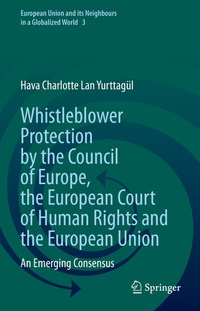
Whistleblower Protection by the Council of Europe, the European Court of Human Rights and the European Union
Description

First introduced in the United States, whistleblower laws have become increasingly popular around the world. This book illustrates the regional efforts undertaken by European organizations to promote whistleblower protection in Europe. To provide context, the first part of the book presents an overview of the international best practices for whistleblowing legislation and explores the status of whistleblower under international law. It also assesses the global hot topics regarding whistleblowing, from the cases of Edward Snowden and Julian Assange to the silencing of whistleblowers during the COVID-19 pandemic. The following parts focus on the European approach to whistleblower laws. It illustrates the influence of the Council of Europe in putting whistleblower protection on the European agenda and discusses the European Court of Human Rights' case law on whistleblowing under Article 10 of the European Convention on Human Rights. In the final part, the author analyzes the evolutionof the European Union's approach to whistleblowing and the legal significance of the EU Whistleblower Directive adopted in 2019. In the respective parts, the author also examines the effectiveness of the international organizations' own internal rules on whistleblowing, from the United Nations and the World Bank Group to the Council of Europe and the European Union.
More details
Other editions
Additional editions
Person
Hava Yurttagül is a Doctor of Law. After a double degree in French and German law and an LL.M. in European and International law, she pursued a doctoral degree in the field of European whistleblower protection at the Saarland University, Germany. She also worked for different international organizations, including the United Nations and the Organization for Security and Co-operation in Europe.
