

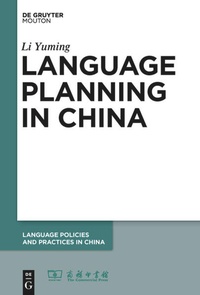
Language Planning in China
Description

Written by a leading scholar who has been closely involved in language planning in China over many decades, this collection of essays is a critical reflection of the work the Chinese government and academics have undertaken in establishing appropriate policies regarding language standard, language use and language education. The essays contain unique insights into the thinking behind much of the language planning work in China today.
Reviews / Votes
"This new translated collection of writing by Li Yuming goes well beyond the topic of Chinese language planning, and could well form the basis for a guide to the field of language management as a whole. It demonstrates the sophistication of Chinese language management, especially in its recognition of the importance of computers and IT. Its publication will help build up the possibility of cooperation between Chinese and Western scholars in the study of language policy and management."
Berard Spolsky in: Lang Policy 18 (2019), 155-157
More details
Other editions
Additional editions
Person
Content
- Intro
- Preface
- Foreword by Bernard Spolsky
- Table of contents
- Chapter 1. Three major linguistic issues of mankind in contemporary societies
- Chapter 2. On mother tongue
- Chapter 3. On planning of language function
- Chapter 4. Some considerations on enhancing the national language capability
- Chapter 5. Language is also a "hard power"
- Chapter 6. On levels of language life
- Chapter 7. On field language planning
- Chapter 8. Characteristics of language life in contemporary China
- Chapter 9. On foreign language planning in China
- Chapter 10. The status of authoritative dialect in language standardization
- Chapter 11. A supplement to The Status of Authoritative Dialects in Language Standardization
- Chapter 12. Building up bilingual and bi-dialectical competence
- Chapter 13. On the establishment of Chinese Language Resource Audio Database
- Chapter 14. Some thoughts on the standardization of lexical items
- Chapter 15. On terminology
- Chapter 16. Reflection on the modernization of lexicography in China
- Chapter 17. On Zhongguo Yuyan Shenghuo Lüpishu (Green Paper on the Language Situation in China)
- Chapter 18. Issues of the Chinese language in the information age
- Chapter 19. Language tasks in the information age
- Chapter 20. The work of language standardization in the information age
- Chapter 21. Constructing the grand platform of China Character Set
- Chapter 22. On annotation of language knowledge in the corpus
- Chapter 23. The needs for language learning and teaching Chinese as foreign language
- Chapter 24. The significance of a study on the history of the international dissemination of Chinese
- Chapter 25. Contemporary China: the core of international education of the Chinese language
- Chapter 26. The intension and extension of qieyinzi
- Chapter 27. The proposition of universal education in the Qieyinzi Movement
- Chapter 28. Late Qing script reformers' view of dialects
- Chapter 29. Late Qing script reformers' views on language unification
- Chapter 30. Centenary of the promulgation of the state resolution Proposal for Establishing a Common National Language
- Index
