

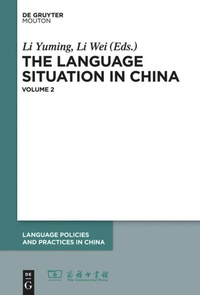
2008-2009
Description

China, with the world's largest population, numerous ethnic groups and vast geographical space, is also rich in languages. Since 2006, China's State Language Commission has been publishing annual reports on what is called "language life" in China. These reports cover language policy and planning invitatives at the national, provincial and local levels, new trends in language use in a variety of social domains, and major events concerning languages in mainland China, Hong Kong, Macau and Taiwan. Now for the first time, these reports are available in English for anyone interested in Chinese language and linguistics, China's language, education and social policies, as well as everyday language use among the ordinary people in China. The invaluable data contained in these reports provide an essential reference to researchers, professionals, policy makers, and China watchers.
More details
Other editions
Persons
Content
1.1 - 1 An update on the use and management of standard spoken and written Chinese [Seite 19]
1.2 - 2 Information management of spoken and written languages in China: An update on the latest efforts and development [Seite 31]
1.3 - 3 An overview of ethnic language affairs [Seite 41]
1.4 - 4 A survey of sci-tech terminology work [Seite 49]
1.5 - 5 Status quo of sign language [Seite 59]
2 - II Special Research [Seite 67]
2.1 - 6 The international dissemination of Chinese language [Seite 69]
2.2 - 7 Language use in civil aviation [Seite 81]
2.3 - 8 Language situation on the Qinghai-Tibet railway [Seite 89]
2.4 - 9 Language standardization in criminal courts [Seite 97]
2.5 - 10 Language of psychological assistance in post-earthquake services [Seite 105]
2.6 - 11 The improvement of the language environment for the Shanghai Expo 2010 [Seite 117]
2.7 - 12 Language situation of the Three Gorges immigrants of the Changjiang River [Seite 127]
2.8 - 13 A survey of the language use at the migrant schools in Shanghai [Seite 137]
2.9 - 14 A survey on parents' attitudes towards maids' use of dialects [Seite 147]
2.10 - 15 The language situation at foreign companies: A case study of Shanghai [Seite 153]
2.11 - 16 An overview of languages used in Beijing markets catering to foreign customers: A case study of Silk Street [Seite 161]
2.12 - 17 Language situation of Zhejiang's Yiwu Small Commodity Market [Seite 167]
2.13 - 18 Bilingual education in Altay Prefecture of Xinjiang [Seite 173]
2.14 - 19 A survey of languages used by immigrants in the Xinjiang Production and Construction Group [Seite 183]
2.15 - 20 The English translation of Chinese menus [Seite 195]
2.16 - 21 Short message language use report [Seite 203]
2.17 - 22 Buzzwords vis-á-vis social change in China from 1978 to 2008 [Seite 209]
3 - III Language Focuses [Seite 219]
3.1 - 23 Chinese elements in the Beijing Olympics and Paralympics [Seite 221]
3.2 - 24 Language issues in advertising [Seite 235]
3.3 - 25 The case of Zhao C [Seite 245]
3.4 - 26 The Internet language craze [Seite 255]
3.5 - 27 The three buzzwords: (Shanzhai),(Lei),and(Jiong) [Seite 265]
3.6 - 28 Chinese catchwords of the year (2007-2008) [Seite 273]
3.7 - 29 Chinese neologisms of the year (2007-2008) [Seite 279]
4 - IV Hong Kong, Macao and Taiwan [Seite 283]
4.1 - 30 New shifts in the medium of instruction policy of Hong Kong [Seite 285]
4.2 - 31 Language policy and language education for ethnic minorities in Hong Kong [Seite 297]
4.3 - 32 Legal language of Macao [Seite 311]
4.4 - 33 Language situation in Taiwan [Seite 323]
5 - Appendix [Seite 335]
5.1 - 1 A record of major Chinese language events (2007) [Seite 335]
5.2 - 2 A record of major Chinese language events (2008) [Seite 347]
6 - Contents (Chinese version 2007) [Seite 357]
7 - Contents (Chinese version 2008) [Seite 361]
8 - Postscript [Seite 365]
9 - Editorial Teams of the English Edition [Seite 367]
10 - Index [Seite 369]
