

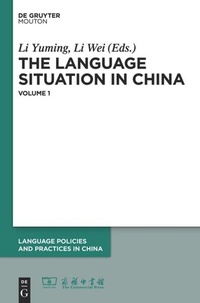
2006-2007
Description

China, with the world's largest population, numerous ethnic groups and vast geographical space, is also rich in languages. Since 2006, China's State Language Commission has been publishing annual reports on what is called "language life" in China. These reports cover language policy and planning invitatives at the national, provincial and local levels, new trends in language use in a variety of social domains, and major events concerning languages in mainland China, Hong Kong, Macau and Taiwan. Now for the first time, these reports are available in English for anyone interested in Chinese language and linguistics, China's languge, education and social policies, as well as everyday language use among the ordinary people in China. The invaluable data contained in these reports provide an essential reference to researchers, professionals, policy makers, and China watchers.
More details
Other editions
Additional editions
Persons
Content
2 - Introduction: Building a harmonious language life [Seite 13]
3 - I Language Work [Seite 21]
3.1 - 1 Language policies and regulations in China: An overview [Seite 23]
3.2 - 2 The promotion of Putonghua (Mandarin Chinese): An overview [Seite 39]
3.3 - 3 Evaluation of language management in China's cities [Seite 53]
3.4 - 4 Language standardization in China [Seite 69]
3.5 - 5 Language resource monitoring and applied research on language [Seite 79]
3.6 - 6 The status of the language in the press and publishing [Seite 87]
3.7 - 7 Use of language in radio and television broadcasting [Seite 97]
3.8 - 8 Standardization of scientific terms in China [Seite 109]
3.9 - 9 Ethnic minority bilingual education in China [Seite 121]
3.10 - 10 The standardization and computerization of minority languages and writing [Seite 135]
3.11 - 11 Cross-provincial cooperation in enhancing the development of the spoken and written languages of the ethnic minorities in China [Seite 145]
4 - II Special Research [Seite 155]
4.1 - 12 Status quo of language use in medical documents and on medicinal packages [Seite 157]
4.2 - 13 The Language status of migrant workers [Seite 171]
4.3 - 14 Efforts of creating a good language environment for Beijing Olympic Games: A brief report [Seite 183]
4.4 - 15 A survey of Shànghai students' use of Putonghua and Shanghai dialect [Seite 193]
4.5 - 16 Status quo of the Jinuo language [Seite 205]
4.6 - 17 A survey of Chinese characters, words and phrases used in news media (2005-2006) [Seite 215]
4.7 - 18 Investigation of Tibetan language informationization and software use [Seite 225]
4.8 - 19 An investigation into lettered words [Seite 233]
5 - III Language Focuses [Seite 247]
5.1 - 20 Dialect craze [Seite 249]
5.2 - 21 Controversy in Chinese language education: Classical or vernacular? [Seite 263]
5.3 - 22 Language endangerment [Seite 273]
5.4 - 23 The craze for English [Seite 283]
5.5 - 24 The use of characters for names [Seite 301]
5.6 - 25 Chinese buzzwords (2002-2006) [Seite 309]
5.7 - 26 A survey of media neologisms in 2006 [Seite 317]
6 - IV Hong Kong, Macau and Taiwan [Seite 321]
6.1 - 27 Putonghua in Hong Kong [Seite 323]
6.2 - 28 Language and language policy in Hong Kong [Seite 337]
6.3 - 29 Language situation and language policy in Macao [Seite 345]
6.4 - 30 The Linguistic situation and language policy in Taiwan [Seite 363]
6.5 - 31 Internet language use [Seite 385]
7 - Appendixes [Seite 397]
7.1 - 1 Law of the People's Republic of China on the Standard Spoken and Written Chinese Language [Seite 399]
7.2 - 2 List of Standards for Language and Writing Planning [Seite 405]
7.3 - 3 List of Languages in China [Seite 413]
7.4 - 4 List of Institutions for Chinese Linguistics and Applied Linguistics [Seite 417]
7.5 - 5 Directories of Language Journals and Newspapers [Seite 421]
7.6 - 6 Distribution of Chinese Population Worldwide [Seite 425]
7.7 - 7 A Record of Major Chinese Language Events (2005) [Seite 429]
7.8 - 8 A Record of Major Chinese Language Events (2006) [Seite 439]
8 - Contents (Chinese version 2005) [Seite 447]
9 - Contents (Chinese version 2006) [Seite 450]
10 - Postscript [Seite 455]
11 - List of authors of the original Chinese text [Seite 457]
12 - Editorial Teams of the English Edition [Seite 463]
13 - Index [Seite 465]
