

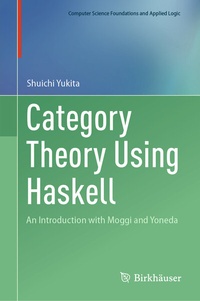
Category Theory Using Haskell
Description

This unique book offers an introductory course on category theory, which became a working language in algebraic geometry and number theory in the 1950s and began to spread to logic and computer science soon after it was created.
Offering excellent use of helpful examples in Haskell, the work covers (among other things) concepts of functors, natural transformations, monads, adjoints, universality, category equivalence, and many others. The main goal is to understand the Yoneda lemma, which can be used to reverse-engineer the implementation of a function. Later chapters offer more insights into computer science, including computation with output, nondeterministic computation, and continuation passing.
Topics and features:
- Contains rigorous mathematical arguments to support the theory
- Provides numerous Haskell code-implementing examples
- Engages with plentiful diagram chasing, with special emphasis on the design patterns for constructing a large diagram out of basic small pieces
- Offers insights into category theory to quantum computing and the foundation of computing discipline
- Serves as a preparatory course for monoidal categories and higher categories
The work will be useful to undergraduate students in computer science who have enough background in college mathematics such as linear algebra and basics in Haskell polymorphic functions. Further, it will appeal to graduate students and researchers in computing disciplines who want to newly acquire serious knowledge of category theory.
More details
Other editions
Additional editions
Person
Shuichi YUKITA was born in 1954. He received the B.S. degree in physics, M.S. degree in mathematics from the University of Tokyo in 1976 and 1978, respectively. He received the Ph.D. degree in information science from Tohoku University, Sendai, Japan in 2000. He is now with the Faculty of Computer and Information Sciences at Hosei University, Japan.
Content
1. Catetory, Functor, Natural Transformation.- 2. Equivalence of categories.- 3. Universality and Limits.- 4. Functors and Limits.- 5. Adjoints.- 6. Monads.- 7. Representable Functors.
