

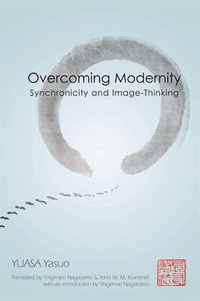
Overcoming Modernity
Description

In Overcoming Modernity, which contains the last writings from Yuasa, the prominent Japanese scholar reconsiders the modern Western paradigm of thinking and in its place proposes a more holistic worldview. A wide range of topics are examined, including the relationships between language, being, psychology, and logic; Jung's concept of synchronicity; the Yijing (Book of Changes); paranormal phenomena; physics and metaphysics; mind and body; and teleology. Through these explorations, engaging a wide range of Western and East Asian thought, Yuasa offers an alternative to the scientific worldview inherited from the seventeenth and eighteenth centuries. This new paradigm involves the integration of space-and-time and mind-and-body, thematics brought together through what Yuasa calls "image-thinking," a mode of thinking that incorporates image-experience.
Yuasa Yasuo (1925-2005) was Professor Emeritus at Obirin University in Japan and the author of several books, including The Body, Self-Cultivation, and Ki-Energy and The Body: Toward an Eastern Mind-Body Theory, both also published by SUNY Press. At Temple University, Shigenori Nagatomo is Associate Professor of Comparative Philosophy and East Asian Buddhism and John W. M. Krummel teaches religion.
More details
Other editions
Additional editions
Persons
Yuasa Yasuo (1925-2005) was Professor Emeritus at Obirin University in Japan and the author of several books, including The Body, Self-Cultivation, and Ki-Energy and The Body: Toward an Eastern Mind-Body Theory, both also published by SUNY Press. At Temple University, Shigenori Nagatomo is Associate Professor of Comparative Philosophy and East Asian Buddhism and John W. M. Krummel teaches religion.
Content
Translator's Introduction
Preface
Part I
1. The Image-Thinking of Ancient People, East and West
The Four Archai and the Human Soul
A Comparison with the Image-Thinking in Ancient India
The Chinese View of Nature Based on Qì-Energy [Jap., Ki: ¿]
The Study of "That Which Is Above Form" and Metaphysics
Logic and Being: "What Is" and "That It Is"
The Passive Understanding of "Being" [ari]
The Eternal and the Changing
The Future- Direction of Ethics and Physics
Translator's Note
2. Image-Thinking and the Understanding of "Being": The Psychological Basis of Linguistic Expression
Chinese, Japanese, and Western Expressions for "Being"
The Characteristics of Expressions in the Chinese Language
The Relation between Logic and Psychology in the Linguistic
Expressions of the Chinese and Western Languages
Logic and Lived Experience
The Cognition and Intuition of Living Nature
Part II
Translator's Note
3. What Is Synchronicity?
Introduction
The Overlap between the World of Spirit and the World of Objects
Divination of the Yìjing and Its Worldview
Parapsychology and Its Meaning
Synchronicity and Contemporary Physics
Nature's Psychoid Nature
Synchronicity and the Movement of New Age Science
Summary
Postscript
Translator's Note
4. Life and Space-Time: Synchronicity and the Psychology of the Yìjing
Introduction
The Divination of the Yìjing and the Mind-Body Relation
The Yìjing's Theory of Time
The Theory of Time and the View of Nature
The Traditional Views of Nature of the East and the West; Are Space and Time Separable?
Space and the Energy Immanent in Time
Translator's Note
5. Synchronicity and Spiritualism
The Birth of the Theory of Synchronicity
A Reexamination of the Parapsychological Disputes
"Meaningful Coincidence" and Human Life
Conclusion
Part III
Translator's Note
6. Space-Time and Mind-Body Integration: The Resurrection of Teleology
Contemporary Science and Eastern Thought
Einstein and Bergson
Is Time an Illusion?
Ripening Time
Synchronicity and the Collective Unconscious
What Is Present: The Problem of Measurement
Methodological Reflections on Science
Physics and Metaphysics
Summary
Notes
Bibliography
Index
