

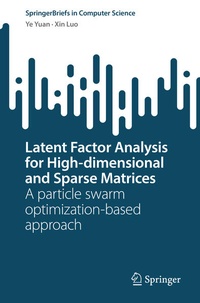
Latent Factor Analysis for High-dimensional and Sparse Matrices
Description

This is the first book to focus on how particle swarm optimization can be incorporated into latent factor analysis for efficient hyper-parameter adaptation, an approach that offers high scalability in real-world industrial applications.
The book will help students, researchers and engineers fully understand the basic methodologies of hyper-parameter adaptation via particle swarm optimization in latent factor analysis models. Further, it will enable them to conduct extensive research and experiments on the real-world applications of the content discussed.
More details
Other editions
Additional editions
Persons
Dr. Xin Luo is a Professor at the College of Computer and Information Science, Southwest University. His current research interests include machine intelligence, big data, and cloud computing. He has published over 200 papers (including over 87 IEEE TRANSACTIONS papers and 17 highly cited papers in ESI) in the above areas. He holds 35 national invention patents. He was part of the Pioneer Hundred Talents Program of the Chinese Academy of Sciences in 2016, the Advanced Support of the Pioneer Hundred Talents Program of Chinese Academy of Sciences in 2018, and the National High-Level Talents Special Support Program in 2020. He won First Prize in the Chongqing Natural Science Award (2019), First Prize in the Wu Wenjun AI Science and Technology Progress Award (2018) and First Prize in the Chongqing Science and Technology Progress Award (2018). He serves as an Associate Editor for the IEEE/CAA Journal of Automatica Sinica, and for IEEE Transactions on Neural Networks and Learning Systems. He received the Outstanding Associate Editor Award from the IEEE/CAA Journal of Automatica Sinica in 2020.
Content
Chapter 1. Introduction.- Chapter 2. Learning rate-free Latent Factor Analysis via PSO.- Chapter 3. Learning Rate and Regularization Coefficient-free Latent Factor Analysis via PSO.- Chapter 4. Regularization and Momentum Coefficient-free Non-negative Latent Factor Analysis via PSO.- Chapter 5. Advanced Learning rate-free Latent Factor Analysis via P 2 SO.- Chapter 6. Conclusion and Discussion.
