

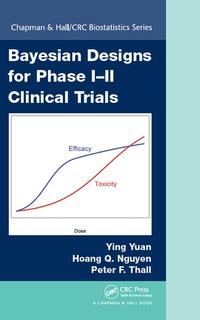
Bayesian Designs for Phase I-II Clinical Trials
Published on 19. December 2017
324 pages
978-1-4987-0956-9 (ISBN)
Description

Reliably optimizing a new treatment in humans is a critical first step in clinical evaluation since choosing a suboptimal dose or schedule may lead to failure in later trials. At the same time, if promising preclinical results do not translate into a real treatment advance, it is important to determine this quickly and terminate the clinical evaluation process to avoid wasting resources.
Bayesian Designs for Phase I-II Clinical Trials describes how phase I-II designs can serve as a bridge or protective barrier between preclinical studies and large confirmatory clinical trials. It illustrates many of the severe drawbacks with conventional methods used for early-phase clinical trials and presents numerous Bayesian designs for human clinical trials of new experimental treatment regimes.
Written by research leaders from the University of Texas MD Anderson Cancer Center, this book shows how Bayesian designs for early-phase clinical trials can explore, refine, and optimize new experimental treatments. It emphasizes the importance of basing decisions on both efficacy and toxicity.
Bayesian Designs for Phase I-II Clinical Trials describes how phase I-II designs can serve as a bridge or protective barrier between preclinical studies and large confirmatory clinical trials. It illustrates many of the severe drawbacks with conventional methods used for early-phase clinical trials and presents numerous Bayesian designs for human clinical trials of new experimental treatment regimes.
Written by research leaders from the University of Texas MD Anderson Cancer Center, this book shows how Bayesian designs for early-phase clinical trials can explore, refine, and optimize new experimental treatments. It emphasizes the importance of basing decisions on both efficacy and toxicity.
Reviews / Votes
"The book provides a clear and detailed illustration of the motivation, applicability, and implementation of a range of Phase I-II Bayesian adaptive clinical trial designs. ...A significant advantage of the text is its broad and straightforward applicability. For some of the proposed designs, software is freely available from an online repository of the MD Anderson Cancer Center, and step-by-step guides on how to implement the designs are often provided. A variety of examples is also included alongside the methodological sections. Moreover, the extensive research experience of the authors often translates into advice on practical issues, which may arise in a trial design, from, for example, guidance on choices, which may affect the reliability and/or effectiveness of the design, to communication dynamics with the clinicians. ... Overall, it is a valuable text for those who are willing to design a Phase I-II Bayesian trial, as a reference to some existing designs and recent advancements in the field, and, more generally, for anyone interested in gaining knowledge of such designs, as a tool to explore their applicability and characteristics."
-Silvia Calderazzo, in Biometrical Journal, November 2017
"This book is a must-read for students, statisticians, principal investigators and researchers who wish to apply innovative and more ethical designs for Phase I/II clinical trials. Several statisticians have previously proposed designs for dose-finding studies modelling the dose-toxicity and the dose-efficacy relationships. However such methods have been published in highly specialized statistical/biostatistical journals that are not very accessible nor comprehensible for non-initiated readers. To the best of my knowledge, no book has yet solely focused on the design of Phase I/II clinical trials, despite the fact that these studies represent 33% of all conducted trials (source: ClinicalTrials.gov). This excellent book offers a well written and a step by step guide to planning, conducting and analyzing Phase I/II clinical trials."
-Sarah Zohar, The French National Institute of Health and Medical Research (Inserm), Paris
"Yuan, Nguyen and Thall are statisticians on the forefront of both theoretical statistics and practical implementation of adaptive trial designs, and have combined their knowledge and experience here to provide an exceptional textbook... A highlight of the text is a chapter on choosing priors, where the authors demonstrate that prior calibration is critical. Casual choice of priors can be disastrous in these trials (which have small cohorts and often small sample sizes), and Yuan et al. provide examples to demonstrate how poorly chosen priors can ruin operating characteristics. Complex trial designs are explained in a clear and sensible manner, making the arguments very plainly obvious as to the benefits of these more modern designs. The authors have pioneered adaptive approaches for dose-finding combining toxicity and efficacy trade-offs and present these and other designs that jointly model toxicity and efficacy... The writing style is conversational in places, making this text more enjoyable to read than many other statistics textbooks, and readers will appreciate the chapters that address practical problems often ignored in theoretical clinical trial texts: late onset and cumulative (toxicity) outcomes, molecularly targeted agents, and missing data in adaptive designs. Interactive software with a user-friendly interface is available for many of the designs, with illustrations in the text which demonstrate the implementation."
-Elizabeth Garrett-Mayer, Professor of Biostatistics, Medical University of South Carolina
"This book covers almost every topic that you will need when designing Phase I, Phase II, and Phase I-II clinical trials. Each chapter is a treasure trove of wonderful new ideas, and contains examples - based on the authors' outstandingly broad experiences - that help the reader clearly understand the methodological aspects involved in clinical trials... This book is a "must-have" for every biostatistician involved in clinical trials."
-Satoshi Morita, Department of Biomedical Statistics and Bioinformatics, Kyoto University "The book provides a clear and detailed illustration of the motivation, applicability, and implementation of a range of Phase I-II Bayesian adaptive clinical trial designs. ... A significant advantage of the text is its broad and straightforward applicability. For some of the proposed designs, software is freely available from an online repository of the MD Anderson Cancer Center, and step-by-step guides on how to implement the designs are often provided. A variety of examples is also included alongside the methodological sections. Moreover, the extensive research experience of the authors often translates into advice on practical issues, which may arise in a trial design, from, for example, guidance on choices, which may affect the reliability and/or effectiveness of the design, to communication dynamics with the clinicians. ... Overall, it is a valuable text for those who are willing to design a Phase I-II Bayesian trial, as a reference to some existing designs and recent advancements in the field, and, more generally, for anyone interested in gaining knowledge of such designs, as a tool to explore their applicability and characteristics."
-Silvia Calderazzo, in Biometrical Journal, November 2017
"This book is a must-read for students, statisticians, principal investigators and researchers who wish to apply innovative and more ethical designs for Phase I/II clinical trials. Several statisticians have previously proposed designs for dose-finding studies modelling the dose-toxicity and the dose-efficacy relationships. However such methods have been published in highly specialized statistical/biostatistical journals that are not very accessible nor comprehensible for non-initiated readers. To the best of my knowledge, no book has yet solely focused on the design of Phase I/II clinical trials, despite the fact that these studies represent 33% of all conducted trials (source: ClinicalTrials.gov). This excellent book offers a well written and a step by step guide to planning, conducting and analyzing Phase I/II clinical trials."
-Sarah Zohar, The French National Institute of Health and Medical Research (Inserm), Paris
"Yuan, Nguyen and Thall are statisticians on the forefront of both theoretical statistics and practical implementation of adaptive trial designs, and have combined their knowledge and experience here to provide an exceptional textbook... A highlight of the text is a chapter on choosing priors, where the authors demonstrate that prior calibration is critical. Casual choice of priors can be disastrous in these trials (which have small cohorts and often small sample sizes), and Yuan et al. provide examples to demonstrate how poorly chosen priors can ruin operating characteristics. Complex trial designs are explained in a clear and sensible manner, making the arguments very plainly obvious as to the benefits of these more modern designs. The authors have pioneered adaptive approaches for dose-finding combining toxicity and efficacy trade-offs and present these and other designs that jointly model toxicity and efficacy... The writing style is conversational in places, making this text more enjoyable to read than many other statistics textbooks, and readers will appreciate the chapters that address practical problems often ignored in theoretical clinical trial texts: late onset and cumulative (toxicity) outcomes, molecularly targeted agents, and missing data in adaptive designs. Interactive software with a user-friendly interface is available for many of the designs, with illustrations in the text which demonstrate the implementation."
-Elizabeth Garrett-Mayer, Professor of Biostatistics, Medical University of South Carolina
"This book covers almost every topic that you will need when designing Phase I, Phase II, and Phase I-II clinical trials. Each chapter is a treasure trove of wonderful new ideas, and contains examples - based on the authors' outstandingly broad experiences - that help the reader clearly understand the methodological aspects involved in clinical trials... This book is a "must-have" for every biostatistician involved in clinical trials."
-Satoshi Morita, Department of Biomedical Statistics and Bioinformatics, Kyoto University
More details
Series
Language
English
Place of publication
Philadelphia, PA
United States
Publishing group
Taylor & Francis Inc
Target group
College/higher education
Illustrations
40 s/w Abbildungen, 63 s/w Tabellen
63 Tables, black and white; 40 Illustrations, black and white
File size
26,35 MB
ISBN-13
978-1-4987-0956-9 (9781498709569)
Copyright in bibliographic data and cover images is held by Nielsen Book Services Limited or by the publishers or by their respective licensors: all rights reserved.
Schweitzer Classification
Other editions
Additional editions
Ying Yuan | Hoang Q. Nguyen | Peter F. Thall
Bayesian Designs for Phase I-II Clinical Trials
Book
12/2021
1st Edition
Chapman & Hall/CRC
€63.00
Shipment within 10-20 days
Ying Yuan | Hoang Q. Nguyen | Peter F. Thall
Bayesian Designs for Phase I-II Clinical Trials
Book
06/2016
1st Edition
Chapman & Hall/CRC
€156.30
Shipment within 15-20 days
Persons
Ying Yuan is a professor and co-chief of the Section of Adaptive Clinical Trials in the Department of Biostatistics at the University of Texas MD Anderson Cancer Center. He is also an adjunct associate professor in the Department of Statistics at Rice University. Dr. Yuan has published over 100 peer-reviewed research papers in top statistical and medical journals. He is an associate editor of Biometrics and a board member of the International Chinese Statistical Association. He received his PhD in biostatistics from the University of Michigan. His research interests include Bayesian adaptive clinical trial design, statistical analysis of missing data, and Bayesian statistics.
Hoang Q. Nguyen is a senior computational scientist in the Department of Biostatistics at the University of Texas MD Anderson Cancer Center. He received his PhD in computational and applied mathematics from Rice University. His research interests include Bayesian clinical trial design, computational algorithms, regression modeling, and Bayesian data analysis.
Peter F. Thall is the Anise J. Sorrell Professor in the Department of Biostatistics at the University of Texas MD Anderson Cancer Center. He is also an adjunct professor in the Department of Statistics at Rice University. Dr. Thall is a fellow of the American Statistical Association (ASA) and the Society for Clinical Trials, an associate editor for Clinical Trials and Statistics in Biosciences, and an ASA Media Expert. He has published over 200 papers and book chapters in the statistical and medical literature. He received his PhD in statistics and probability from the Florida State University. His research interests include clinical trial design, dynamic treatment regimes, prior elicitation, Bayesian nonparametric statistics, and personalized medicine.
Hoang Q. Nguyen is a senior computational scientist in the Department of Biostatistics at the University of Texas MD Anderson Cancer Center. He received his PhD in computational and applied mathematics from Rice University. His research interests include Bayesian clinical trial design, computational algorithms, regression modeling, and Bayesian data analysis.
Peter F. Thall is the Anise J. Sorrell Professor in the Department of Biostatistics at the University of Texas MD Anderson Cancer Center. He is also an adjunct professor in the Department of Statistics at Rice University. Dr. Thall is a fellow of the American Statistical Association (ASA) and the Society for Clinical Trials, an associate editor for Clinical Trials and Statistics in Biosciences, and an ASA Media Expert. He has published over 200 papers and book chapters in the statistical and medical literature. He received his PhD in statistics and probability from the Florida State University. His research interests include clinical trial design, dynamic treatment regimes, prior elicitation, Bayesian nonparametric statistics, and personalized medicine.
Content
Why Conduct Phase I-II Trials? The Phase I-II Paradigm. Establishing Priors. Efficacy-Toxicity Trade-Off-Based Designs. Designs with Late-Onset Outcomes. Utility-Based Designs. Personalized Dose Finding. Combination Trials. Optimizing Molecularly Targeted Agents. Optimizing Doses in Two Cycles. Optimizing Dose and Schedule. Dealing with Dropouts. Optimizing Intra-Arterial tPA. Optimizing Sedative Dose in Preterm Infants. Bibliography.
