

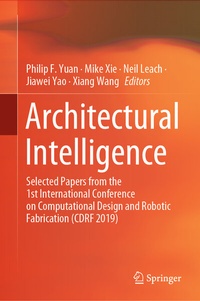
Architectural Intelligence
Description

This book presents selected papers from The 1st International Conference on Computational Design and Robotic Fabrication (CDRF 2019). Focusing on novel architecture theories, tools, methods, and procedures for digital design and construction in architecture, it promotes dialogs between architecture, engineer, computer science, robotics, and other relevant disciplines to establish a new way of production in the building industry in the digital age. The contents make valuable contributions to academic researchers and engineers in the industry. At the same time, it offers readers new ideas for the application of digital technology.
More details
Other editions
Additional editions
Persons
Philip F. Yuan is a Professor at the College of Architecture and Urban Planning, and the Vice-President of the Built Environment Technology Center at Tongji University, China. He also serves as the Deputy Director of the National Architectural Professional Steering Committee of Colleges and Universities and Construction Digital Technology Teaching Committee, the Head of the Digital Design Research Center at the Ministry of Education's High Density Human Settlements Environment Laboratory, and the Head of the Academic Committee of Shanghai Digital Construction Engineering Technology Center.
Yi-Min (Mike) Xie is a Fellow of the Australian Academy of Technology. Currently, he is a Distinguished Professor at RMIT University, an Adjunct Professor at Nanjing Tech University, and a Guest Professor at the School of Architecture and Urban Planning, Tongji University. In 1992, he played a leading role in pioneering the Evolutionary Structural Optimization (ESO) method, which has had a far-reaching impact on the field of structural optimization around the globe. Jiawei Yao is an Associate Research Fellow at the College of Architecture and Urban Planning, Tongji University.
Content
Section 1: Material Intelligence.- Material Agency.- Material Performance.- Interactive Environment.- Section 2: Data Intelligence.- Data Gathering.- Simulation and Optimization.- Information modelling.Section 3: Computational Intelligence.- Generative Morphology.- Design Neural Networks.- AI Design.- Section 4: Robotic Intelligence.- Automated Fabrication.- Robotics.- Human-Machine Collaboration.
