

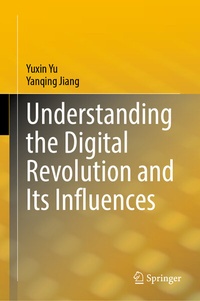
Understanding the Digital Revolution and Its Influences
Description

Guided by the question of why digital technology has a transformative impact, this book systematically explains the root causes of the transformative impact, reexamines the history of human development and the basic point of social division of labor, and further conducts a new deconstruction and elaboration of the logic and development trend of the digital technology impact. The book also analyzes and explains the latest commercial phenomena and future trends associated with the development of digital technology that have emerged. This book creatively points out the necessity and importance of introducing a decision cost analysis into the behavioral choices of economic agents, and puts forward that information processing efficiency is a new standard for measuring the competitive advantage of individuals and economic organizations in the digital era, thus reinterprets the logic of human-economic development. This book has a unique research perspective, includes innovative research and a unified analytic framework, and has achieved an organic and deep integration of the logic of technological evolution and the logic of economic operation, forming many fresh and profound views and insights.
More details
Other editions
Additional editions
Persons
Yuxin Yu, Associate Professor of Economics at the School of Economics and Finance, Shanghai International Studies University in China, and Senior Researcher at Shanghai Research Center for Innovation and Policy Evaluation. He received his PhD in Economics from Shanghai University of Finance and Economics. Dr. Yu has published more than 40 academic papers, 2 monographs, and 1 work of translation, he has also obtained a national patent authorization. Dr. Yu's research interests include the digital economy, artificial intelligence and the blockchain. Yanqing Jiang, Professor of Economics at the School of Economics and Finance, Shanghai International Studies University in China. He received his PhD in Economics from Hanken School of Economics in Finland. Professor Jiang's recent research interests include international economics, development economics and China's growth. His recent academic works include over fifty journal articles and more than ten research monographs published in English worldwide.
Yanqing Jiang, Professor of Economics at the School of Economics and Finance, Shanghai International Studies University in China. He received his PhD in Economics from Hanken School of Economics in Finland. Professor Jiang's recent research interests include international economics, development economics and China's growth. His recent academic works include over fifty journal articles and more than ten research monographs published in English worldwide.
Content
Chapter 1. Understanding the Evolution of Digital Economy.- Chapter 2. Digital Technology Iteration and Productivity Revolution.- Chapter 3. Basic Theory of Social Division of Labor.- Chapter 4. Evolution of the Social Division Mode of Digital Economy.- Chapter 5. The Reshaping Force of Digital Economy upon Social Division of Labor.- Chapter 6. Individual Economic Behavior Decision under the Digital Economy.- Chapter 7. Individual Economic Phenomenon of Digital Economy.- Chapter 8. Commercial Operation and Value Creation of Digital Economy.- Chapter 9. Evolution and Development of Enterprise Organizations in Digital Economy.- Chapter 10. Development Trend of Enterprise Organizations in the Digital Age.
