

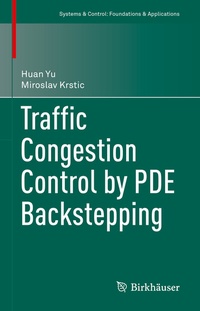
Traffic Congestion Control by PDE Backstepping
Description

Part II then extends the conventional ARZ model utilized until this point in orderto address more complex traffic conditions: multi-lane traffic, multi-class traffic, networks of freeway segments, and driver use of routing apps. The final chapters demonstrate the use of the Lighthill-Whitham-Richards (LWR) first-order PDE model to regulate congestion in traffic flows and to optimize flow through a bottleneck. In order to make the text self-contained, an introduction to the PDE backstepping method for systems of coupled first-order hyperbolic PDEs is included.
Traffic Congestion Control by PDE Backstepping is ideal for control theorists working on control of systems modeled by PDEs and for traffic engineers and applied scientists working on unsteady traffic flows. It will also be a valuable resource for researchers interested in boundary control of coupled systems of first-order hyperbolic PDEs.
Reviews / Votes
"This book provides a mathematically rigorous framework for the control of congested traffic flow on highways in various contexts. . Through its combination of theory, modeling of various phenomena, and the derived solutions to many important control problems, the text provides a valuable resource for researchers working in control of hyperbolic PDEs, engineers interested in traffic flow applications, and also for both instructors and readers seeking a self-contained and complete textbook on traffic congestion control." (Christophe Prieur, IEEE Control Systems Magazine, Vol. 44 (3), June, 2024)
"The book is well-organized, with excellent information, great formulas, stunning figures, and references to over 320 papers. The presentation is superb and simple to understand. It will benefit students, researchers, professors, and the general public." (P. Senthil Kumar, zbMATH 1519.90001, 2023)
More details
Other editions
Additional editions
Persons
Huan Yu is an Assistant Professor in the Thrust of Intelligent Transportation at the Hong Kong University of Science and Technology (Guangzhou), and a joint Assistant Professor in the Department of Civil and Environmental Engineering at the Hong Kong University of Science and Technology. She received her Ph.D. degree from University of California, San Diego. She was a visiting scholar at University of California, Berkeley and Massachusetts Institute of Technology.
Miroslav Krstic is Fellow of SIAM, IEEE, IFAC, ASME, AAAS, IET, AIAA (AF), and the Serbian Academy of Sciences and Arts. His awards include the Bellman, Reid, Oldenburger, Ragazzini, Chestnut, Paynter, Nyquist Lecture, IFAC Nonlinear Control , IFAC Ruth Curtain DPS, Balakrishnan, Axelby, and Schuck ('96 and '19). He has served as EiC or senior editor in Systems & Control Letters, Automatica, and IEEE Transactions on Automatic Control. Four of Krstic's 18 coauthoredbooks have been with this Birkhäuser series, including the single-authored Delay Compensation for Nonlinear, Adaptive, and PDE Systems.
