

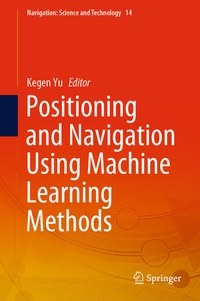
Positioning and Navigation Using Machine Learning Methods
Description

This is the first book completely dedicated to positioning and navigation using machine learning methods. It deals with ground, aerial, and space positioning and navigation for pedestrians, vehicles, UAVs, and LEO satellites. Most of the major machine learning methods are utilized, including supervised learning, unsupervised learning, deep learning, and reinforcement learning. The book presents both fundamentals and in-depth studies as well as practical examples in positioning and navigation. Extensive data processing and experimental results are provided in the major chapters through conducting experimental campaigns or using in-situ measurements.
More details
Other editions
Additional editions
Person
Kegen Yu is currently Distinguished Professor in the School of Environment Science and Spatial Informatics at China University of Mining and Technology (CUMT), Xuzhou, China. He received his bachelor's degree from Changchun Geological College (now Jilin University), Changchun, China, in 1983; master's degree from Australian National University, Canberra, Australia, in 1999; and Ph.D. degree from the University of Sydney, Australia, in 2003. He then participated in a number of research and development projects, as Task Leader or Principal Investigator in various institutions in Finland, Australia, and China, including Pervasive Ultra-wideband Low Spectral Energy Radio Systems (PULSERS), SAR Formation Flying (Garada), GNSS-R-based Ground Snow Water Equivalent Measurement, GNSS-R based Sea Rainfall Intensity Retrieval, etc. Prof. Yu's research focuses on the fields of positioning, navigation, and remote sensing.
Prof. Yu was awarded Hubei Provincial "One Hundred Talents Program" and received the honor of Distinguished Expert of Hubei Province in 2015. He has co-authored 6 books and more than 150 journal papers. He is also Senior Member of IEEE and Member of Navigation Systems Panel of IEEE AESS. He was ranked in the world's top 2% scientists list in 2022 by Stanford University and Elsevier.
Content
Chapter 1. Introduction.- Chapter 2. Indoor localization using ranging model constructed with BP neural network.- Chapter 3. Classification of signal propagation channel using CNN and wavelet packet analysis.- Chapter 4. Semi supervised indoor localization.- Chapter 5. Unsupervised learning for practical indoor localization.- Chapter 6. Deep learning based PDR localization using smartphone sensors and GPS data.- Chapter 7. Deductive reinforcement learning for vehicle navigation.- Chapter 8. Privacy preserving aggregation for federated learning based navigation.- Chapter 9. Learning enhanced INS/GPS integrated navigation.- Chapter 10. UAV localization using deep supervised learning and reinforcement learning.- Chapter 11. Learning based UAV path planning with collision avoidance.- Chapter 12. Learning assisted navigation for planetary rovers.- Chapter 13. Improved planetary rover localization using slip based autonomous ZUPT.
